



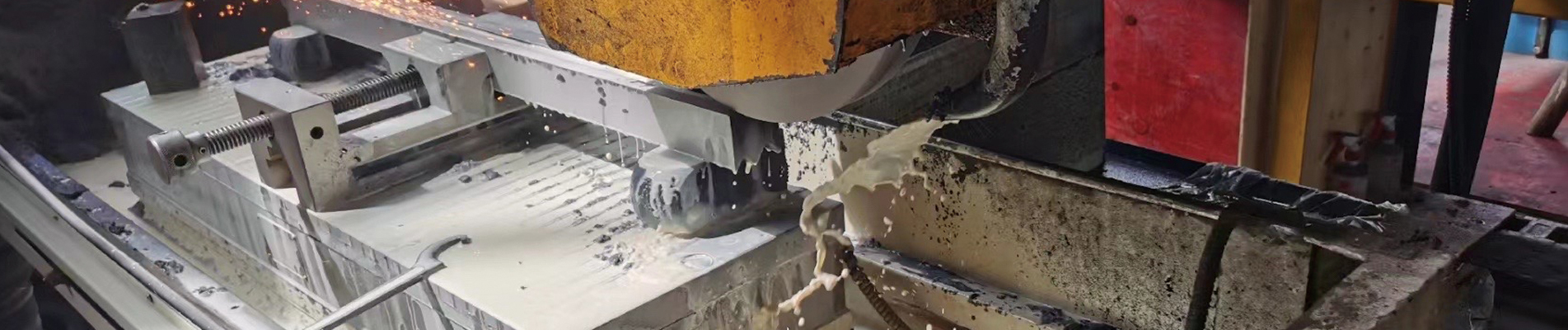

Plastic crusher blades determine far more than how quickly a recycling machine reduces scrap. The right knife set affects the shape of each cut, motor load, dust generation, cleaning time, and how often a production team must stop to sharpen or replace cutting tools. For an injection-molding plant processing clean sprues, a sharp standard tool-steel set may offer excellent value. A recycler processing abrasive post-consumer bottles or glass-filled engineering plastics may need a different combination of steel, edge geometry, maintenance practices, and contamination control.
This guide explains how to evaluate plastic crusher blades, crusher knives, plastic granulator blades, granulator knives, and plastic recycling blades for real production conditions. It compares blade formats and steel options, distinguishes machine-setting data from supplier promises, and provides a practical specification checklist for replacement orders. The goal is to help plant managers, maintenance technicians, purchasing teams, and OEM equipment builders buy cutting tools that fit the machine and solve the actual operating problem—not simply select the hardest blade in a catalog.
Quick selection principle: First verify the machine and knife drawing; then identify feedstock, contamination, cutting load, and expected regrind quality. Choose steel and edge geometry only after those requirements are clear. Never treat an example clearance, hardness, blade angle, or bolt torque as a universal machine setting.
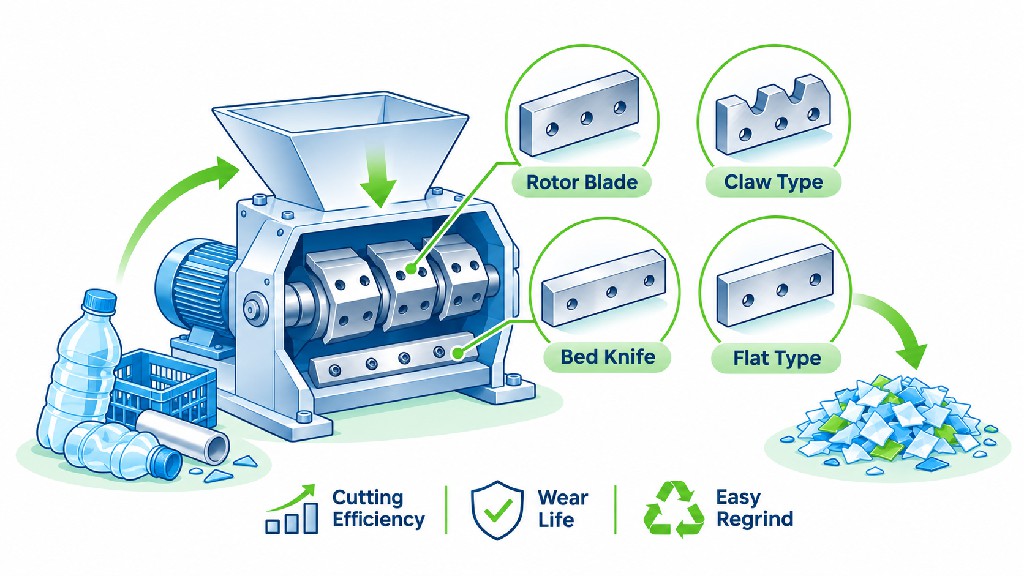
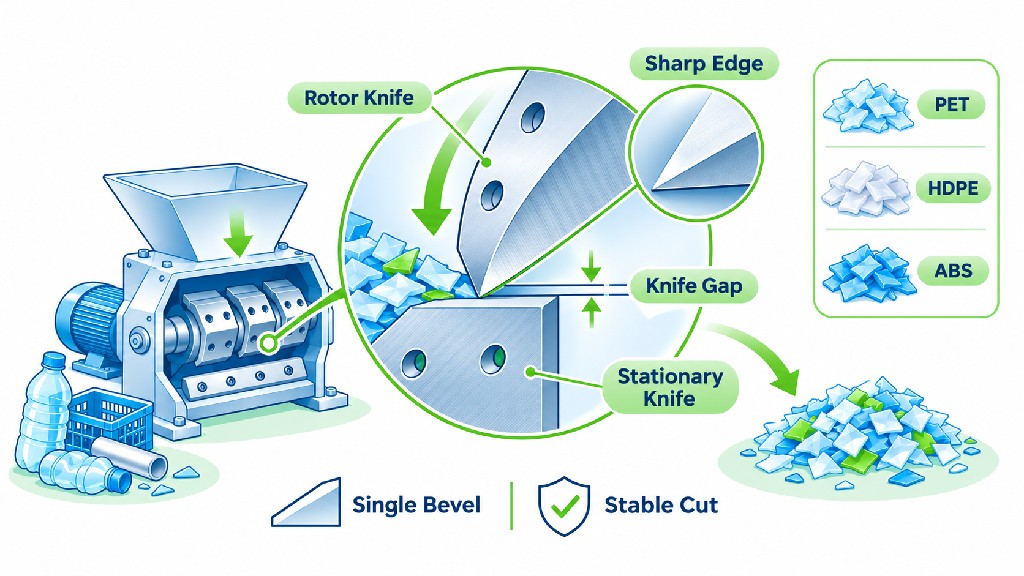
Plastic crusher blades are hardened cutting components installed in granulators, grinders, and certain plastic crushing machines. In a common high-speed granulator, rotating knives mounted to a rotor pass close to stationary bed knives attached to the cutting chamber. Their relative motion creates repeated shearing events. Small plastic pieces pass through a perforated screen, while larger pieces remain in the chamber for further cuts. In this design, the screen largely governs the nominal maximum exit dimension, but actual particle shape, fines content, and uniformity also depend on feeding, cutting geometry, screen condition, and material behavior.
A useful mechanical distinction is shearing versus tearing. With sharp opposing edges, correct alignment, and the machine manufacturer's specified knife gap, the feedstock is more likely to be separated by a controlled cut. Blunt knives or excessive clearance can make flexible plastic bend, rub, stretch, or fracture irregularly before separation. That can generate more heat and undesirable fines, particularly with films, thin-walled pieces, or brittle material. It can also increase residence time because pieces do not escape through the screen as efficiently.
The cutting chamber is a system, not a loose collection of components. Rotor design, feed opening, rotor speed, number of cutting edges, stationary knife support, drive power, discharge airflow, and screen perforation interact with the knives. Cumberland's overview of granulator knives emphasizes knife arrangement, tip angle, speed, sharpness, and clearance as important influences on machine efficiency and regrind quality. That is why replacing a worn knife with a geometrically incompatible but harder knife rarely solves a chronic granulation problem.
The word crusher is used broadly in machinery catalogs. A fast knife granulator used to make controlled regrind is not the same as a low-speed, high-torque shredder that breaks bulky waste into coarse pieces. Shredder cutters may be hooked, block-shaped, or assembled as multi-tooth cutters on parallel shafts; granulator knives are often long, straight, skewed, or segmented shearing edges used with a screen. Some industrial lines combine a shredder upstream with a granulator downstream.
Before ordering, check whether the request concerns rotor and bed knives for a granulator or cutters for a slow-speed shredder. The mounting method, load regime, required toughness, and replacement dimensions can be completely different. GUANG CHUAN organizes its offerings into separate crusher blades and shredder blades categories, which is a useful starting point for buyers with uncertain machine terminology.
There is no single blade profile suited to every plastic. Selection begins with understanding where the knife sits and how material enters the cutting zone. A machine may also use several of the categories below at the same time: for example, a V-arranged rotor with reversible stationary knives and slotted mounts for gap adjustment.
| Blade type | Typical position or design | Main benefit | What to verify before purchase |
|---|---|---|---|
| Rotor knife | Mounted to the turning rotor | Repeated moving shear cuts | Cutting-circle geometry, seat angle, balance, mounting pattern |
| Stationary or bed knife | Fixed to the chamber frame | Stable opposing cutting edge | Gap adjustment, support surface, edge orientation |
| Straight-edge knife | Continuous straight cutting edge | Simple grinding and replacement | Load spikes, alignment and feedstock suitability |
| Inclined or slant knife | Cutting edge skewed to rotor axis | Progressive scissors-like engagement | OEM-designed helix or skew angle and handedness |
| Segmented or staggered knife | Multiple shorter cutting segments | Flexible replacement and progressive engagement | Exact segment order, position and matching hardware |
| Reversible multi-edge knife | Two or more usable edges | More service intervals before regrinding | Whether the reverse edge is designed and approved for use |
| Slotted-mount knife | Elongated or U-shaped fixing slots | Adjustment flexibility on designed machines | Slot geometry, clamping area, fastener strength, adjustment range |
Rotor knives rotate with the shaft and carry material toward the mating fixed edge. Depending on the granulator, they may be bolted into longitudinal seats, installed as short staggered segments, or assembled around a solid cutting rotor. Their exact projection is critical: too little projection may compromise engagement, while too much can reduce the required clearance or create a collision. A new rotor knife must therefore match both the dimensional drawing and the machine's cutting-circle setup procedure.
For a rotor with several knives, matching mass, dimensions, and edge projection is essential. A replacement set that contains mismatched pieces may produce uneven engagement, vibration, and difficulty maintaining the gap. It is not enough for the bolt holes to line up. Buyers should ask how the supplier controls thickness, blade straightness, knife-seat contact and grinding consistency across a complete matched set.
Stationary knives, also called bed knives or stator knives, give the rotor a defined counter-edge. They are attached to a rigid bed or cutting-chamber wall and may be adjusted toward or away from the rotor. A damaged stationary knife can undermine the performance of an entirely new rotor set. When one edge is chipped or rounded, the cutting gap and shear action can vary along the chamber width.
Some bed knives can be turned to expose a second designed cutting edge. Other shapes have only one working bevel or an asymmetrical seat and are not reversible. Do not flip a knife merely because both broad faces appear similar. Confirm usable-edge count, bevel orientation, and minimum permitted size in the machine manual and the knife drawing.
Straight knives engage along a substantial portion of the edge at once, depending on machine geometry and feed presentation. This can make sharpening and inspection straightforward, but simultaneous cutting loads may be higher than with a progressive cutting arrangement. Slant or chevron arrangements spread cutting contact over time, creating a scissors effect. Cumberland's granulator-selection guidance notes that a slant-knife configuration can improve throughput while lowering noise and fines compared with a traditional straight-cut arrangement in suitable applications.
Those benefits belong to the machine-and-rotor design, not to an arbitrary blade modification. A straight-knife rotor cannot safely be converted into a V-knife system just by ordering angled blades. Staggered and segmented knives also require the correct seating order, direction and fasteners. An OEM drawing or approved replacement sample is the best reference.
Elongated slots can permit controlled positioning on machines designed for that mounting arrangement. For example, GUANG CHUAN lists Cr12MoV plastic granulator blades with slotted mounting features and U-slot crusher blades. A slot is not automatically an upgrade. Its length, radius, bolt clearance, washer and clamp geometry must preserve sufficient support under cyclic cutting load.
A round hole on a fixed rotor seat may provide a more constrained installation. A U-slot or open slot can simplify access in a particular machine, but only if that arrangement is authorized by its designer. The key purchasing rule is simple: never change a mounting system on the assumption that a more adjustable design is always better. First reproduce the known safe design, then investigate machine-approved improvements.
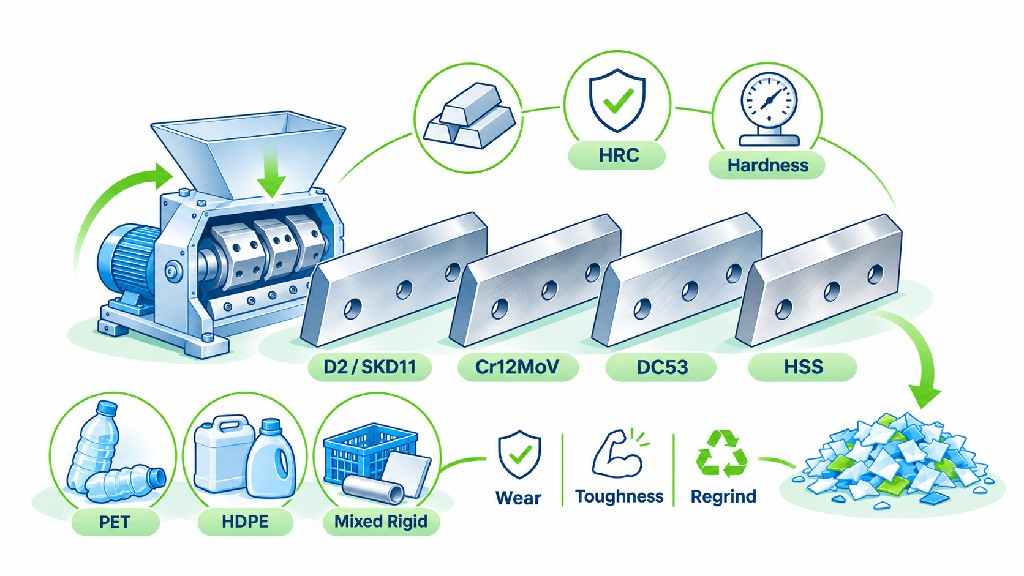
Material selection is a balance between abrasive wear resistance, resistance to edge chipping, dimensional stability, grinding cost, and price. Steel grade matters, but heat treatment, section size, manufacturing quality, and contamination are equally important. Two knives advertised under the same grade can perform differently if one has decarburization, grinding burns, unsuitable edge geometry, or a brittle microstructure.
| Material or material family | General engineering characteristic | Potentially suitable conditions | Caution for purchasing |
|---|---|---|---|
| D2 / 1.2379 / SKD11-family cold-work tool steel | High carbide content and strong abrasive-wear resistance | Clean to moderately abrasive rigid plastic, demanding production | Chipping risk can rise under severe impacts; actual heat treatment matters |
| Cr12MoV-family tool steel | High-carbon chromium alloy tool steel used for industrial cutting tools | General-purpose crusher and granulator knives | Do not assume every Cr12MoV, D2, and SKD11 designation is chemically identical |
| 6CrW2Si alloy tool steel | Toughness-oriented candidate for certain impact-loaded tools | Selected heavy-duty work where edge support matters | Request actual grade, hardness and application validation |
| M2 / 1.3343 high-speed steel | Alloyed HSS offering wear resistance and hot-hardness capability | Selected fine-cut or specialized knife applications | More costly; not inherently better in dirty, shock-loaded scrap |
| Carbide or carbide-inlaid edge | Very high hardness and abrasion resistance | Some strongly abrasive or filled plastics with controlled loading | Brittle fracture, joining design, regrinding and repair need evaluation |
The table is an application-oriented screening guide, not a guarantee of service life, a cross-grade equivalence certificate, or an OEM blade recommendation.
AISI D2 is a high-carbon, high-chromium cold-work tool steel. The tool-steel manufacturer Uddeholm identifies its Sverker 21 grade with D2 / 1.2379 and gives a typical chemistry of approximately 1.55% carbon, 11.3% chromium, 0.8% molybdenum, and 0.8% vanadium. Its published material data describes high abrasive-wear resistance and good compressive strength, while recognizing the limits of chipping resistance. This metallurgical profile makes D2 a credible starting point for many granulator knives, provided the edge is supported and the feed is managed.
However, D2 is not an all-purpose impact-proof steel. A hard D2 edge may last well while cutting consistent rigid polypropylene or PET parts, yet chip quickly if the process introduces steel fasteners, stones, or other hard contaminants. In such a case the first corrective action is often upstream sorting or metal detection, not simply increasing hardness. Repeated impact failure calls for a review of both material toughness and cutting-system geometry.
Some industrial product listings combine the words "D2" and "HSS" in the same title. For technical purchasing, treat these as different metallurgical classifications: D2 is a cold-work tool steel, whereas grades such as M2 are high-speed steels. Ask the supplier to state the exact steel designation and traceability, not only a marketing label.
Cr12MoV is widely offered in industrial knife manufacturing for its combination of hardenability and wear resistance. Its name is sometimes casually grouped with D2 or SKD11 in commercial listings, but local specifications, actual chemistry, and material sourcing can differ. Cross-referencing grades by name alone is risky when a buyer requires a specified alloy or must meet an OEM drawing.
For standard post-industrial plastic scrap, a properly heat-treated Cr12MoV blade can be a practical commercial option. GUANG CHUAN currently advertises a Cr12MoV blade series with selectable grades, mounting layouts and edge designs. Its product page gives a stated product hardness range of 56–62 HRC; this is a supplier listing for that family, not a universal requirement for every crusher blade. The correct target should be established for the selected grade, dimensions, intended service and documented heat-treatment route.
Bulky purgings, thick-walled parts, or heavily contaminated feedstock can produce severe intermittent cutting forces. If edges develop deep chips or cracks rather than slowly rounding, a harder or more wear-resistant steel may make matters worse. A more damage-tolerant blade grade, different hardness target, thicker supported geometry, or a change to feed preprocessing may be needed.
Candidates from tougher alloy tool-steel families—including 6CrW2Si in some knife designs—can be discussed with the blade manufacturer, but there is no universal rule that one alloy always outperforms another. Request the anticipated failure mode, heat-treatment condition, sample inspection plan, and reference to the specific cutting duty before approving a material change. The machine's rotor and knife-seat strength still determine the boundary of safe use.
M2 high-speed steel, commonly designated 1.3343, is formulated for cutting tools needing wear resistance, edge stability and hot-hardness capability. BÖHLER's S600 material information identifies this as a high-speed steel family used in industrial cutting tools. These characteristics can be attractive for specialized, precision-oriented cutting conditions, but granulation usually involves intermittent loads, abrasive solids, contamination and strict operating economics rather than the continuous high-temperature cutting environment of a milling cutter.
Consequently, the question is not whether M2 has impressive datasheet values. The question is whether its life advantage in the customer's feedstock exceeds higher purchase and sharpening costs without increasing breakage risk. Evaluate M2 through a controlled trial and total cost per processed tonne. A modestly priced D2 or suitable alloy-steel blade may give better economics in many ordinary plastic recycling lines.
Tungsten carbide and carbide-inlaid cutting edges can resist abrasion extremely well, which may help with glass-filled plastics or other mineral-filled materials. But a hard edge is not automatically safe under high impact. A carbide insert or inlay introduces considerations around joint integrity, backing support, thermal compatibility, grinding method and the consequences of a chipped insert. A complete structural assessment is particularly important for high-speed rotors.
GUANG CHUAN has published a company update on recycling blade options that discusses modified D2 and carbide inlays. Any specific lifespan uplift promoted there is a supplier statement, not a transferable performance guarantee for unrelated equipment. Before choosing carbide, ask for the exact joint construction, machine compatibility, service conditions, and a controlled trial with the actual feedstock.
Hardness is only one piece of the blade specification. A steel can meet its nominal HRC value and still suffer early failure if the microstructure is unsuitable, if the surface was overheated during grinding, or if decarburization weakened the edge. For demanding applications, request evidence of material identity, controlled hardening and tempering, hardness testing, dimensional inspection, and visual examination for cracks or damaged edges.
For material purchasing, ASTM A681 describes requirements for wrought alloy tool steel products; it does not independently approve a finished granulator blade design. For hardness verification, ASTM E18 establishes Rockwell hardness test methods. An HRC test result should be interpreted together with where the indentation was taken, the specimen condition, heat treatment and the finished part's allowable testing location.
A purchasing specification should name the actual resin and its condition. "Waste plastic" is too vague. Separate clean production scrap from post-consumer waste; brittle molded parts from ductile film; unfilled resin from mineral- or glass-filled compounds; and room-temperature scrap from parts that arrive warm from processing.
| Feedstock | Typical cutting challenge | Initial selection focus | Process checks |
|---|---|---|---|
| PP and PE rigid parts | Tough, ductile pieces and variable wall thickness | Supported sharp edge, correct shear gap | Stringing, long strips, discharge efficiency |
| PE film and stretch film | Flexible material may wrap or stretch | Sharp close-shearing knife system approved by OEM | Feeding, wrapping, heat buildup, screen blinding |
| PET bottles and flakes | Mixed shapes, labels, occasional contaminants | Wear resistance with practical toughness | Sorting, labels, residual liquid and fines |
| ABS and PS sprues | Brittle fracture and mixed gate shapes | Clean edge and controlled cutting | Fines, noise, part geometry |
| PVC scrap | Variable formulation; possible process sensitivity | Material-compatible blade, controlled temperature | Contamination and downstream handling requirements |
| Glass-filled PA, PBT or PP | Abrasive fibers and high edge wear | Wear-resistant grade with adequate chip resistance | Glass content, blade wear map, dust extraction |
| Thick purgings and pipes | Intermittent high torque and large sections | Robust knife support and impact tolerance | OEM clearance, feed sizing and overload protection |
Polypropylene and polyethylene are frequently processed as sprues, runners, injection-molded rejects, blow-molded pieces, containers and film. A relatively clean stream of rigid PP or HDPE can often be handled with precision-ground tool-steel knives matched to the machine. The main operating questions are whether the material is sufficiently brittle for clean fracture, whether knife geometry produces effective shear, and whether long pieces can jam the chamber.
Film is more demanding because its flexibility can allow it to fold, stretch, or wrap around rotating parts. A film-processing machine may use specialized feed rolls, a particular rotor profile and a closer permitted knife gap. Installing the sharpest possible steel will not solve the wrong feed geometry. For an uncertain line, perform a limited test using the actual film gauge, feed density, moisture level and discharge arrangement before ordering a large knife batch.
PET bottles are commonly accompanied by labels, caps, adhesives, moisture and debris, depending on collection and preprocessing. Knife performance depends on whether the stream is pre-sorted and washed, whether it contains sand or metal, and the bottle's geometry. A clean bottle line and an unsorted post-consumer stream can impose very different wear patterns on the same knife grade.
If wear appears as smooth, progressive edge recession, abrasion resistance may be the right optimization target. If a knife shows isolated deep chips or broken corners, check for foreign metal, stones or oversized hard pieces. Higher nominal hardness is not a substitute for reliable sorting and metal separation. Compare output flakes and contamination over equal production intervals, rather than judging blade quality solely by the number of calendar days installed.
Brittle plastics can fracture into smaller fragments readily, potentially producing more fine particles if cutting is unnecessarily aggressive or residence time is prolonged. For injection-molding rejects and runners, start with the OEM geometry and an accurately sharpened rotor-bed pair. Examine the screen, blade gap and material temperature before changing steels. Too much fines content is not necessarily evidence that the steel lacks hardness; repeated recutting and a blunt edge may also be involved.
Plants that mix several resin grades should separate or identify feedstock streams whenever required by regrind specifications. A knife can deliver mechanically sound cuts yet still leave the recycler with unusable mixed-polymer output. Blade selection contributes to quality but cannot replace resin control, identification and upstream sorting.
Reinforced PA, PBT, PP and similar compounds can wear knife edges more quickly because embedded fillers act as abrasives. The relevant specification is not simply "glass-filled": buyers should report filler type, nominal loading, feed size, throughput and any history of chipping. An extremely hard steel or carbide option may reduce one type of wear but become vulnerable to sudden edge breakage if large hard pieces are also present.
A practical trial should record edge condition at scheduled intervals. Measure wear near the center and both ends of the cutting edge, note whether the rotor and bed knife wear similarly, and document throughput and fines. If wear is concentrated in one region, inspect feeding distribution, alignment and knife-seat condition before interpreting it as a material-grade problem.
Heavy cross-sections can demand much more torque per bite than thin runners or bottles. Select knives with adequate support, appropriate edge robustness, and compatibility with the granulator's rotor arrangement. Consider pre-shredding large pieces when the machine maker recommends it. Do not force an oversized lump into a granulator whose feed opening and motor were designed for smaller scrap.
Cumberland's operating information for particular C-series granulators distinguishes ordinary cutting gaps from settings used for very heavy sections. This illustrates a broader principle: the appropriate gap changes with machine design and feedstock. A larger gap may be authorized for one model handling purgings while being unsuitable for a smaller precision granulator. Start from the specific machine's manual, not a figure copied from an unrelated article.
Hardness influences how strongly a cutting edge resists deformation and certain wear mechanisms. But it is not a direct measure of toughness, and it cannot independently predict knife life. A blade with excessive hardness for its loading may chip; one too soft for the resin and contaminants may round rapidly. Quality begins with a balanced specification rather than a single maximum HRC number.
HRC is a Rockwell hardness scale used for many hardened steels. If a supplier quotes 58–60 HRC, the value should be supported by the specified measurement process and suitable testing location. It does not describe impact energy, carbide distribution, microcrack content, or whether the bevel was ground without thermal damage. For carbide, a different scale or a material-specific set of properties may be more appropriate; avoid comparing HRA and HRC values as if the numbers were interchangeable.
One GUANG CHUAN Cr12MoV product page lists a 56–62 HRC range and a 25°–45° customization range for cutting angles. Those are advertised options for that product family, not standardized settings for all plastic crushers. The actual approved knife-edge geometry must come from the OEM drawing and the cutting application. A supplier should confirm the specified values on the quotation and provide inspection evidence where required.
A sharper, more acute included edge angle can reduce cutting resistance in suitable materials, but the thin wedge has less support. A more obtuse edge provides a stronger cross-section but may require greater cutting force or perform poorly on thin, flexible stock. It is easy to confuse the included angle with a single-bevel angle measured from a face. Technical drawings should explicitly define the reference surfaces and whether the knife is single-bevel, double-bevel, or asymmetric.
Do not copy a nominal "30-degree knife" designation without the corresponding drawing. The angle might mean different things at different suppliers. For a replacement order, request the existing approved bevel profile and any land, relief, micro-bevel, or special edge treatment. Where the original knife worked reliably, preserving its geometry is usually the lowest-risk first step.
A long blade can appear sharp yet cut badly if it is bowed or if the mounting face fails to sit fully against the knife seat. In that condition, setting clearance at one end does not guarantee acceptable clearance along the full width. After tightening, a small error in flatness or a chip beneath the blade can produce an irregular running gap, noise, heat and localized wear.
Buyers should therefore request inspection of the dimensions that matter in the assembled machine: thickness consistency, mounting-face flatness, cutting-edge straightness, hole or slot locations, and the relationship between edge and datum surfaces. An impressive tolerance printed on a catalog page is meaningful only when it references the correct feature, measurement method, and drawing revision. Ask for a marked-up drawing if the specification is ambiguous.
The knife gap is the clearance between a rotor knife and its mating stationary knife at the cutting position. Too wide a gap can reduce shearing efficiency, particularly with thin or ductile material. Too narrow a gap may create contact after thermal movement, blade deflection, bearing play or incorrect installation. The result can be chipped edges, severe mechanical damage, or unsafe operation.
Published machine manuals demonstrate why a one-size-fits-all number is misleading. Cumberland's C1000/C1400 maintenance manual gives 0.15–0.20 mm (0.006–0.008 in.) as a standard gap for those models and also discusses different settings for heavy cross-sections. A separate Dynisco MiniGran manual specifies 0.20 mm for the cutting-gap procedure shown in that machine's maintenance instructions. These values are model-specific examples, not an instruction to set a GUANG CHUAN blade or an unrelated machine to either value.
| Published example | Knife-gap figure | Meaning | Safe purchasing interpretation |
|---|---|---|---|
| Cumberland C1000/C1400 | 0.15–0.20 mm standard setting | Specific OEM maintenance guidance | Use only when that manual applies to the machine |
| Dynisco MiniGran | 0.20 mm in its service procedure | Specific OEM maintenance guidance | Do not transplant to a different rotor or cutting design |
| Any other crusher or granulator | Confirm with its own OEM documentation | Depends on design, material and wear state | Request machine model, serial number and setting procedure |
Only trained, authorized maintenance personnel should inspect the cutting chamber. First isolate hazardous energy and follow the machine's lockout procedure; the rotor must be secured against movement according to the OEM instructions. Inspect the knife seats, fasteners, bearing play and edge condition. Then apply the maker's setting and measuring procedure—some use a fixture, shims or a feeler gauge. Measure at the prescribed positions, including both ends where required, and verify the gap after the mounting hardware is tightened.
Check for interference using the machine's approved method, with guards and safe access controls in place. Never improvise by rotating machinery under power with the chamber open. Torque values are particularly machine-specific: a bolt torque published for one granulator must not be used for another simply because the bolts look similar. The safe source is the relevant OEM service documentation, fastener specification and approved maintenance procedure.
If regrind quality falls, first determine whether knives are dull, the screen is damaged, airflow is poor, feed is overloaded, or the rotor has excessive mechanical movement. Adjusting the bed knife to compensate for a damaged rotor bearing is unsafe and unlikely to last. If a machine repeatedly loses clearance after a correct adjustment, investigate seating, fastener retention, wear, thermal effects and other mechanical faults before ordering more expensive blades.
Screen hole diameter affects which particles can leave the cutting chamber, but it should not be equated with a perfectly uniform particle dimension. Flake length, aspect ratio, material stiffness, blade sharpness, feed orientation and discharge performance all matter. A nominal screen opening is only one part of particle-size control. Thin film can pass through differently from rigid granules, and brittle materials can create fines smaller than the nominal screen aperture.
A smaller screen generally increases the need for material to remain in the chamber until it passes, which may increase recutting, energy use, heat and fines if the machine is not designed or configured appropriately. A larger screen can raise effective exit capacity but may produce regrind that does not meet downstream extruder or washing requirements. Screen choice must be coordinated with the target flake specification, conveying line, throughput and contamination-removal equipment.
Rotor speed also changes cutting frequency and material movement. More speed does not necessarily mean better particle quality. Cumberland's technical guide describes how lower tip speed can reduce noise and fines in certain conditions. A blade supplier can help select geometry and material, but cannot promise a particular output size without considering the screen, machine condition and feedstock.
For an evidence-based comparison, retain samples at the same screen specification and operating feed rate. Measure a meaningful distribution of particle sizes, fines percentage, and bulk handling behavior. If the customer requires a specific flake specification, agree on a sampling method before the trial rather than relying on photographs of a single handful of granules.
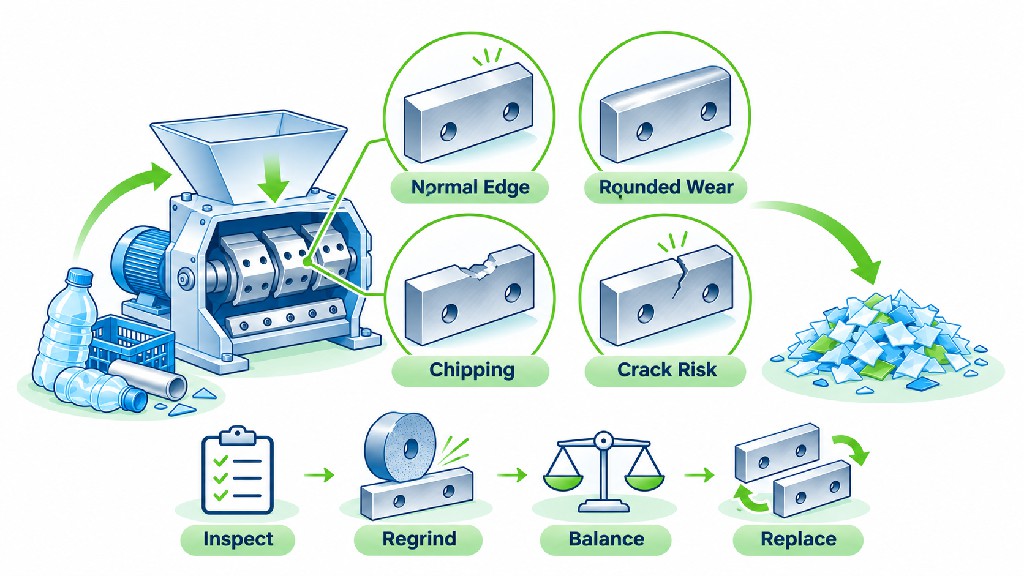
A worn edge is a diagnostic signal. Distinguishing gradual abrasion from isolated chipping or cracking helps avoid repeated purchases of the wrong grade. The following table offers investigation priorities, not a substitute for the equipment manufacturer's troubleshooting procedure.
| Observable symptom | Plausible causes to investigate | First corrective direction |
|---|---|---|
| Rounded cutting edge along most of its length | Normal abrasion, filled resin, contaminated feed | Inspect feed cleanliness, wear rate, material selection |
| Isolated chipped corner or deep notch | Hard foreign object, impact, unsupported edge, incorrect geometry | Inspect contamination, edge support and gap |
| Cracks near mounting holes or slots | Excess load, stress concentration, bad seating, fastener issue | Remove from service; inspect design and mount |
| Uneven wear from one end to the other | Misalignment, uneven feeding, poor mounting face, rotor issue | Check seat, datum, bearing and feed distribution |
| Excess fines or powder | Blunt knives, prolonged residence, unsuitable screen or speed | Audit knife condition and full process settings |
| Long strips or uncut film | Poor shear, excess gap, wrapping, unsuitable rotor | Check OEM clearance and film-specific feeding |
| Higher power draw or frequent stalls | Dull edges, overload, jam, incorrect feed or mechanical drag | Inspect machine before changing metallurgy |
| Repeated blade breakage after sharpening | Excessive material removal, grinding damage, mismatched dimensions | Check minimum knife dimensions and grinding records |
Gradual edge rounding usually creates a recognizable trend: cutting performance degrades over time, motor current may creep upward under comparable load, and output quality becomes less consistent. This suggests maintenance scheduling and wear-resistant materials may help. In contrast, a sudden deep chip demands a prompt investigation into hard objects, poor support, impact loads, and whether a section of broken tool could enter the regrind stream.
Do not keep operating with a visibly cracked blade to "finish the shift." A crack can propagate and the failed component may damage adjacent knives, screens or the rotor. Stop, isolate and inspect the machine according to its maintenance and safety procedures. Record the blade's position and the failure location before cleaning away evidence.
Poor regrinding can shorten the next service interval even when the underlying steel grade is sound. Excessive grinding heat can change the surface, cause microcracking or degrade the edge. Unequal removal can also shift knife dimensions or create mismatch across a rotor set. A blade that cracks soon after sharpening may require examination of the grinding procedure as much as a change of steel.
When comparing suppliers, ask whether the cutting edge is inspected after final grinding, what controls are used for cooling, and whether the finished edge and reference surfaces are checked. A cost-effective blade is one that can be returned to a correct service condition safely and repeatedly—not one that merely arrives with a bright polished bevel.
Blade life is best tracked by production conditions, not an unqualified calendar promise. Two lines using the same knife grade may process radically different volumes, fillers and contaminants. A practical inspection log records operating hours, processed mass, resin mix, sharpening dates, adjustment history, edge condition, motor load trends and reasons for knife removal.
The Dynisco MiniGran manual recommends that its rotor knives be sharpened or replaced as a matched set with equal length and warns against reusing knives with grinding cracks. Its procedures are not universally applicable, but the principle is valuable: maintain the designed geometry and compatibility across the complete cutting assembly. Other OEMs may specify different matching, wear limits and grinding allowances.
At the start of a maintenance program, establish a baseline using new or correctly reconditioned blades. During operation, monitor feed stability, output uniformity, unexpected noises and current draw where instruments are available. At each scheduled shutdown, document the condition of rotor and stationary edges and the knife gap using the authorized procedure. After each sharpening, record how much material was removed and whether the pieces remain above their minimum permissible dimensions.
Replace a knife when it is cracked, below its minimum safe dimension, unable to hold approved clearance, or otherwise rejected by the equipment manufacturer's criteria. A reversible knife can be turned only if the design authorizes it and the next edge has adequate geometry and support. Keep a clean spare set available before the running set reaches its removal limit, especially for continuous recycling lines.
Granulators can retain hazardous rotational or other stored energy after electrical power is disconnected. In the United States, OSHA 29 CFR 1910.147 addresses control of hazardous energy during servicing, while OSHA 29 CFR 1910.212 addresses machine guarding. Applicable laws and standards vary by location. Qualified personnel must follow the specific machine's approved isolation, rotor restraint, handling and guarding requirements, including appropriate protective equipment.
The blade manufacturer should never encourage adjustment by reaching into an unguarded, powered cutting chamber. Reject maintenance advice that omits energy isolation, proper lifting of heavy knives, protection against sharp edges, and rechecking the installation before restart. Operating discipline is part of knife life and plant reliability, not an optional add-on.
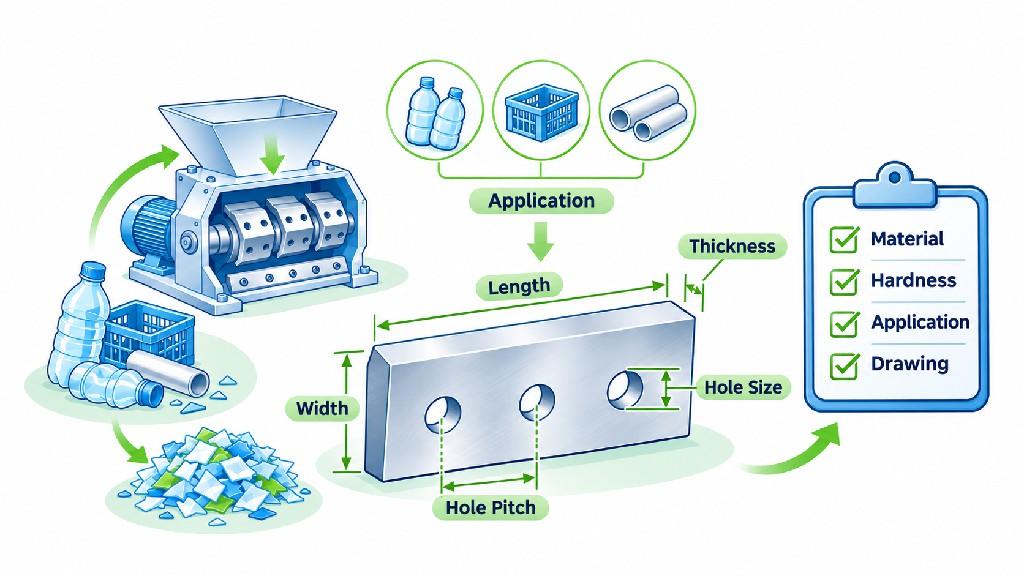
A replacement order should be treated as a controlled manufacturing task. A photograph with a ruler may help identify the part, but it rarely defines the datums, tolerances and geometry needed for safe rotor operation. Use the original drawing or OEM part number whenever available, supplemented by measurements from a serviceable sample.
| Specification item | What to provide | Why it matters |
|---|---|---|
| Machine identification | Maker, model, serial number, rotor type | Confirms intended configuration and reference parts |
| Blade position | Rotor or stationary; installation location | Prevents mixing incompatible knives |
| Overall dimensions | Length × width × thickness, units clearly stated | Establishes fit and available grinding stock |
| Mounting design | Hole/slot count, diameter, width, length, radii, center distances | Secures correct seating and clamp arrangement |
| Datum relationships | Edge-to-hole, edge-to-back-face, edge-to-seat measurements | Determines cutting-circle position and knife gap |
| Edge geometry | Bevel type, included angle, relief, edge orientation | Reproduces the intended shear action |
| Material | Exact specification and approved substitutes | Avoids incorrect grade equivalence |
| Heat treatment | Target hardness range and inspection method | Controls finished blade condition |
| Quality requirements | Flatness, straightness, parallelism, dimensional tolerances | Reduces assembly and adjustment problems |
| Commercial details | Set quantity, drawings, packaging, destination, delivery priority | Produces a comparable, complete quotation |
For a long rectangular knife, start by identifying the mounting or seating face and the face that locates the blade against the rotor. These are often more useful datums than a worn cutting edge. Measure the body thickness and length at several locations and record the hole pattern relative to the design datum. On slotted knives, report the slot width, full length, end radius, centerline and position relative to the cutting edge.
A used sample may be shorter than the original because of prior sharpening. Tell the manufacturer whether the measurements come from a new blade, a worn blade, or an OEM drawing. Otherwise a supplier could faithfully reproduce an already undersized part. If necessary, compare a new and used specimen or request a drawing confirmation from the machine builder.
Two visually similar knives can have opposite bevel directions. Supply top, bottom and side views, show which surface contacts the knife seat, and mark the direction of rotor rotation or product movement when known. Note any relief, chamfer, counterbore, recessed slot, or asymmetric edge. Include a photo of the installed orientation only if it can be obtained safely during a fully isolated maintenance condition.
Do not invent a tight tolerance for every dimension. Identify which dimensions are critical to the cutting circle, fit and clearance, then request reasonable manufacturing tolerances for those functions. The final accepted drawing should specify a revision number and be approved before production. That simple step prevents disputes when the customer later compares a replacement blade with an old, repeatedly reground sample.
Suppose a recycling plant needs one matched set of rotor knives and stationary knives for a granulator handling clean injection-molding runners. The buyer provides a machine model and serial number, a dimensioned drawing of both blade types, photos of the mounting faces, current steel designation if known, the authorized OEM knife gap, annual operating hours, and a note that the current knives become blunt rather than chipped. The supplier can then quote an exact replacement design and optionally propose a controlled material trial.
Contrast that with an inquiry saying only "please quote D2 crusher blades, good quality, low price." The second request leaves the blade maker guessing about fit, edge orientation, failure mode and quantity. A vague quote may look cheap but creates far greater installation and operational risk. Technical completeness is not bureaucracy: it directly improves procurement accuracy and delivery reliability.
The true cost of a knife set includes engineering verification, machining quality, inspection, packaging, lead time, sharpening capacity and operational reliability. A supplier should be able to explain the relationship between material choice and working conditions, not just promise that a harder blade will last longer. Commercial comparisons are best made on identical drawing revisions and clearly defined acceptance requirements.
Ask whether the supplier manufactures in-house or outsources critical processes, how it records material batches, and which inspection reports it can supply. For custom parts, confirm who approves the drawing, whether a first article is offered, how nonconforming dimensions will be handled, and whether replacement sets can be reproduced from a saved specification. These questions matter especially for international purchasing, where returning an incorrect high-mass blade shipment is expensive.
| Evaluation category | Strong supplier response | Weak or incomplete response |
|---|---|---|
| Application review | Asks about resin, contamination, duty and failure mode | Recommends one steel for everything |
| Drawing control | Requests dimensions, datums and approved revision | Quotes from a photo without confirmation |
| Material traceability | States exact grade and available documentation | Uses ambiguous "premium steel" label |
| Heat-treatment assurance | Defines test method and achievable hardness | Promises maximum hardness without conditions |
| Precision inspection | Names critical checked dimensions and reports | Quotes vague "micron precision" without criteria |
| Service and sharpening | Discusses wear limits and matching requirements | Gives an unsupported lifetime guarantee |
| Commercial terms | Clear quantity, delivery, packaging and dispute process | Unspecified inclusions and uncertain lead time |
GUANG CHUAN describes itself as a manufacturer of industrial machine knives and precision tooling based in Ma'anshan, China, with CNC machining, grinding, heat treatment and customization capability; these are company-described capabilities. Its published catalog includes dedicated crusher blade products, such as custom replacement crusher knives, Cr12MoV granulator knife variants, and U-slot mounting designs.
For an RFQ, request an application-specific material recommendation, a revised manufacturing drawing for approval, explicit grade and hardness, measured tolerances on critical dimensions, quantity per complete set, packaging method, and current production lead time. Do not treat values printed on a single catalog page as confirmed for every custom order. Ask the sales and engineering team to document the exact deliverable on the quotation and purchase order.
A lower knife price does not necessarily reduce the cost of recycling. If a cheap set requires frequent changeovers, causes poor output quality or raises the risk of damage to a rotor, its unit-price saving can disappear. Equally, a premium-grade set is not automatically cost-effective if the line processes clean, low-abrasion scrap and already has short changeovers.
A transparent comparison can use the following simplified model:
Cost per processed tonne = (knife purchase cost + sharpening cost + planned changeover labor + valued downtime + documented scrap or quality losses) ÷ tonnes processed during the evaluation period.
To make the calculation credible, compare equal feedstock and operating conditions and do not count the same cost twice. Actual costs depend on labor, production scheduling, product sales value and the plant's accounting method. Use line-specific data wherever possible.
The figures below are illustrative assumptions only, not GUANG CHUAN prices, independent test results or typical industry averages. They demonstrate how a buyer might compare options over an equal 1,200-tonne production horizon.
| Cost input over 1,200 tonnes | Standard blade option | Premium blade option |
|---|---|---|
| Blade purchases consumed in comparison period | $900 | $1,300 |
| Sharpening and reconditioning | $360 | $240 |
| Planned maintenance labor | $300 | $200 |
| Valued production downtime | $720 | $360 |
| Measured quality-related loss | $240 | $180 |
| Illustrative total | $2,520 | $2,280 |
| Illustrative cost per tonne | $2.10/t | $1.90/t |
In this hypothetical example, the premium option reduces modeled cost by $0.20 per tonne, or $240 across the evaluation horizon, despite a $400 higher blade purchase expense. If there were no downtime or quality benefit, the conclusion could reverse. That is exactly why a procurement decision should be based on measured service performance rather than a generic claim of "two times longer life."
Agree in advance on the candidate knives, machine, resin family, screen, feed-size range, target throughput, edge condition and sampling interval. Use the same inspection procedure for each candidate and document unplanned stops, sharpening events, tonnes processed, and condition of both rotor and stationary knives. Where possible, account for changes in contamination and filler content; otherwise a knife evaluated during a clean production week may appear artificially superior to one tested on dirty post-consumer scrap.
A controlled trial need not be complicated. Even a simple spreadsheet linking shifts, processed tonnes, downtime cause and blade observations will be more valuable than a verbal estimate. When selecting between two steels, the most persuasive evidence is the production log from the actual facility, supported by repeatable dimensions and photos of the edges after comparable duty.
Once the technical design is approved, turn it into a commercial specification that prevents ambiguity. The order should include part numbers for rotor and stationary knives, drawing revisions, requested material and approved substitutes, heat-treatment requirements, critical dimensional limits, surface and edge condition, inspection documentation, quantity, labeling, packaging, and delivery terms.
For overseas shipments, protect cutting edges against impact and corrosion during handling, but make sure the protective materials can be safely removed. Heavy knives should be immobilized to prevent contact with one another. Each set should be traceable to the supplied drawing and identification. If multiple similar-looking knives are shipped, clear labeling and packing-list separation reduce the risk of incorrect installation.
Do not assume every factory can provide the same certificate package for every order. If a buyer requires a material certificate, hardness inspection record, full dimensional report, or first-article approval, request it before the quotation is accepted. Also clarify whether sharpening allowances, installation instructions or spare fasteners are included. An unexpectedly missing fastener or mounting component can delay commissioning even when the cutting steel itself is correct.
The following scenarios show how to convert a production problem into a defensible material and blade specification. They are decision examples, not guaranteed recipes. All final choices must remain compatible with the granulator's OEM design.
A molding facility processes relatively uniform sprues close to the press. The current blade set wears gradually, downtime is short, and there is little evidence of hard contamination. The first priority is accurate replacement geometry and consistent sharpening—not necessarily premium carbide. Begin with the OEM-approved material family, document the baseline sharpening cycle and use a properly matched rotor/bed knife set. If downtime is already low, the payback for a more expensive steel may be limited.
The buyer should still specify the machine model and resin grade, verify clearance against the manual, and retain a spare set for changeovers. The relevant performance indicators are granulate consistency, ability to feed the regrind, predictable maintenance intervals and cost per tonne. An expensive alloy that improves lab wear resistance but complicates sharpening could be a poor practical choice.
A recycler experiences occasional deep chips on rotor knives, inconsistent feed and known contamination in incoming bottles. A straightforward switch to maximum-hardness D2 is not the first recommendation. Review sorting and metal detection, inspect knife mounts and damage patterns, and confirm whether occasional hard objects are reaching the rotor. Only after the contamination and mechanical conditions are understood should a more damage-tolerant tool-steel or edge geometry be trialed.
A controlled trial might compare a baseline alloy knife and an alternative toughness-oriented design under similar feed conditions. Record both the total edge wear and the occurrence of isolated defects. If chipped material could reach downstream products, the production-quality and safety implications need consideration as well. The correct solution may involve upstream process control and a material change together.
A compounding facility processes relatively clean, glass-filled rejects and observes gradual, broad wear rather than cracking. The primary opportunity may be improved abrasion resistance. A high-quality D2-family blade, a suitably engineered HSS option, or a specially designed hard-edge solution can be compared, depending on equipment approval and economics. Request a small trial set before committing to plant-wide standardization.
Keep the test meaningful by recording filler percentage, approximate feed rate, processed tonnes, fines and blade wear. Carbide should be considered only if its edge support and mounting are compatible with the machine's loading. If a candidate lasts longer but fails suddenly under occasional impact, that risk may outweigh its abrasion advantage. Serviceability and controlled failure behavior belong in the decision.
A plant with a single critical granulator may value repeatable deliveries more than small differences in knife price. Standardizing the drawing, stocking matched spare sets, and agreeing on clear inspection and packaging requirements can reduce the risk of an extended outage. In such a line, sourcing reliability and dimensional interchangeability are strategic purchasing criteria.
Ask suppliers to label all matching rotor and bed knives, keep approved revisions on record and provide predictable reorders. This does not eliminate normal maintenance, but it reduces dependence on urgent reverse engineering when a set finally reaches its grinding limit. The measurable benefit is fewer procurement-related stoppages and more consistent replacement quality.
Sometimes, but not always. In many sales catalogs, crusher blades means the rotor and stationary knives used in a plastic granulator. In other catalogs it can describe low-speed shredder cutters or even non-plastic crushing tools. Always identify the equipment, blade position, mounting drawing and intended feedstock. Naming alone is insufficient for technical purchasing.
There is no universal best steel. D2 and suitable Cr12MoV-family tool steels are credible candidates for many wear-oriented applications; a tougher alloy can be preferable where impact damage dominates; HSS or carbide may deserve trials in selected specialized conditions. Balance wear resistance, toughness, edge geometry, regrinding, price and actual processing results. The machine manufacturer's approved design sets the starting point.
Hardness should follow the chosen material grade, blade design and service conditions. GUANG CHUAN lists 56–62 HRC for a particular customizable Cr12MoV product, but that figure must not be copied into unrelated specifications. Request the final hardness target and measurement method on the approved order. Harder is not necessarily safer or more economical.
Use the OEM instruction for the exact machine and application. Published manuals demonstrate different model-specific procedures; for example, certain Cumberland C-series machines specify 0.15–0.20 mm as a standard setting, while a Dynisco MiniGran procedure uses 0.20 mm. Neither figure authorizes a setting for another machine. Untrained personnel should never adjust knives in a powered or unsecured chamber.
Properly sharpened knives can improve shearing, but fines also depend on screen size, rotor speed, residence time, brittle or ductile material behavior, feed rate, and contamination. A poorly configured machine can still produce excessive fines with new blades. Compare a complete system under equivalent conditions instead of attributing particle quality to sharpness alone.
Sharpen only if the knife remains structurally sound, its geometry can be restored, and it stays above the machine's minimum permitted dimension. Cracked, severely damaged or undersized knives should not be returned to service. Rotor knives may need regrinding as matched sets to preserve consistent geometry. Follow the exact OEM limits and a qualified grinding procedure.
Possibly, but compatibility must be evaluated rather than assumed. The alternate grade must meet design, strength, heat-treatment, grinding and operating requirements, and any OEM approval or warranty conditions. Keep geometry, mounting, clearance, fastener specifications, and balance under control. A small monitored trial is preferable to replacing an entire fleet with an unverified substitute.
Provide machine make and model, blade position, a dimensioned drawing or reliable sample, blade quantity, exact hole or slot layout, datum locations, edge angles and orientation, original material if known, working resin, contamination conditions, and recent blade failure history. Define which dimensions require inspection reports and agree on the drawing revision before production starts.
Request comparable prices for the same material designation, approved drawing, number of pieces, inspection scope and delivery terms. Include sharpening serviceability and estimated downtime in the decision. Where a supplier proposes an upgraded material, ask for an application-specific reason and trial method rather than relying on an unsupported service-life multiplier.
A suitably designed granulator may accept several resin families, but the best blade geometry and operating settings can vary with feedstock shape, ductility, fillers and contamination. Moreover, mixing incompatible resins may undermine regrind quality even when the blades cut successfully. Confirm permitted materials and process settings with the machine manufacturer and downstream recycling specification.
Before buying replacement plastic crusher blades, verify the machine and cutting-system type; identify rotor and stationary knives separately; confirm the precise mounting pattern, edge orientation and dimensions; define the resin, filler and contamination environment; and investigate the actual mode of blade failure. Choose the material and heat treatment for those conditions, not by maximum hardness alone. Validate the cutting gap using the applicable OEM documentation, plan how the blades will be sharpened, and define inspection and packaging requirements before placing a custom order.
For buyers seeking a manufacturer that can quote from a drawing or sample, GUANG CHUAN offers a starting point through its crusher blade range, including plastic granulator replacement blades and U-slot industrial knife designs. Share the technical details rather than only a target price, so the quotation can address fit, wear resistance and serviceability.
Request a technically matched quotation: Send GUANG CHUAN your crusher or granulator model, knife drawings or samples, resin and contamination details, current wear problem, quantity and destination. Ask for confirmation of proposed material, edge geometry, drawing revision, inspection scope and current lead time. Contact the GUANG CHUAN team to discuss a customized replacement-blade specification.
Technical scope note: All OEM examples, supplier catalog values, illustrative costs and material-selection guidance in this article are identified by context. No published clearance, hardness, cutting angle, service-life figure, or torque should replace the specific equipment maker's approved instructions. This guide provides purchasing and engineering context; it does not certify equipment modifications or authorize unsafe maintenance.

Оставить сообщение
Отсканируйте в WhatsApp :

 Pусский