




Troubleshooting guide for recycling plants, injection molders, compounders, maintenance teams, and OEM buyers
A plastic granulator is supposed to cut, not cook, its feedstock. When regrind starts leaving the cutting chamber unusually warm, plastic films smear across a knife, or pellets and flakes stick to a screen, the machine is communicating that something has changed. The problem may be a worn blade, but it may also be an overloaded chamber, incorrect knife clearance, blocked discharge airflow, unsuitable feedstock, bearing trouble, or a combination of smaller defects. Treating every temperature complaint as a request for harder steel can waste money and leave the real cause untouched.
This guide explains how to diagnose crusher blade heat buildup systematically and safely. It covers granulator blade overheating, plastic melting on crusher blades, hot granulator knives, and crusher blade friction heat in both production and recycling settings. Rather than prescribing one universal clearance or operating temperature, it provides a sequence of checks, model-specific published examples, measurement methods, feedstock considerations, maintenance priorities, and a practical specification sheet for replacement knives.
Quick answer: If a previously stable granulator begins running hot, compare it with its own healthy baseline. First make the operation safe. Then check whether cutting edges are dull or chipped, the rotor-to-bed-knife clearance remains within the exact machine manufacturer's specification, the screen and discharge are clear, feeding is controlled, and bearings and drive components are healthy. Correct the confirmed fault, run a controlled test, and record product temperature, motor current, throughput, and regrind quality. Consider a different knife grade or geometry only when those measurements show that the existing knife is unsuitable for the cutting duty.
Engineering boundary: This article explains troubleshooting and purchasing decisions; it is not a machine-specific setup manual. Knife gaps, grinding limits, bolt torque, rotor speeds, bearing temperatures, and permissible polymer temperatures must come from the relevant machine OEM, blade drawing, resin data sheet, and site safety assessment. Published figures below are identified as examples rather than universal settings.
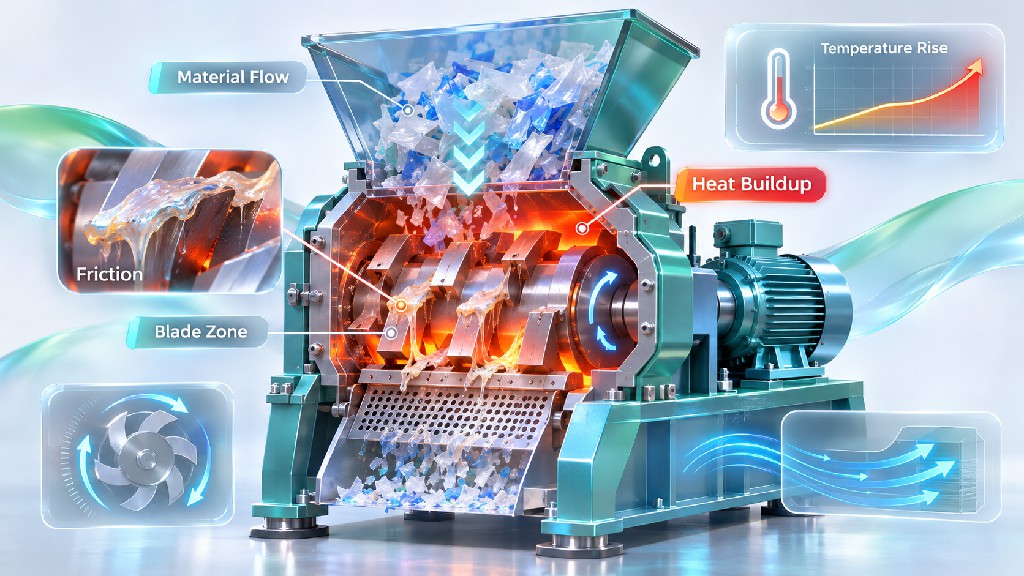
A hot knife by itself does not prove an abnormality. A cutting chamber converts some mechanical work into heat, and the motor, bearings, ambient air, and recently processed material all influence measured temperature. What matters is whether temperature is rising above a comparable normal run and whether the rise accompanies quality or reliability problems. A short batch of thick runners behaves differently from a long run of lightweight film, even when both are described as polypropylene scrap.
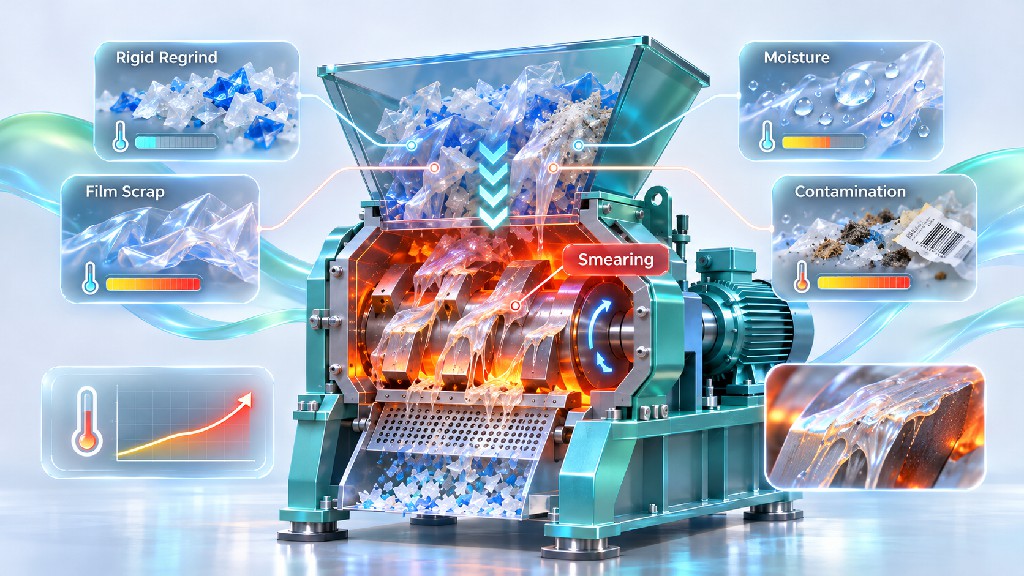
Operators usually detect heat problems indirectly. A clean flake becomes stringy, film starts sticking to a stationary knife, the screen accumulates fused fragments, or material exits warmer than it used to. Other signs include a persistent increase in drive current, a different cutting sound, extra fines, throughput decline, a hot spot near one bearing, and a change in regrind color or odor. No single symptom identifies the root cause. A high motor current can result from dull cutting edges, overfeeding, obstructed discharge, or a mechanical fault; a warm housing can reflect bearing friction rather than blade friction.
Establish a useful baseline by recording the resin or material mix, feed geometry, feed rate, screen aperture, machine speed, knife set identification, hours since sharpening, and ambient conditions. Compare the same machine under the same job. An infrared reading taken from a painted housing should not be compared casually with one taken from a shiny steel knife; surface emissivity, measurement angle, and distance can change the apparent result. When the process permits it, a contact probe or other validated measurement at a safe accessible point is more repeatable.
There is an important distinction between warm regrind and degraded regrind. A product can become soft, tacky, or smeared well below the published crystalline melting point because its formulation, local pressure, dwell time, and frictional contact govern behavior. Conversely, a surface temperature taken after shutdown may be much lower than the short-duration temperature at the moving cut. Do not use a single infrared number as evidence that no thermal damage occurred.
| Observable symptom | Plausible mechanism | First evidence to collect | Practical next step |
|---|---|---|---|
| Film wraps around rotor or sticks to bed knife | Poor shearing, excessive residence, wrapping geometry | Edge condition, gap history, wrap location | Inspect the cutting pair and approved film setup |
| Fused plastic on the screen | Retained particles, blocked holes, local rubbing | Screen blockage pattern, discharge performance | Check screen and material evacuation |
| Motor current climbs during the same product | More cutting work, feed overload, or mechanical drag | Current trend at matched feed rate | Separate process load from no-load mechanical load |
| Regrind contains more dust and fines | Repeated cuts, fragile fracture, dull edges, inappropriate speed | Sieve test, screen condition, edge photos | Correct cutting and escape conditions |
| Knife temperature rises immediately after sharpening | Wrong edge geometry, poor installation, incorrect gap | Grind record, dimensions, clearance map | Stop and inspect the installation |
| One end of the knife is hotter | Nonparallel knife seating, runout, or localized rubbing | Left/center/right gap and seat condition | Investigate alignment and the high point |
| Strong new vibration or metallic sound | Contact, loose fasteners, foreign object, bearing trouble | Vibration trend, inspection after isolation | Do not continue until the cause is resolved |
| Flakes are stringy rather than sharply cut | Excessive clearance or rounded edge on ductile feed | Cut-face samples, measured gap | Restore OEM cutting condition |
| Frequent overload trips on thick purgings | Excess bite, inappropriate chamber duty or feed rate | Feed dimensions, current event log | Reduce load or use approved pre-shredding |
| Hot outlet but normal knife condition | Material recirculation, discharge restriction, warm incoming feed | Chamber residence and outlet transport | Repair evacuation and evaluate feed temperature |
| Melted spots only on mixed feed batches | Lower-softening constituent or contamination | Material identification and separation records | Segregate and qualify the feedstock |
| Heat persists after new knives | Screen, machine alignment, bearings, airflow, or excessive load | Before/after comparison across operating conditions | Diagnose the full system, not the knife alone |
Most screened plastic granulators use a rotating knife set and fixed bed knives to shear a part into smaller pieces. Pieces too large to pass through the screen remain in the chamber and can be cut again. Each cycle introduces cutting work, impact, bending, surface sliding, and some aerodynamic or transport losses. The machine also generates heat in its drive, bearings, and other moving parts. The amount of heat retained in plastic depends on the incoming material temperature, how efficiently it cuts, how long it circulates, and how rapidly hot material leaves.
The desired event is a clean shear. Sharp edges support the material, concentrate cutting stress near the shear plane, and separate it without unnecessary crushing or stretching. When an edge becomes rounded, the machine must push the polymer farther before separation occurs. Thin film may fold instead of cutting. A thick sprue may be compressed and recirculated repeatedly. The extra mechanical work does not disappear; part of it becomes heat in the material and machine.
Friction heat is only one contribution. It is tempting to blame every hot blade on metal rubbing against plastic, but repeated deformation of the polymer, contact between particles, and screen retention also matter. Direct metal-to-metal contact between rotor and stationary knives is a more serious mechanical defect. The difference matters because adding cooling air cannot correct a knife collision, and buying a more heat-resistant blade cannot make a blocked screen discharge effectively.
Cumberland's technical guide, How to Choose a Granulator, identifies sharpness, knife angle, rotor speed, the cutting gap, and screen choice as interacting factors. It notes that excessive recutting can produce fines and that slower rotor speed may help some material escape rather than continue circulating. Those observations support a system-level diagnosis rather than a single-variable cure.
Consider a hypothetical machine that draws an additional 2 kW of electrical power after its knives deteriorate while feed rate and all other operating conditions remain comparable. That additional electrical input is 2 kWh over one hour, equivalent to 7.2 MJ. Not all of this energy enters the plastic; some is dissipated by the motor, drive, bearings, vibration, and air. Nevertheless, the example shows why even a seemingly modest increase in sustained power demand can create a serious thermal and energy-efficiency problem.
Do not translate those 7.2 MJ directly into a predicted polymer temperature rise. That would require the fraction of additional energy deposited in the plastic, actual mass throughput, mixture-specific heat capacity, moisture and phase behavior, air exchange, and thermal losses. A measured increase in motor current is a useful warning indicator, not a calorimeter. It is also not proof of sharpness: compare the current against feed rate, power factor if available, and no-load behavior.
A granulator can have correctly sharpened knives and still run hot if the product cannot leave. As the screen plugs, retained fragments circulate and suffer repeated contact. If extraction air is insufficient, regrind can accumulate below the screen and impede further escape. If an operator increases feed to compensate for falling output, the chamber becomes more congested and the condition can worsen. This feedback loop is common in soft-film handling and dirty mixed scrap.
Cumberland's size-reduction service tips specifically recommend maintaining appropriate airflow to evacuate regrind and checking the damper when material accumulates under the screen. Conair's plastics granulator maintenance guidance likewise emphasizes sharp knives, OEM-specified clearance, and inspected screens. These are practical preventive measures, not a promise that every heat complaint has the same solution.
A plastic granulator can retain dangerous stored energy even when the motor has been switched off. Rotors can coast, trapped material can release unexpectedly, pneumatic or hydraulic mechanisms can move, and sharpened edges can injure an operator who is merely inspecting a jam. Never reach through a feed opening, defeat an interlock, insert a hand-held thermometer into a running chamber, or attempt to feel whether a knife is hot. Never clean a screen, loosen a knife, or measure blade clearance while the rotor is powered or capable of moving.
Use the site's machine-specific energy-control procedure, with isolation, lockout/tagout as applicable, verification of zero hazardous energy, and controls for gravity, stored pressure, and residual rotor motion. In the United States, OSHA 29 CFR 1910.147 establishes requirements for controlling hazardous energy during covered service and maintenance. ANSI/PLASTICS B151.11-2021 addresses safety requirements for granulators, strand pelletizers, and dicers. Applicable national rules and manufacturer instructions may impose additional requirements.
If material is discolored, smoking, or giving off unfamiliar fumes, stop feed and execute the plant's approved abnormal-condition response. Avoid assuming that all odor is harmless plastic vapor. OSHA's technical manual on air contaminants notes that thermal decomposition of certain polymers can generate hazardous substances; it specifically associates hydrogen chloride with PVC. A qualified safety professional should determine appropriate ventilation, exposure assessment, and response procedures for the actual feedstock. A cooling experiment is never a substitute for controlling a fume hazard.
Rounded cutting edges increase the distance over which material is compressed or torn before separation. The consequences are especially visible on ductile film, woven sacks, thin-wall containers, and soft purgings: rather than producing a clean cut, the machine may stretch a piece, generate heat, and force it through the cutting zone again. On brittle feedstock, a poor edge may create excessive dust and unpredictable particle size instead. A sharper edge is often more valuable than a higher hardness number when the dominant problem is ineffective shearing.
A blade should be assessed as part of a pair. Rotor knives and bed knives cooperate across a gap; a new rotor set working against heavily rounded bed knives may still produce poor cutting. Also inspect whether one edge is slightly higher than the others, whether all knife lengths remain compatible after prior sharpening, and whether the fixed knife is clamped firmly against a clean seat. A correctly manufactured edge installed in a distorted holder can behave like a defective tool.
Evidence matters more than a fingertip test. Photograph the edge under consistent lighting, compare it with an approved new or freshly ground reference, inspect the cut surfaces of the regrind, and review current and throughput trends. Measure the knife dimensions against the OEM drawing and approved minimum regrind dimensions. Never run a fingernail or finger over an exposed edge to judge sharpness.
Cumberland's service tips state that dull knives and unsuitable gaps can increase vibration and current draw, and caution against sharpening below minimum knife height. Its advice to monitor motor current and vibration can be turned into a condition-based maintenance program, provided the line has a repeatable operating baseline.
Resharpen when wear is uniform, the substrate is sound, sufficient grinding allowance remains, the correct edge profile can be restored, and the OEM allows regrinding. Replace a cracked blade, a blade with unacceptable deep chipping, damaged mounting geometry, insufficient remaining section, or an edge that cannot be brought into specification. Investigate the installation before reusing a knife that failed immediately after grinding. A new blade will not survive an uncorrected collision or loose seat.
A geometry change is a separate engineering decision. A tough high-impact edge might be appropriate for thick purgings; a refined shear geometry might help flexible material. Neither should be improvised by changing the bevel freehand. The grinder or manufacturer must verify the finished profile, edge support, dimensional interchangeability, expected wear mechanism, and any balance implications. See GUANG CHUAN's plastic crusher blade selection guide for broader material and geometry trade-offs.
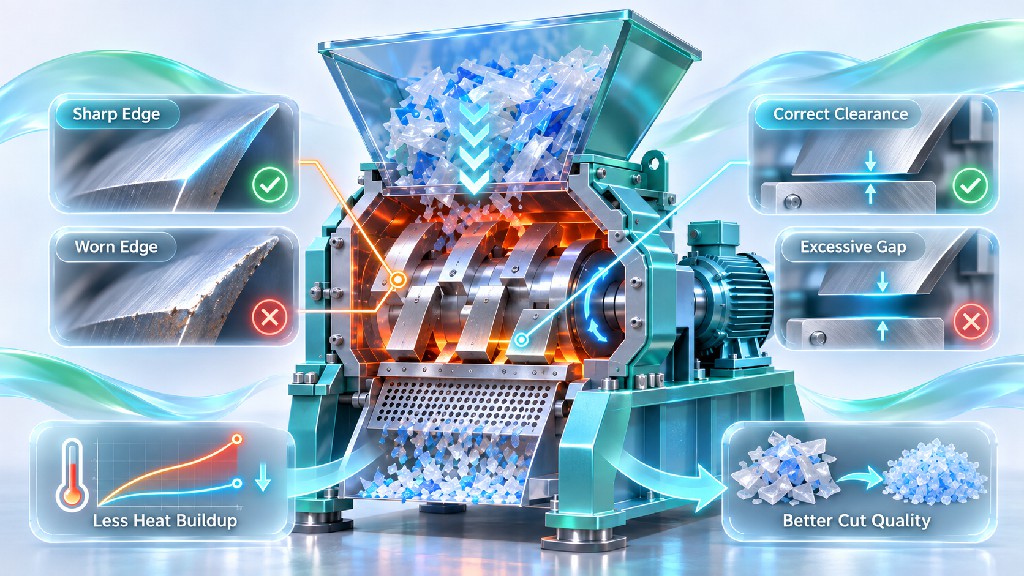
Cutting clearance is the distance between the moving and fixed cutting edges at their working approach. Excessive clearance lets flexible material deflect, bend, and tear instead of being sheared cleanly. It may increase recirculation and motor effort. Insufficient clearance can cause edge contact after thermal expansion, rotor deflection, inconsistent mounting, or normal dynamic movement. The result may be noise, impact damage, abnormal heat, and a serious risk of tool or machine failure.
There is no universal gap that cures overheating. A dimension useful for one rotor diameter, blade design, polymer, and bed-knife arrangement may be unsafe for another. Even within a machine family, different instructions may apply to film and thick sections. The objective is not the smallest possible gap; it is the clearance approved by the OEM for the actual construction and application, maintained consistently across all intended measuring points.
| Documented machine-specific example | Published knife clearance | How to use this information |
|---|---|---|
| Cumberland C1000/C1400 C Series, manufacturer service manual | 0.006–0.008 in (0.15–0.20 mm) | Example only for the identified machine family; verify the actual manual revision |
| Conair 8 Series granulators, as summarized in GUANG CHUAN's rotor/bed-knife guide | 0.15–0.25 mm | Identified model-family example, not a setting for all Conair machines |
| Shini SGF-26 / SGF-26E, as referenced in GUANG CHUAN's rotor/bed-knife guide | 0.10–0.15 mm | A different machine-family requirement; not interchangeable with the above |
| Any granulator with unknown model, rotor geometry, or prior modification | Do not infer a setting | Obtain the OEM document, machine identity, and verified knife drawing |
The Cumberland figure appears in its C1000/C1400 C Series service manual, while GUANG CHUAN's rotor-knives-versus-fixed-bed-knives technical article discusses distinct published OEM examples. These values show why mixing a supplier's generic rule of thumb with a specific equipment model is a bad troubleshooting practice.
Under the authorized lockout procedure, first establish that both knives are properly seated and that no chips, embedded polymer, or burrs are lifting the knife from its mounting surface. Identify the correct measurement position and rotor indexing method in the service manual. Some machines require a specified feeler gauge or shim, a defined rotor direction, and a reference to the highest projecting rotor knife. Others have a presetting fixture and different adjustment architecture. Follow that document rather than a generic online diagram.
Record measurements at every OEM-required location, commonly including both ends and any specified intermediate positions. Recheck after fasteners are tightened because tightening can shift the knife. Inspect all rotor blades, not only the one nearest the service opening. If one position consistently has a tighter gap, investigate seat straightness, knife height, rotor condition, bearing condition, and runout before starting again. GUANG CHUAN's blade-clearance adjustment article provides additional troubleshooting context; the governing setting remains the machine's own documentation.
If material is wrapping or smearing, do not automatically widen the clearance. Wider clearance may make ductile material bend and rub even more. If the knives are chipping, do not automatically close the gap. Narrower clearance could cause metal contact. The correct direction depends on the verified state and OEM requirements.
A screen is not merely a hole-size specification. It controls when a particle can leave the cutting chamber. If holes are obstructed by soft plastic, fines, labels, tape, or debris, an acceptable particle can remain in circulation and be cut or rubbed again. Excessive residence increases opportunities for heat generation and makes particle-size distribution harder to control. A knife replacement may briefly mask the symptom without restoring the rate at which material exits.
After safe isolation, inspect the screen from both sides. Record whether blockage is uniform or concentrated at one location. Uniform blockage may suggest unsuitable aperture, wet or tacky incoming material, excessive loading, or inadequate extraction. Localized deposits may point to uneven material flow, a hot spot, damaged screen geometry, or a gap problem at the corresponding position. Also check whether the screen is worn, cracked, distorted, or installed incorrectly; fitting an unapproved substitute can change the entire process.
The discharge route matters as much as the holes. Look for packed flakes below the screen, a plugged duct or cyclone, a full collection bin, poor vacuum transfer, obstructed filters, and damper settings that no longer match the line. A blocked air filter may lower conveying performance even though the blades are in excellent condition. Clean or replace components by the OEM procedure, restore the intended discharge conditions, and then repeat the same throughput test before changing knives.
A common but unwise response is to increase the screen holes dramatically merely to eliminate plugging. It may improve escape while producing regrind that no longer meets the downstream quality specification. Likewise, a finer screen can increase retention and recutting. The choice requires a compromise between acceptable particle distribution, required throughput, polymer characteristics, and the granulator's designed capacity.
Imagine a line producing a consistent HDPE regrind at a documented feed rate. Over several shifts, the operator notices that the motor draws more current, the screen acquires sticky deposits, and fewer kilograms reach the collection bin. There is no new metal-on-metal sound, and knife inspection reveals normal edge condition. The right first hypothesis is not automatically “the steel is too soft.” Verify whether the discharge is blocked, whether the screen is damaged or partially plugged, and whether the feed contains a new low-softening contaminant. When removal of a confirmed restriction returns the line to its baseline, the evidence favors a transport or feedstock cause rather than a blade-material defect.
The same logic applies to dust. Fines may rise because a product is cut too often while waiting to escape. However, a brittle material, sharp new blade, or unsuitable speed can alter the fines fraction as well. Always confirm the mechanism using material samples and machine observations rather than assigning blame by appearance alone.
Overfeeding can cause material to circulate, compact, and experience more contact before an effective cut. But “too much feed” does not mean only total kilograms per hour. Two feeds with equal mass flow can be very different duties: a steady stream of thin sprues versus occasional thick purgings may impose radically different instantaneous torque. A long flexible web can wrap around the rotor, while a rigid lump may interrupt cutting and trigger an overload. In both situations, the same average feed-rate figure can conceal a problem.
Start with the recommended capacity and feed dimensions for the exact machine. Record whether the line uses manual loading, a belt conveyor, a roll feeder, or automatic metering. Look at the frequency of peaks in motor current, not only the average. If peaks coincide with large pieces, segregate or pre-reduce the heavy items according to the process design. Cumberland's granulator FAQ describes shredding ahead of a granulator as a possible option for heavy-duty, high-volume material, rather than expecting every screened granulator to accept large parts directly.
For flexible film, the issue may be uncontrolled sheet width, folded bundles, roll tension, or poor traction. A dedicated film-feed system may meter material more consistently than bulk loading. For thick runner scrap, alternating feed batches or an upstream shredder may reduce sudden peak loads, but the decision must be validated against safety, throughput, and material specification. Never alter guarded feed mechanisms or attempt to push a jam through the chamber by hand.
Some scrap enters the granulator directly from a molding or extrusion process. Warm sprues, profiles, or edge trim have less temperature margin before softening than the same items after controlled cooling. A plant may believe the knife is suddenly generating more heat when the actual change was an upstream cycle-time adjustment or a hotter feed. Log the inlet material temperature safely and consistently, together with production source and dwell time before grinding.
Letting material cool appropriately before reduction may help, but simply storing hot scrap without ventilation or process controls can create new housekeeping risks. Follow the resin supplier's recommendations and the plant's cooling and handling design. If granulation must occur hot, the equipment selection and knife configuration should reflect that duty from the outset.
Rotor speed is often treated as a production lever: faster rotation appears to mean more cuts per minute and therefore higher output. The reality is conditional. Faster tip speed can increase cutting events, abrasion, noise, and the opportunity to recut particles. If discharge is limiting, additional cuts may mostly create heat and fines rather than saleable throughput. On the other hand, reducing speed too far can reduce shearing effectiveness, change feed bite, and overload the drive. A variable-frequency drive is not an invitation to operate outside an OEM-approved speed range.
Knife arrangement also matters. A slanted or cross-cutting knife pair can create a progressive, scissors-like cut instead of engaging the full blade width at once. In suitable geometries, that can reduce instantaneous cutting force and improve load distribution. The benefits depend on the machine layout, edge angle, length, and material. Cumberland's granulator-selection article discusses slant-knife configurations and the relationship between tip speed, fines, and granulate quality. Its granulator FAQ discusses water-cooled rotor designs for high-temperature duties.
Cooling features are appropriate only when matched to an engineered machine and process. Some applications benefit from designed air exchange, temperature-controlled components, or equipment specifically built for warm feed. However, improvised water sprays into an electrical machine, uncontrolled cold-air jets, or modifications to a rotor's internal passages can introduce corrosion, electrical hazards, condensation, dust transport issues, and imbalance. Do not use coolant as a workaround for knife contact, blockage, or feed overload.
If an engineering team proposes a cooling retrofit, it should document heat load, compatible materials, bearing and seal design, electrical protection, condensation risk, extraction arrangement, and the effect on downstream regrind moisture. Verify with the OEM and relevant engineering specialists. The first cooling strategy should ordinarily be to eliminate avoidable cutting work and restore reliable evacuation.
Plastic processors sometimes ask for a single temperature at which crusher knives become too hot. There is no defensible universal number. Different plastics have different softening, glass-transition, heat-deflection, melting, and degradation behavior. Even different grades of the same polymer can respond differently because of additives, recycled content, fillers, crystallinity, and moisture. A steel knife can remain mechanically safe at a temperature that damages the recycled material; conversely, a moderate external knife temperature does not exclude momentary hot spots in a thin film.
One useful reference is MatWeb's heat-deflection temperature overview, which explicitly says that values depend on polymer grade and reinforcement. Its illustrative average values at a 0.46 MPa test load include approximately 85°C for HDPE, 100°C for polypropylene, 70°C for PET, 98°C for ABS, and 140°C for polycarbonate. These are standardized heat-deflection examples, not crusher operating limits, melting points, adhesion thresholds, or safe exposure temperatures. A granulator does not perform the same loaded laboratory test, and its material may soften or smear under very different contact conditions.
| Feedstock | Typical heat-related concern during granulation | Diagnostic priority | Why a single temperature limit is misleading |
|---|---|---|---|
| PE / HDPE rigid containers | Smearing after prolonged recirculation; deposits at screen | Screen escape, cutting edge, incoming temperature | Grade, wall thickness, and additives change behavior |
| LDPE / PE film | Wrapping, stretching, tacky deposits | Film feed, knife pair, approved gap, residence time | Thin film can deform and stick at local contacts |
| PP sprues and molded parts | Warm, stringy regrind when shear becomes poor | Edge sharpness, load peaks, feed size | Homopolymer and copolymer grades differ |
| PET bottles or flakes | Fines, frictional warming, wear from contaminants | Screening, edge condition, grit and labels | Crystalline melting point alone says little about process quality |
| Rigid PVC profiles | Heat-sensitive discoloration or decomposition if overheated | Stop on abnormal fumes; examine cutting and safety controls | Formulation and stabilizers affect behavior; fumes need assessment |
| Flexible PVC products | Deformation, sticking, contamination-dependent deposits | Formulation, feed control, screen, knife geometry | Plasticizers and fillers vary widely |
| ABS runners | Rubbing, dust or smear depending on grade and geometry | Blade sharpness, feed temperature, regrind examination | Amorphous softening is not a single melting event |
| Glass-filled engineering plastics | Edge abrasion, rising load as wear accelerates | Wear rate, filler content, contamination, steel choice | Abrasive filler can dominate before thermal behavior does |
| Mixed post-consumer scrap | Unpredictable sticky pieces, odor, inconsistent granulate | Sorting, material identification, contamination mapping | Lowest-softening component may control the problem |
This matrix is a qualitative diagnosis guide, not a recommended temperature setting. Request the actual resin's technical data sheet, and do not confuse the nominal polymer identity with a verified formulation. If a mixed stream contains tape, hot-melt adhesive, multilayer packaging, or incompatible polymers, deposits on the blades may originate from the contaminant rather than the main resin. A knife coating cannot reliably solve unknown contamination in the feed stream.
PVC deserves special attention because heat-related discoloration or unusual fumes can signal a higher-risk condition. The correct response is to stop, assess the process, identify the resin, and follow ventilation and safety procedures; it is not to continue production while testing progressively higher knife temperatures. For occupational-exposure context, refer to OSHA's technical manual. For application-specific blade selection across PET, HDPE, PP, PVC, and ABS, see GUANG CHUAN's dedicated material comparison.
A rising housing temperature may be associated with the rotor rather than cutting. Worn or insufficiently lubricated bearings can introduce friction and vibration. Belt misalignment or unsuitable tension can waste energy and load the shaft. A damaged rotor seat can make one knife run too close to its mating bed knife, while a loose fastener can create impact and clearance changes. These problems are important because they may escalate from poor output quality to catastrophic mechanical failure.
One useful distinction is whether the machine shows abnormal electrical load with the cutting chamber empty under a permitted OEM diagnostic procedure. Persistent abnormal no-load current or noise points toward a drive or mechanical condition rather than the polymer alone. A normal no-load result does not prove the knives are correctly set; errors may become evident only under dynamic cutting forces. Authorized maintenance staff should inspect bearings, pulley systems, runout, rotor balance, mounting faces, and fasteners under the manufacturer's service requirements.
Do not try to diagnose a suspect bearing by touching the running frame. Use the machine's installed instrumentation or suitable noncontact monitoring from a safe location. Thermal cameras can identify relative hot spots, but they require consistent emissivity treatment and repeatable measurement points. Vibration trend analysis can be valuable, yet a sudden change must trigger equipment-specific checks rather than an unsupported assumption that blades are dull.
Likewise, a cracked knife or a repeated metal-contact event should not be addressed by grinding a small amount off the edge and resuming production. Preserve damaged parts, examine the counterpart knife and seat, and resolve the underlying cause. GUANG CHUAN's crusher blade chipping troubleshooting guide covers interactions among contamination, installation, hardness, clearance, and feed impact.
Successful troubleshooting is not based on finding one plausible cause. It is based on changing a justified variable and observing whether the same problem improves without creating a new one. A controlled test should use an approved operating window, stable feedstock, known knife and screen status, and repeatable measurements. Do not deliberately run equipment with unsafe knife contact, blocked discharge, or suspected hazardous fumes to obtain comparative data.
For an otherwise safe and approved process, choose a reference product and record its batch identification, weight, approximate feed size, resin type, moisture where relevant, source temperature, and screen configuration. Record average feed rate and variation, not just a shift total. Note knife maintenance history and the last verified clearance. If current temperature instrumentation is absent, select safe accessible measurement points and establish a written method before starting.
Compare operating periods under the same conditions. Record electrical data from the control panel or logged instrumentation rather than placing unqualified staff near live circuits. Collect representative regrind at fixed intervals; use a sieve or validated particle-size method when fines matter. Measure accepted usable output, not merely the amount of scrap loaded. Document stoppages and cleaning time, since a nominal increase in kilograms per hour can be erased by more frequent blocked-screen shutdowns.
| Test variable | Baseline record | Observation after corrective action | What counts as convincing evidence |
|---|---|---|---|
| Feedstock and batch | Polymer, additives, contamination, temperature | Same or deliberately controlled comparison | Material variation is documented |
| Knife condition | Set ID, last grind, visual inspection | Known inspected or approved replacement set | Edge condition and dimensions confirmed |
| Knife clearance | OEM spec and measured map | Rechecked after final tightening | All positions satisfy the correct OEM spec |
| Screen and discharge | Aperture, hole condition, airflow/transfer status | Clean and functioning system | No abnormal buildup or conveying restriction |
| Motor load | Stable current or measured power under matched load | Same metric and measurement method | Reduction is repeatable without reduced saleable output |
| Regrind temperature | Specified accessible measurement point | Same point and interval | Lower stable trend, not one isolated reading |
| Product quality | Accepted size range, fines, appearance | Same acceptance test | Quality meets downstream requirements |
| Useful throughput | Accepted kg/hour over defined period | Same averaging period | Productivity is stable or improved |
| Maintenance burden | Cleaning time, unplanned stops | Recorded post-change experience | Benefit persists across a representative production run |
Shift 1: Establish and preserve evidence. Under safe normal operating conditions, collect baseline observations, energy data, accepted throughput, material samples, and machine history. Stop if there is a hazardous condition.
Shift 2: Correct housekeeping and material-flow defects. With equipment properly isolated, inspect the screen, discharge, ducts, filters, and incoming feed classification. Document the specific correction rather than describing the task only as “machine cleaned.”
Shift 3: Verify mechanical condition. Check edge condition, seats, fasteners, bearings, and the actual OEM clearance procedure. If a replacement or regrind is necessary, install the approved set and record all relevant dimensional checks.
Shift 4: Re-establish a stable production comparison. Use a suitable consistent feed and the same accepted regrind specification. Confirm that unusual temperature, load, and noise symptoms have not returned.
Shift 5: Examine the difficult product. Once the safe baseline has been restored, evaluate the material that triggered the original complaint within the equipment's approved capacity. Watch for load peaks, wrapping, and residence-time problems.
Shift 6: Check repeatability. Compare results with another normal production period; confirm any improvement is not due to lower feed rate, changed material composition, or a different screen.
Shift 7: Approve corrective actions and monitoring limits. Agree on maintenance trigger points, responsible staff, spare-knife inventory, and objective criteria for calling the knife supplier or machine OEM.
This schedule is an illustrative project plan, not a fixed maintenance rule. Some plants can complete the evidence gathering over fewer shifts, while mixed-feed recyclers may need longer sampling. A properly documented stop condition always overrides the plan.

The best time to prevent overheating is when the machine is still producing acceptable regrind. Condition-based maintenance can reduce emergency stops without replacing knives on an arbitrary calendar date. Keep a simple log for each granulator: knife set ID, installation and grinding dates, processed resin and filler, approximate accepted tonnes, screen configuration, current or power trend, vibration observations, clearance checks, and reasons for service. A spreadsheet is sufficient if the team uses it consistently.
At the start of a production shift, inspect only those items accessible safely under the normal operating procedure: alarm history, material identification, extraction readiness, feed condition, and visible product quality. At planned isolated maintenance intervals, inspect the cutting edges, knife clamps, mounting faces, screen, belt system, and lubrication points according to the actual machine manual. After a new knife set or substantial service, perform any specified post-run gap and fastener checks. Do not copy another manufacturer's “weekly” or “eight-hour” schedule onto an unrelated machine.
Sharpening intervals should be derived from real performance and wear. A line processing clean polypropylene runners may maintain sharpness longer than a line handling mineral-filled scrap, contaminated bottles, or glass-fiber-reinforced molding waste. A fixed number of hours cannot reflect those differences. Create service thresholds around product quality, sustained load increase under matched conditions, approved edge wear, and the minimum allowable regrind dimensions.
Store spare knives in matched, clearly identified sets. Protect cutting edges during transport and storage; keep the drawing revision and material certificate associated with each batch. Regrinding should preserve edge geometry, knife-to-knife dimensions, and thermal control during grinding. A poor grinding job can create local overheating of the steel, edge microdamage, or unacceptable dimensional mismatch even if the surface looks shiny. Require inspection records from the grinding service, especially for high-value, heavily loaded knives.
| Responsible team | Owns the measurement or decision | Escalation trigger |
|---|---|---|
| Operators | Feed identity, alarms, visible regrind quality, safe observations | New odor, smear, jamming, high-load trend |
| Maintenance | Lockout, knife inspection, OEM gap, screen, bearings, mounting | Contact, loose seat, crack, unexplained vibration |
| Process engineer | Accepted throughput, residence behavior, quality, trial design | Heat persists with healthy machine and controlled feed |
| Purchasing | Blade drawings, grade, certificates, matched sets, delivery | Replacement dimensions or supply quality cannot be verified |
| EHS / safety team | Hazardous-energy controls, dust and fumes, fire response | Smoke, abnormal decomposition, unsafe access, exposure concern |
| Knife manufacturer / machine OEM | Blade capability, machine limitations, approved design changes | Repeated premature wear, chipping, unacceptable heat after verified setup |
A replacement knife can be the correct solution when the cutting edge is worn out, too thin after repeated grinding, mechanically damaged, made from an unsuitable material, or incapable of maintaining a stable geometry in the actual cutting duty. It is less likely to cure overheating when the sole problem is a plugged discharge line, an overly hot feed, or a failing bearing. An expensive steel grade does not replace the need for correct installation and stable operating conditions.
Common candidates for plastic crusher and granulator knives include wear-resistant cold-work tool steels such as AISI D2 / DIN 1.2379, related SKD11-grade options, and suitably specified Cr12MoV materials. Other grades can be more appropriate when impact toughness, abrasive filler, or specialized edge stability dominates. Even where a higher hardness promises abrasion resistance, an excessively brittle edge may chip in a contaminated or high-impact process. The buyer should request actual composition or grade documentation, appropriate heat-treatment requirements, acceptable hardness band, dimensional tolerances, and a drawing-controlled edge profile rather than purchasing on a nominal HRC value alone.
If the root cause is rounded edges after a reasonable amount of service, improve resharpening quality or assess a longer-wearing grade. If chipping occurs near a specific mounting point, inspect that position before changing steel. If film smears while edges are apparently good, verify cut geometry, feed presentation, screen escape, and OEM clearance first. If abrasive filler steadily wears the edge, ask the supplier to evaluate wear resistance while protecting against chipping. If matched new knives run hot immediately, investigate fit and setup rather than automatically ordering an even harder batch.
GUANG CHUAN manufactures industrial cutting tools and provides product information through its crusher blades category. For a primer on different cutting systems and why a rotor knife is not interchangeable with a coarse shredder cutter, see Crusher Blades vs Granulator Knives. A supplier can evaluate the blade; the machine OEM is the controlling authority for the machine's mechanical settings and safe operating limits.
Heat buildup creates costs beyond the visible price of a replacement blade. There may be extra electricity, greater fines, unusable or discolored regrind, screen-cleaning labor, production interruptions, extra grinding services, damaged knives, and reduced downstream processing stability. The right decision compares the cost of fixing a specific cause against the measurable cost of leaving it in place.
Consider a purely hypothetical example in which excess drag increases measured electrical input by 2 kW during 8 operating hours per day, over 22 operating days per month. The excess energy is 352 kWh/month. At an assumed electricity price of US$0.12/kWh, that is US$42.24/month. This is not an estimate of any GUANG CHUAN customer's actual consumption. It illustrates that electricity alone may be a minor portion of the financial impact.
Suppose the same site loses six hours of production per month to hot-screen cleaning and repeated stoppages, and its fully burdened, defensible contribution loss is an assumed US$180 per hour. The modeled interruption cost is US$1,080/month, before counting reject material, additional cleaning and maintenance, or any downstream quality claims. If a corrective project demonstrably avoids those losses, it may be worth substantially more than its power savings. However, use local accounting inputs and do not count the same labor or production losses twice.
| Hypothetical monthly cost element | Illustrative input | Worked result | Important qualification |
|---|---|---|---|
| Additional electricity | 2 kW × 8 h/day × 22 days | 352 kWh | Requires measured comparable power data |
| Electricity spending | 352 kWh × $0.12/kWh | $42.24 | Electricity price is an assumption |
| Downtime impact | 6 h × $180/h | $1,080 | Use real contribution loss, not arbitrary machine selling price |
| Extra unusable regrind | Actual rejected kg × verified net loss/kg | Site-specific | Do not invent a reject percentage |
| Additional knife service | Extra qualified grinds × full service cost | Site-specific | Include freight and labor as appropriate |
| Total avoidable cost | Sum of non-overlapping validated items | Site-specific | Compare against correction and validation costs |
A useful purchasing metric is accepted regrind tonnes between qualified blade services, measured alongside energy per accepted tonne and unscheduled downtime. A blade that costs less per unit but needs frequent grinding may have a higher lifecycle cost. Conversely, paying a premium for a new alloy without showing longer usable service life, better product quality, or lower maintenance burden is not an evidence-based investment. Run a controlled blade trial and evaluate the complete operating cost.
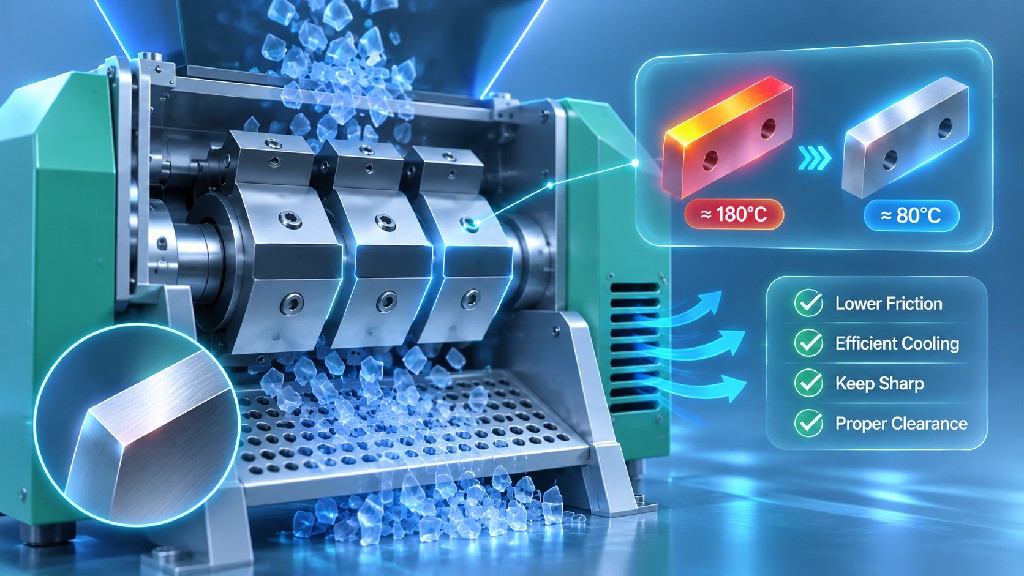
If inspection confirms that the blade design or condition is part of the problem, the quality of the quotation depends on the information sent to the supplier. “We need harder knives for melted plastic” is not enough. A competent replacement proposal should identify what the knife must fit, what it must cut, what has gone wrong, and which trade-offs matter. Include the existing blade drawing or a measurable sample where possible, while maintaining the plant's machinery safety and intellectual-property procedures.
Provide the machine manufacturer, model, manufacturing year or serial family where relevant, and whether the cutting system is a screened granulator, crusher, or slow-speed shredder. State rotor versus fixed knife position and quantities in the set. Supply length, width, thickness, hole quantity, hole positions, slot details, bevel configuration, edge orientation, datum surfaces, and mounting tolerances. Note the current grade and hardness if documented, but do not assume labels on an old box are certified facts.
Describe the material by actual grade or stream: PET bottle flake, HDPE container, PP sprue, flexible film, rigid PVC, ABS runner, glass-filled polymer, or mixed scrap. Include filler percentage if known, contamination risks, maximum part thickness, feed condition, planned throughput, screen size, and whether material enters warm from upstream processing. Attach photographs of deposits, edge damage, and cut samples, along with the before-and-after measurements recorded during troubleshooting.
| Information to supply | Why it matters to the blade proposal |
|---|---|
| OEM and machine model; current manual revision | Prevents inappropriate generic advice on clearance and installation |
| Blade position, quantity, and mounting drawing | Confirms fit, support, edge direction, and set compatibility |
| Actual material stream and contamination | Guides hardness, toughness, edge geometry, and wear assessment |
| Photos of smearing, chipping, or heat-affected residues | Separates gradual wear from collision, load, and feed problems |
| Measured gap and installation history | Identifies possible non-material root causes |
| Screen and discharge setup | Shows whether retention and evacuation may dominate |
| Baseline current, accepted output, and service interval | Makes performance comparisons measurable |
| Required certificates and inspection reports | Enables traceability and incoming quality verification |
| Desired deliverable: direct replacement or reviewed redesign | Defines the level of engineering review and approval required |
An effective RFQ distinguishes a drop-in equivalent from a proposed engineering change. A drop-in replacement should match the approved mounting geometry and specification. An upgraded edge angle or different knife section may require machine-maker approval, changes to the setup method, and a documented production trial. Ask for drawing approval, quality inspection, and clear treatment of any deviation before ordering a production batch.
When ready, share the information through GUANG CHUAN's contact page or review its crusher blade products. The company's About Us page provides background on its industrial blade and tooling manufacturing focus. The appropriate commercial request is a documented quotation and a technically reviewed proposal, not an unsupported guarantee that one alloy will eliminate heat buildup in every machine.
A delayed temperature rise often indicates gradual accumulation: screen holes begin plugging, a duct or filter restricts extraction, more pieces remain in the chamber, or the material feed changes during the shift. Knife wear generally develops over longer periods, although an existing blunt edge can make a heat problem more noticeable as loading increases. Check the trend under matched conditions and inspect screen, discharge, and feed composition before assuming a thermal defect in the steel.
Yes. Dull edges can compress, bend, and rub plastic instead of making a prompt shear, increasing cutting work and time in the chamber. This can contribute to local softening and deposits. But a melted film on a knife is not proof that the knife alone is responsible; sticky contamination, feed temperature, excessive recirculation, and an unsuitable screen may produce similar symptoms. Examine the whole system.
Not automatically. If clearance is excessive for the exact equipment, restoring the OEM-approved setting can improve cutting. However, an overly tight setting can create contact, noise, heat, and knife damage. Identify the manufacturer and model, inspect the knives and mounting faces, use the specified gauge procedure, and recheck all relevant positions after final tightening. Never borrow a number from another machine.
A larger approved screen aperture may permit particles to leave sooner, which can reduce recutting in some applications. It can also make finished regrind too coarse for downstream use. Screen performance depends on polymer, hole condition, blade geometry, airflow, and actual capacity. Remove blockages and confirm the product-size specification before considering a screen change with the OEM.
No. Hardness is related to wear behavior but does not fix blocked discharge, excessive feed, or poor alignment. A harder edge can be vulnerable to chipping when large impacts or foreign objects dominate. Select steel and geometry after documenting the actual wear mode, material composition, mounting requirements, and acceptable maintenance economics. The best knife is the one that performs reliably in the defined application.
There is no universal safe blade temperature applicable to all machines and polymers. A machine bearing may have one approved limit, the steel another, and a thermoplastic formulation a much lower process-quality threshold. Measured external metal temperatures also differ from instantaneous contact temperatures. Use machine OEM limits, the actual resin documentation, plant process acceptance criteria, and reliable baseline measurements to establish stop and investigation thresholds.
It can contribute useful trend information at consistent safe locations, but it does not directly measure the hottest short-duration contact point. Shiny metal surfaces, incorrect emissivity settings, reflections, and changing measurement distance can introduce error. Validate the method and pair temperature data with product samples, motor load, and visible deposits. Do not open a machine to take a measurement while it is running.
Sometimes engineered airflow or cooling helps with high-temperature duty, but it is not the first solution to a mechanical or cutting fault. Restore sharpness, correct clearance, unobstructed screen escape, and appropriate feed conditions. An OEM-approved cooling feature may then be evaluated if the process itself generates more heat than the product can tolerate. Avoid ad-hoc liquid cooling or guard modifications.
The interval varies with material abrasiveness, filler content, contamination, feed geometry, operating hours, steel, blade geometry, and the required regrind specification. Use documented inspection criteria and accepted production between services rather than a universal number of operating hours. Confirm minimum approved knife dimensions and matched-set requirements before grinding; replace knives that are cracked or no longer meet specification.
New knives do not guarantee proper seating, geometry, or clearance. Inspect whether the set matches the drawing, mounting faces are clean, fasteners are correct, and the complete rotor/bed arrangement has been verified to the OEM procedure. If those conditions are correct, investigate screen plugging, discharge restriction, warm feed, overload, bearings, and drive problems. Repeating blade purchases without isolating these causes is unlikely to be economical.
Provide the machine maker and model, knife drawing or complete measurements, rotor and bed knife quantities, material stream, fill or contaminant level, current blade grade if known, and photographs of the failure. Share the symptom history and objective process measurements, including clearance verification, current trend, regrind appearance, and service life. This gives the supplier enough context to quote a compatible set and flag a possible engineering issue.
When a plastic crusher or granulator runs hotter than normal, the fastest sustainable fix is usually a disciplined diagnosis, not a rapid purchase based on hardness alone. Confirm that the machine is safe, compare the symptom with its own stable baseline, inspect the condition and installation of both knife sets, verify the correct model-specific gap, and restore screen escape and discharge airflow. Then consider feed size, incoming material temperature, rotor speed, bearings, drive load, and the formulation of the plastic itself.
If the evidence identifies blade wear or a mismatch between knife design and process duty, a documented replacement proposal can deliver value. GUANG CHUAN can review application information for custom or replacement crusher blades; the correct purchasing path is to supply the blade drawing and operating evidence, agree on the required material and dimensions, and validate the result against accepted output, wear rate, energy use, and maintenance demand.
Next step: Prepare the machine model, knife dimensions, material description, and photographs of the deposit or failed edge, then request a technical quotation from GUANG CHUAN. A good solution should reduce the verified cause of heat buildup while protecting machine safety, finished regrind quality, and total operating cost.

Оставить сообщение
Отсканируйте в WhatsApp :

 Pусский