



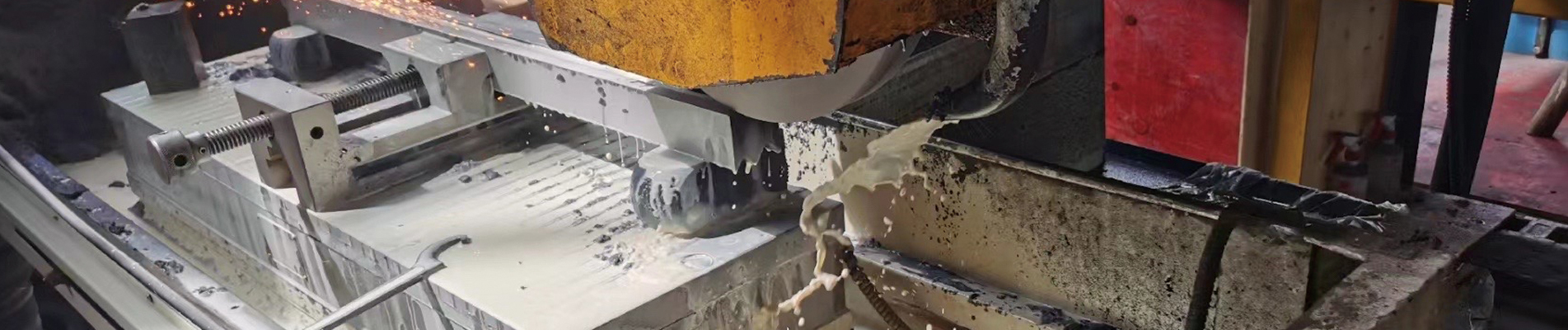

Crusher blades vs granulator blades is a comparison that sounds simple until a purchasing team discovers that two suppliers use different names for the same cutting system. A plastic processor may call its machine a crusher, an OEM may list it as a granulator, and a replacement-knife quotation may use both descriptions. The name alone does not tell you whether the knife will fit, hold its edge, or produce the required regrind.
The useful answer is this: crusher blades and granulator knives are not necessarily two distinct product families. In plastics recycling, a high-speed plastic crusher often works as a granulator, using rotating knives, stationary bed knives, and a perforated discharge screen. However, the term crusher blade is also applied to heavier primary-reduction equipment, while granulator knife often emphasizes controlled secondary cutting and regrind quality. Differences become meaningful only after the machine design, incoming waste, cutting geometry, and required output are established.
This guide helps recycling-plant operators, purchasing managers, maintenance engineers, and OEM buyers identify the correct recycling machine knives. It compares cutting principles, knife geometry, steel grades, blade clearance, screen performance, common failure modes, total cost, and the information needed for an accurate replacement quote. It also explains when the best purchasing decision is to request an identical OEM-compatible blade and when an engineered material or geometry change is justified.
Quick answer: For a screened, rotor-and-bed-knife plastic granulator, “plastic crusher blade” and “granulator blade” may describe the same replacement part. For a slow-speed primary shredder, tooth-like cutters, high torque, and coarse size reduction represent a different cutting duty. Buy by machine configuration and drawing, not by product name.
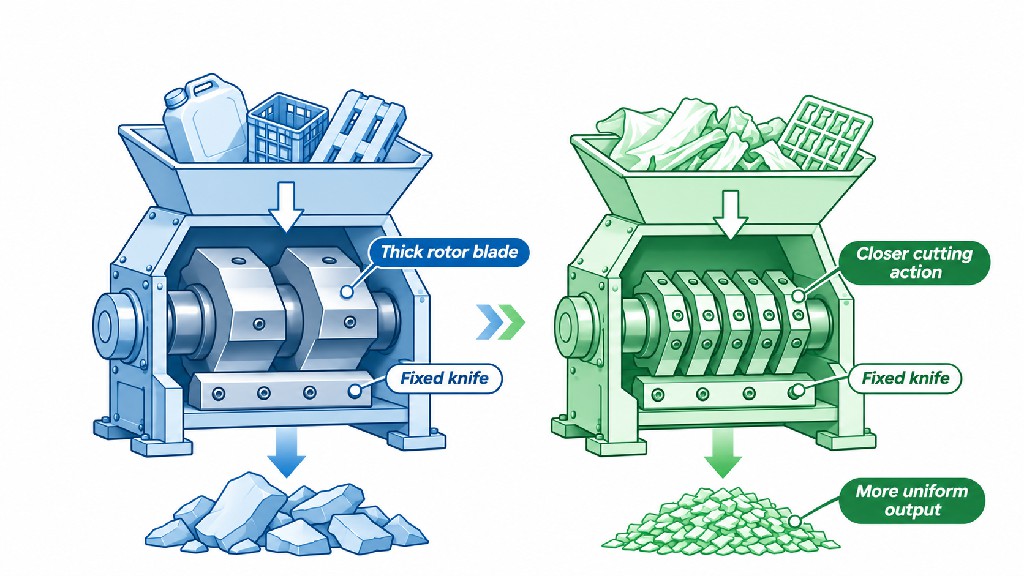
Before comparing alloys or unit prices, determine which machine architecture your production line actually uses. A generic advertisement may describe a “heavy-duty crusher” without revealing whether it has a screened granulating chamber or intermeshing shredder shafts. That missing information is more important than the advertisement's terminology.
| Comparison factor | Crusher blades / crusher knives | Granulator blades / granulator knives | What the buyer should verify |
|---|---|---|---|
| How the name is used | Broad commercial term covering many plastic crushing and size-reduction machines | Usually associated with a purpose-built granulator that cuts to a screened regrind size | Machine maker, model, cutting-chamber layout |
| Typical process role | May be primary, secondary, or single-stage reduction | Commonly final or controlled reduction before reprocessing | Feed size and downstream size specification |
| Cutting action | Could be rotor-to-bed shear, tearing, or coarse cutting depending on equipment | Frequently rotor-to-bed shearing with repeated cutting until discharge | Rotor/stator relationship, OEM drawings |
| Knife shape | Flat inserts, hooked profiles, claw designs, or robust cutters | Flat, angled, chevron, stepped, and other model-specific rotor or bed knives | Actual outline, bevel, holes, datum faces |
| Screen relationship | Not guaranteed by the word “crusher” | Typically includes a screen that helps control discharged particle size | Screen presence, hole geometry, wear condition |
| Performance priority | May prioritize feed acceptance, impact tolerance, or bulk reduction | Often prioritizes consistent regrind, low fines, and stable throughput | Accepted output, contamination, knife life |
| Steel selection | Alloy chosen around impact, abrasion, geometry, and process | Alloy chosen around wear, edge stability, regrind quality, and process | Certified grade, heat treatment, finished hardness |
| Interchangeability | Sometimes identical; often not. Even blades with the same length and width may have incompatible mounting or edge geometry. | Part number or controlled dimensional comparison | |
The Polymer Machinery Manufacturers and Distributors Association guide to granulators describes a conventional granulator using a rotor, stationary knives, a screen box, and a collection system. This is a useful industry framework, but not a declaration that every machine sold under the word “crusher” uses exactly the same arrangement.
Machine naming varies with geography, application, equipment manufacturer, and supplier tradition. In one factory, the equipment beside an injection molding press is called a plastic crusher. In another, a very similar machine is called a beside-the-press granulator. Sales catalogs may add the words grinder, recycling crusher, or granulating mill. This variation creates practical problems when sourcing an unbranded replacement knife from a photograph.
There is nevertheless a useful functional distinction. A primary shredder is commonly selected for larger, difficult, or bulky feedstock and may use low-speed, high-torque shafts with cutters that pull or tear the material. A granulator commonly uses a rotating knife assembly against stationary knives, reducing the material further until it can exit through a screen. A pulverizer serves another duty again, typically producing much finer particles or powder with a different comminution mechanism. Actual machines can combine these duties or depart from these descriptions.
The important question in a purchase order is therefore not “Are crusher blades stronger?” but “What cutting forces, mating edges, supports, and output constraints does this installed machine impose?” The answer can be found by documenting the cutting chamber and its existing knife arrangement.
A common plastic crusher has a motor-driven rotor holding several replaceable knives. The rotating edges pass close to fixed bed knives mounted in the chamber. Material is cut repeatedly, and pieces small enough to pass through the installed screen leave the chamber. Mechanically, this is also a granulation process. The terms are overlapping descriptions of the equipment, not proof of separate metal compositions or universal design standards.
For example, GUANG CHUAN lists both conventional crusher blades and heavy-duty granulator blades for plastic lump and purge crushing. That product-family overlap reflects real buyer language: the correct selection still depends on intended service and dimensions. A supplied photo should be the beginning of technical identification, never the entire acceptance basis.
The wording matters most when an engineer needs a precise output, an OEM buyer is matching a replacement, or a recycler is trying to reduce downtime. A blade described only as “crusher knife, D2” lacks essential information: whether it is a rotor knife or fixed knife; whether it has a handed bevel; whether it needs a clearance-setting slot; whether its seat is flat; and how its finished cutting edge aligns with the mating knife.
Confusing the terms can lead to an avoidable wrong shipment. A similar-looking blade may be impossible to mount, may position the cutting edge too far into the chamber, or may require a regrinding procedure the plant cannot perform. Purchasing specifications should identify both the commercial name and the engineering function. A robust part description reads like “rotor knife for [manufacturer/model], position A, drawing revision B,” followed by measured dimensions, steel grade, and requested quantity.
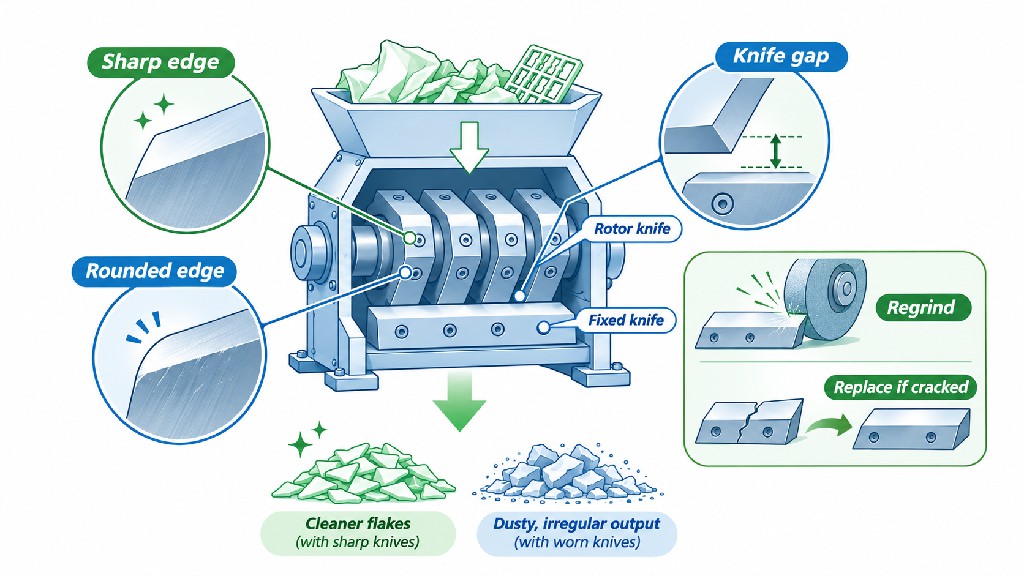
In a conventional screened granulator, cutting occurs as the rotating knife edge moves past a stationary bed knife. The rotating element carries the material toward the fixed edge; the narrow clearance allows a shearing action rather than simply bending a plastic piece. Each knife has a distinct structural job. The rotor knife must retain a sharp edge while experiencing repeated cyclic loading. The bed knife must remain securely seated, maintain its reference position, and cooperate along the cutting length.
Some machines use straight rotor knives; others use staggered or chevron arrangements that distribute engagement progressively along the blade. A chevron design may reduce peak simultaneous cutting load for a particular machine, but the performance depends on rotor construction, feedstock, cutting width, and bed-knife geometry. It is unsafe to claim that a blade profile alone guarantees a specific power saving or production increase.
Cumberland's C Series granulator operating manual describes a balanced rotor, bed knives, and a screen that retains material until it is small enough to discharge. This also illustrates an important procurement principle: a replacement knife is part of an engineered assembly. Its mounting and working edge must be evaluated together with the other components.
In a screen-equipped granulator, perforations act as a classification barrier. A particle may leave the chamber once its geometry and orientation allow it to pass through an opening. The nominal screen-hole diameter is therefore not an absolute maximum dimension for every discharged flake. Long narrow fragments can pass in particular orientations; flexible films may fold; wear and damage can change the screen's effective behavior.
Granulate quality depends on screen area, hole pattern, rotor design, blade sharpness, feeding rate, residence time, and discharge conveying. Specifying a smaller opening can increase recirculation and energy use and may cause heat or excessive fines if the cutting system is poorly matched. Conversely, changing blade steel will not by itself solve a product-size problem caused by a damaged screen or ineffective evacuation.
A large primary shredder may use hooked cutters or cutting discs that seize bulky components at relatively high torque. The primary goal can be to make bales, thick-walled items, or mixed articles manageable for a downstream separator or granulator. Its cutters may encounter intermittent impact, bending loads, and contamination. That duty can place greater value on toughness and resistance to catastrophic cracking than on maintaining a fine cutting edge.
Do not transfer assumptions about a high-speed granulator's shearing gap, knife bevel, or hardness to a low-speed shredder without reviewing the machine drawings. The geometry and failure mechanisms can differ materially. Likewise, the term “heavy-duty crusher blade” does not automatically mean a slow-speed shredder cutter; some high-speed granulators also process thick purgings and need robust blade bodies.
Bulky molded products, plastic purgings, thick pipe, runners, sheets, bottles, woven bags, and films behave differently when introduced to a cutting chamber. A heavy thick-walled component can deliver a sudden load, while soft film may fold, stretch, or wrap around a rotor. Feed length, wall thickness, temperature, contamination, and method of feeding matter as much as the polymer name. A purchasing request that states only “PP plastic” is incomplete.
For compact injection runners, a properly specified screened granulator may provide the desired regrind in one step. For large waste containers or thick production purges, primary reduction may be required first. The knife supplier should know whether feedstock enters intact, pre-cut, shredded, or through a controlled feed roll. These facts help determine edge strength and profile without guessing from a product photograph.
A first-stage crusher may be judged on whether it reduces bulky objects to transportable pieces without jamming. A fine granulation stage may be judged on a repeatable size distribution, low dust fraction, acceptable bulk density, and stable reintroduction into a manufacturing process. The two tasks may be performed by the same machine when feedstock is suitable, but their acceptance tests are different.
Ask what the downstream operation requires: a maximum oversize percentage, a fines limit, a clean polymer stream, a consistent feed to washing, or acceptable molding performance. Report the actual test method and sampling point. Describing regrind as “uniform” without a particle-size test, contaminant specification, and production-rate context is not sufficient evidence.
Flat, diagonal, chevron, claw, and hook profiles have different contact patterns. The correct profile depends on the OEM rotor and intended engagement, not the visual appeal of a product photo. A straight edge is not universally superior for rigid plastic, nor is a claw automatically the answer for every film application. Materials that wrap can also require feeding and discharge changes that no knife edge can solve alone.
Before changing geometry, compare the installed knives with the original manufacturer drawing. The effective cutting edge may be positioned asymmetrically, have a compound bevel, or be designed to work with a particular fixed knife. A small change to the edge location can change clearance over the entire cutting width.
The word “crusher” does not establish a fixed rotor-speed class. Motors may be geared or belt-driven; nameplate motor speed is not necessarily actual cutting-rotor speed. Higher knife tip speed can change impact severity, cutting frequency, heat generation, and throughput, but the outcome also depends on mass, balance, number of knives, and feeding conditions.
When an application needs greater impact resistance, the answer is not automatically a harder blade. Very hard steel can sacrifice resistance to edge chipping or gross fracture, depending on alloy and heat treatment. A technically responsible knife specification balances wear resistance with toughness for the real loading pattern. Record actual operating range and observed overload events before selecting the steel.
Clean in-house sprues may wear blades mainly through repeated polymer cutting and filler content. Post-consumer waste can introduce soil, labels, glass, embedded metal, or other materials. Glass-fiber-reinforced polymers can be highly abrasive even when the stream is carefully sorted. Abrasive service can favor a more wear-resistant grade, while intermittent metal strikes create a different risk of edge fracture.
High hardness cannot compensate for poor contamination control. Metal detection, sorting, suitable magnets, and appropriate upstream separation may prevent more damage than an expensive alloy upgrade. Selection must consider whether the problem is gradual dulling, abrasive grooving, tiny edge chips, or sudden fracture. Each points toward a different corrective action.
A replaceable knife should be judged partly by how it can be maintained. Some stationary knives are designed with reversible edges; others have a single working edge. Some rotor knives permit repeated flat-surface regrinding, while others lose essential cutting position as material is removed. An exact replacement must respect the OEM's minimum usable dimension, adjustment range, and permitted sharpening geometry.
Compare not only initial price but also the usable edge count, grinding allowance, mounting repeatability, and local access to suitable grinding equipment. A cheaper blade can become expensive if each removal demands difficult realignment or if grinding removes too much stock.
Two knives specified as 300 × 80 × 20 mm may still be incompatible. Their bolt pitch, hole diameter, counterbores, slots, bevel hand, flatness, datum geometry, and edge exposure may differ. Conversely, identical OEM-compatible knives could be marketed under crusher, grinder, or granulator categories. Dimensioned drawings and inspection requirements solve this confusion.
For any repeat order, keep a controlled part number, drawing revision, heat or material identification, finished hardness target, accepted measurement records, and installation feedback. Reliable repeatability is more valuable than a broad statement such as “precision-made high-quality blades.”
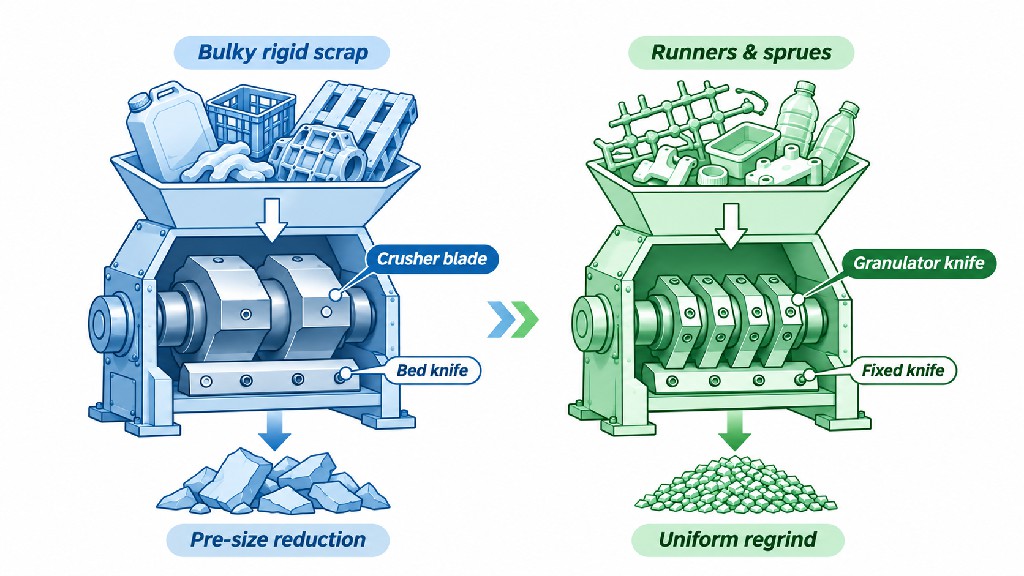
Material specification is central to crusher knives vs granulator knives, but alloy labels are only the first layer of a correct decision. Steel chemistry, manufacturing route, heat treatment, tempering, final grinding, operating temperature, edge thickness, and contamination all determine real cutting performance. Two knives made from nominally similar steel may behave very differently if these variables differ.
Buyers should also be careful with international grade names. AISI D2 and DIN 1.2379 are common cross-reference designations, and JIS SKD11 is frequently treated as a close corresponding grade. That does not eliminate the need to check the actual material standard and mill certificate. China's Cr12MoV is a related cold-work tool steel, but it should not be asserted to be chemically identical to D2 in every specification.
| Material family | Engineering strengths | Limits or caution | Potentially suitable duty | What to request |
|---|---|---|---|---|
| 9CrSi and similar lower-alloy tool steels | Can be economical and machinable for less demanding knife designs | Lower wear potential than selected high-alloy grades under abrasive service; performance depends on treatment | Clean, moderate-duty streams after OEM approval | Exact grade, target hardness, regrind plan |
| Cr12MoV | Wear-resistant cold-work tool-steel option used in industrial knives | Not an automatic one-for-one equivalent for every D2 drawing or heat treatment | Selected crusher and granulator applications | Certified chemistry and finished hardness |
| D2 / 1.2379 / closely corresponding SKD11 | Strong abrasive wear resistance and established heat-treatment knowledge | Chipping and cracking resistance can be limiting during shock loading | Many conventional recycling and granulating operations with controlled impact | Grade traceability, heat treatment, edge geometry |
| Modified cold-work tool steels such as DC53 | May offer a different wear/toughness balance when correctly processed | Marketing claims and nominal hardness alone cannot prove service-life advantage | Applications where standard steel shows a documented failure mode | Supplier-specific data, comparative trial, acceptance criteria |
| High-speed steel (specific grade required) | Selected grades provide useful hardness and hot-hardness characteristics | Cost, brittleness, grindability, and service relevance vary substantially by grade | Specialized cutting demands when justified by actual performance | M2, M42, or other exact grade; test plan |
| Cemented carbide / carbide-tipped design | Excellent potential abrasion resistance for suitable cutting and support geometry | Brittleness, joining design, impacts, and repair economics can dominate | Specialized abrasive duties with controlled contamination and approved construction | Carbide grade, attachment method, impact limits |
D2-family steels are common choices because they can provide good abrasive wear resistance. The published Uddeholm Sverker 21 material information explicitly identifies the grade with AISI D2 and EN 1.2379 and describes its strong wear resistance alongside more limited chipping and gross-cracking resistance. This combination explains why D2 may work well in a clean granulation system but can still fracture when exposed to heavy shocks or foreign metal.
For a granulator with predictable feed and consistent shearing geometry, retention of a stable cutting edge can justify a wear-resistant steel. For an overloaded or poorly protected machine processing irregular solid lumps, the more urgent need may be better feeding, removal of contaminants, or a different toughness balance. In neither case should a buyer choose material based on Rockwell hardness alone.
Suppliers sometimes group Cr12MoV, SKD11, and D2 under one pricing or marketing category. That shorthand can be convenient, but an engineering purchase order should define what is actually permitted. Specify the reference material standard and whether alternatives need written approval. If substituting one grade, ask how differences in chemistry, carbide distribution, hardening response, and achievable toughness affect the installed edge.
At minimum, the quotation should identify the material that will be delivered, not merely the material that could be supplied. The test certificate and finished-part inspection must agree with the purchase order. A broad promise such as “D2 or similar” is not adequate when repeatable performance matters.
High-speed steel is not a single material. Different HSS grades vary in alloy content, heat treatment, abrasion resistance, toughness, and cost. The phrase “HSS granulator blade” provides too little information for a technical comparison. If the proposed upgrade is to a specific HSS grade, compare its edge stability, sensitivity to chipping, and grinding requirements with the current blade under the same processing conditions.
Carbide has a different cost and failure profile. It can offer valuable wear resistance in appropriately engineered applications, but large impacts and poor edge support can turn a theoretically durable material into an expensive failure. Carbide-tipped knives also require careful attention to joint integrity, edge support, grinding practice, and the effects of thermal or mechanical loading. Do not substitute solid carbide for steel without a machine-specific engineering assessment.
Industrial catalogs commonly show finished tool-steel granulator blades around the high-50s to low-60s on the Rockwell C scale. For example, a published commercial granulator-blade guide describes D2/SKD11 knives in approximately the 58–62 HRC range. That interval demonstrates what manufacturers may offer; it is not a blanket operating requirement, a guarantee of toughness, or a recommendation for every blade profile.
A finished hardness target must be chosen alongside grade, cross-section, cutting-edge geometry, service temperature, and expected impact. Report the specified value or band, test method, testing location, and allowed variation. A nominal 60 HRC result does not validate steel chemistry, absence of grinding burns, flatness, or edge integrity.
Material-selection rule: If the current edge wears smoothly and progressively, first investigate abrasion and the potential benefit of a wear-resistant grade. If it chips suddenly, investigate impact, contaminants, clearance, support, and heat treatment before increasing hardness. If it cracks through the blade body, stop operating the machine until the equipment and knife design have been assessed.
A replacement order should start with a controlled drawing whenever available. Dimensions written on packaging may identify the envelope size but leave out essential mating features. Whether you are replacing a plastic crusher blade or a granulator blade, the machine only recognizes actual mounting and cutting geometry—not the label on the carton.
The rotor knife mounts on the moving cutting element; the stationary knife, also called the bed knife or stator knife in many catalogs, mounts to the chamber. Both contribute to the cut but may have different outlines, contact faces, regrinding directions, and quantities. Ordering five rotor knives because the machine contains five total cutting edges is an easy way to create an incomplete maintenance kit.
Record the number of rotating knives, the number of fixed knives, and any differences between their positions. In machines with multiple knife lengths or asymmetric stations, label every position and do not assume a single part can be installed everywhere. Reversible edges should be shown clearly on the drawing. Their usable count is a matter of design, not a universal product feature.
The working bevel determines how the knife penetrates or shears the material and how much support remains behind the edge. A comparatively acute bevel can help cutting of certain thin or soft materials, but it may leave a fragile edge under high impact. A more supported edge may resist damage in another duty yet increase cutting force if unsuitable for the material or cooperating blade.
There is no responsible universal angle covering PE film, PET bottles, glass-filled engineering plastics, and thick purgings. Some supplier catalogs show broad ranges, but the correct angle is determined by OEM geometry and an approved application-specific trial. Record whether the bevel is single-sided, double-sided, compound, or handed. A blade installed with the wrong bevel direction may be unsafe even when its mounting holes line up.
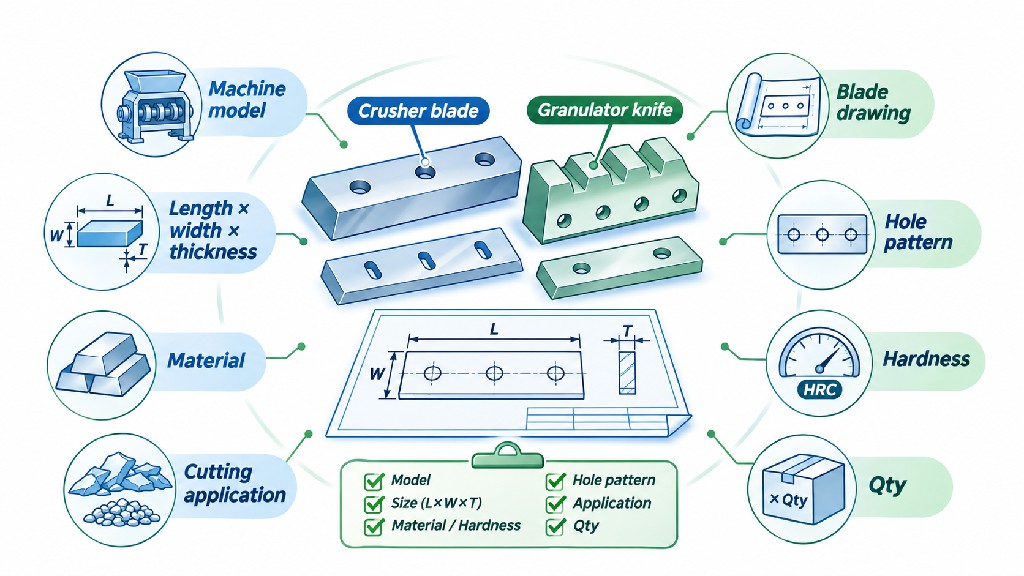
A dimensioned RFQ should specify overall length, width, thickness, mounting-hole diameter, hole-center coordinates, any countersink or counterbore, slot radius, bevel position, and all critical reference faces. A U-slot design may permit an adjustment that a round-hole blade does not. If the blade is fastened against a stepped or recessed support, the step geometry is as important as the outer dimensions.
Whenever a used sample has been reground, its current width may be smaller than its original nominal size. A direct copy of the worn part can produce an undersized replacement. Reference the original drawing or measure an unused knife if possible; otherwise identify which dimensions may have changed through service and verify them against the machine.
Even an alloy with excellent wear resistance will cut poorly if the knife sits at an angle because the mounting face is distorted or the seat has debris. Flatness, parallelism, grinding quality, and edge position directly influence the installed working gap. These requirements should be dimensioned and toleranced in relation to meaningful datums on the drawing.
Do not copy impressive-looking micron tolerances from unrelated catalogs. Instead identify the feature, allowed variation, measurement method, and reason it matters. If the machine cannot physically maintain a tighter installed tolerance, spending money on tighter blade-only inspection might not improve the finished granulate. What matters is the complete assembled cutting relationship.
Knife clearance is the relative gap between moving and stationary cutting edges at a specified position and operating condition. Screen size refers to the openings controlling discharge from a screened chamber. These are separate features. A sharp knife with excessive clearance may bend or tear material; a correctly adjusted knife paired with an unsuitable screen may still produce unacceptable output.
Some online charts assign one gap to rigid plastics and another to films, but polymers alone cannot define a complete machine adjustment. Rotor diameter, length, bearing condition, knife thickness, feedstock behavior, thermal changes, and the manufacturer's mechanical design all affect the acceptable clearance. Set and verify the gap using the exact OEM procedure, including the locations at which it must be measured.
As a concrete example rather than a universal rule, the Cumberland C1000/C1400 manual describes a standard rotor-to-bed knife gap of 0.006–0.008 in. (about 0.15–0.20 mm) for those machines, with larger settings permitted for certain heavy-section material conditions. That specific instruction is useful evidence that gap depends on duty, but it must not be copied into an unrelated crusher or granulator without manufacturer approval.
When replacing blades, cleanliness and mechanical condition matter. Check the mounting seats, correct bolts and tightening procedure, knife exposure, rotor runout or alignment concerns, and whether the installed geometry falls within the machine's approved adjustment range. A paper gauge or feeler gauge procedure, if the OEM specifies one, must be performed only under the required isolation and rotor-locking conditions.
A screen-hole specification is commonly reported in millimeters. However, a 10 mm round opening does not mean every particle has a maximum length of 10 mm. Long strips may orient through an opening, while a larger but flat particle may remain in the chamber for repeated cutting. This is especially important when comparing rigid flakes with thin flexible film.
Ask for measured particle-size distribution and fines content using a documented sampling method rather than interpreting screen size as the complete regrind specification. Verify screen wear and missing sections, and examine whether the discharge system evacuates granulate effectively. Material that remains in the chamber longer than intended experiences more cutting events, which can increase heat and fines.
Suppose the finished flakes have increased fines content. It is tempting to specify a more expensive blade. But the underlying cause may be an undersized screen, discharge blockage, feeding instability, or a misaligned fixed knife. The same warning applies to rising motor current. It may indicate dull edges, but an overloaded feed or mechanical problem can create a similar symptom.
GUANG CHUAN's technical article on adjusting blade clearance for consistent plastic shredding output discusses how incorrect clearance can produce stringy fragments, increased recirculation, and abnormal load. Use that guidance as a troubleshooting starting point, then return to the exact equipment manual for approved measurements and settings.
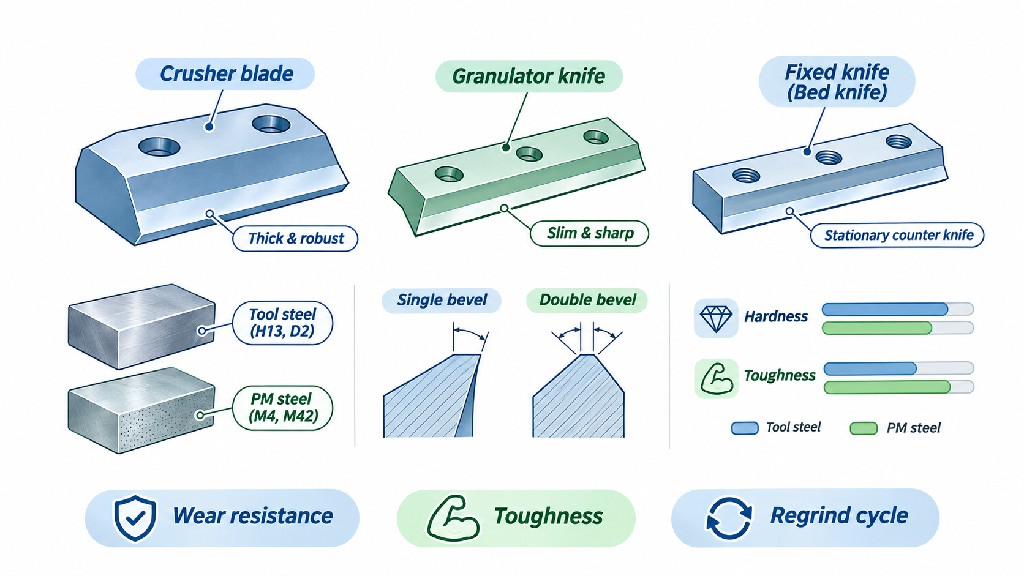
Selection becomes easier when the feedstock is described in operational terms: polymer, shape, thickness, filler, contamination, inlet size, temperature, feeding method, and desired final product. The following recommendations are engineering starting points, not universal machine settings.
| Material stream | Main cutting concern | Likely system approach | Blade question to resolve |
|---|---|---|---|
| Clean PP/PE injection sprues | Stable regrind with economical maintenance | Beside-the-press or central screened granulator where suitably sized | Exact rotor/bed knife set, approved edge geometry |
| PET bottles and rigid containers | Variable feed shape; labels, caps, or contamination | Dedicated screened cutting system or upstream reduction as needed | Cutting profile, foreign-object control, wear balance |
| PE film and woven bags | Stretching, wrapping, irregular feed | Feed-control and rotor design suited to flexible materials | Knife sharpness, anti-wrap behavior, clearance compatibility |
| Thick plastic purgings or lumps | Intermittent peak loads and jamming | Robust granulator or staged pre-reduction | Toughness, edge support, approved machine load |
| Glass-filled PA, PC blends, reinforced scrap | Abrasive filler wear plus possible edge damage | Controlled feed, suitable wear-resistant knives, monitored maintenance | Actual wear mechanism and qualified material grade |
| Post-consumer mixed plastic | Variable composition, grit, hard contamination | Sorting and detection followed by suitable staged reduction | Impact tolerance, contamination prevention, repair strategy |
| Sheet and thermoforming skeletons | Long flexible sections, continuous feeding, recirculation | Proper infeed and granulator geometry | Knife layout, feeding method, screen/discharge match |
When feedstock consists mainly of clean, known polymers from a single process, the objective may be to return consistent regrind to molding or extrusion. Here, knife life and repeatable particle quality matter more than the ability to survive unknown foreign objects. The baseline can often remain the original rotor and bed knife profile, with a correctly certified tool steel and controlled grinding procedure.
Keep polymers separated where processing requirements demand it. A blade specification cannot solve mixing of incompatible resins or contamination introduced by the collection system. Confirm whether regrind will be blended at the press, stored centrally, or sold, because the acceptable size distribution and fines level may differ.
PET bottle streams can combine rigid walls with caps, labels, dirt, and other components. Knife geometry must handle the actual feed, while screens and downstream washing or separation influence the useful product quality. A blade that stays sharp but fails after an occasional metal strike may not be economical in a poorly protected stream. Upstream separation and an agreed wear-inspection schedule are therefore part of the cutting-tool strategy.
For an existing PET granulator, ask whether repeated damage follows the same knife location. Localized failures may reveal mounting, bed-knife, or chamber problems rather than an inherently unsuitable steel. Comparing failed knives from different stations under the same input stream is more informative than comparing catalog hardness figures.
Flexible materials can stretch and wrap rather than fracture cleanly. A sharp edge and suitable rotor-to-bed relationship help, but effective feeding and anti-wrap geometry can be equally important. If the knife cannot grip or carry material consistently, the first correction may be infeeding or rotor configuration rather than harder steel.
For this reason, a generic “heavy-duty crusher blade” should not automatically replace a model-specific film granulator knife. The cutting angle, engagement pattern, and clearances may have been designed around film behavior. Preserve that geometry unless an approved trial demonstrates a better alternative.
Thick production purges deliver higher local resistance and may require a staged process or a granulator specifically rated for the duty. An apparently stronger blade cannot increase the mechanical design limits of a rotor, bearing, chamber, or drive. Glass-filled plastics add abrasive wear and may demand a different alloy or maintenance frequency, but the best option depends on the balance between progressive wear and shock damage.
If a knife repeatedly chips at the same edge location during purge cutting, check the feed geometry, overload history, clearance, bolt condition, and possible foreign objects before increasing hardness. GUANG CHUAN also covers this diagnosis in why plastic crusher blades chip during recycling operations.
Knife failures are not all material failures. The same visible symptom can result from incorrect mounting, a damaged bearing, insufficient clearance, contamination, or a change in the plastic feed. A disciplined diagnosis separates what is observed from what is assumed. It also prevents buyers from solving every problem by purchasing a more expensive alloy.
| Observed symptom | Possible causes | First verification | Potential action after diagnosis |
|---|---|---|---|
| Gradual, uniform edge rounding | Normal abrasion, filled polymer, extended service | Compare accepted output and edge condition over operating hours | Resharpen within allowance; evaluate wear-resistant grade |
| Small chips concentrated at one position | Hard contaminant, local contact, loose support, uneven gap | Inspect mating knife, mounting seat, clearance, feed incidents | Correct underlying issue; replace damaged knife if necessary |
| Crack through knife body | Severe impact, improper support, material or heat-treatment problem | Isolate equipment and inspect for related mechanical damage | Do not reinstall; review design and failure evidence |
| Stringy regrind and oversized fragments | Dull edge, wide clearance, worn screen, unstable feed | Compare both knife edges, actual gap, screen, and feed | Restore correct setup and verify particle distribution |
| Excessive fines or heated plastic | Long residence time, overcutting, poor discharge, rubbing | Screen/discharge condition, production rate, motor load | Correct process conditions before changing blade steel |
| Uneven wear along knife length | Misalignment, worn mounting face, bent rotor, inconsistent gap | Measure installation geometry at OEM reference points | Repair mechanical condition and requalify the knife set |
| Sudden motor-current increase | Overfeed, jam, dulling, bearing issue, foreign object | Follow approved shutdown and diagnosis procedure | Remove cause; do not keep running to “test” the blade |
Resharpening may extend knife life when the body remains sound, the edge can be restored without crossing the minimum permitted dimension, and the original profile and finish can be reproduced. It should not be used as a way to hide fractures, distorted mounting faces, or damaged bolt holes. Measure the part before grinding and check the remaining service allowance against the OEM requirement.
A sharpening service needs more than the statement “make it sharp.” Provide the original bevel angle or profile, the correct grinding face, cooling requirements, maximum permitted stock removal if specified, surface finish, final dimensions, and an edge-inspection criterion. The sharper-looking knife is not necessarily the safer or better-performing knife. Excessively aggressive grinding can damage the edge or shift the functional cutting position.
For matched rotor and bed knives, confirm whether the machine manufacturer requires coordinated grinding, setting, or replacement. In the cited Cumberland C Series instructions, complete knife-set replacement and even clearance are emphasized for the named models. Do not extend that requirement to every granulator, but do investigate whether a mixed set of old and newly ground knives prevents consistent adjustment.
Calendar time is a weak measure of knife life. A machine that operates two hours a day on clean PP is not comparable with a 24-hour recycler processing filled post-consumer material. Use operating hours, accepted tonnes, number of regrinds, material grade, contamination level, and reason for removal. Include the previous and new blade identification so a supplier can evaluate whether a material change helped.
A useful inspection record contains the installation date, knife lot, machine position, mounting inspection, original and remaining dimensions, approved clearance, polymer stream, actual run time, accepted weight, observed defects, and removal reason. For a controlled trial, photograph the same edge regions under consistent conditions. If the data are incomplete, treat a claimed percentage improvement as preliminary rather than verified.
Industrial recycling knives can cause serious injuries even when the motor is switched off. A rotor may retain stored rotational energy, a guard may be interlocked, and a heavy knife can fall or rotate if improperly secured. Maintenance must follow the machine manufacturer's procedures, the plant's risk assessment, and applicable local regulations. This article is not an operating permit or a substitute for qualified service personnel.
In the United States, OSHA 29 CFR 1910.147 addresses the control of hazardous energy during applicable servicing and maintenance work. It covers situations in which unexpected startup or release of stored energy can injure personnel. Other jurisdictions have their own requirements; a plant must apply the applicable rules for its location.
Before inspection, grinding, unjamming, or replacement, authorized personnel should carry out the machine-specific shutdown, energy isolation, verification of zero energy, rotor restraint where specified, and safe access procedure. Use the approved lifting and handling methods for large knives. Do not place hands in the chamber to test clearance, defeat interlocks, or rotate an exposed knife assembly by applying unauthorized power. Guarding and interlock testing must be restored before production restarts.
The manufacturer's C Series manual reinforces that servicing requires electrical isolation, a motionless rotor, and proper guard and interlock operation. Those are equipment-specific instructions illustrating a broader principle: production pressure never justifies bypassing safety systems to save knife-change time.
Commercially, the best knife is not necessarily the least expensive per piece or the hardest in the supplier catalog. The better decision minimizes total cost while meeting output, safety, and quality specifications. Relevant costs include purchase price, planned sharpening, installation labor, production interruptions, wasted feedstock, excess fines, energy use, and premature machine damage.
Start with a useful comparison unit such as knife expenditure per tonne of accepted material or total processing cost per accepted tonne. Track the same processing conditions and denominator. A knife that appears to last twice as long may produce more fines or cause more maintenance time; a cheaper knife may actually be sufficient when processing clean scrap for which more expensive metallurgy adds little benefit.
A basic purchasing formula is:
Knife expenditure per accepted tonne = (replacement-knife purchases + regrinding cost + knife-specific installation consumables) ÷ accepted output in tonnes during the measured period.
Total evaluated cutting-system cost per accepted tonne = (knife expenditure + associated maintenance labor + attributable downtime + attributable quality losses + measurable energy difference) ÷ accepted output in tonnes.
Only count costs that can be consistently attributed to the compared setup. If material value is included as a loss, do not double-count the same reject as both scrap value and lost-sale value. For downtime, distinguish scheduled changeovers from production events that would have happened anyway. Production output should be accepted downstream material, not simply material thrown into the hopper.
The following values are hypothetical arithmetic, not GUANG CHUAN test results, supplier quotations, or guaranteed savings. Assume a recycling line processes 400 kg of accepted material per operating hour for 1,750 hours in a year. Annual accepted production is therefore 700,000 kg, or 700 tonnes. The example compares six conventional knife-set purchases with four upgraded knife-set purchases over the same accepted production.
| Illustrative cost input | Conventional setup | Alternative setup | Interpretation |
|---|---|---|---|
| Accepted annual output | 700 t | 700 t | Same denominator assumed |
| Knife sets used/purchased per year | 6 | 4 | Assumed improved operating life |
| Knife price per set | US$400 | US$550 | Higher unit price in alternative |
| Annual new-knife purchases | US$2,400 | US$2,200 | US$200 less in alternative |
| Knife purchases per accepted tonne | US$3.43/t | US$3.14/t | Rounded to cents |
| Knife-change downtime events | 6 | 4 | Assume one event per used set |
| Downtime per event | 2 hours | 2 hours | Assumed equal maintenance method |
| Attributed downtime cost at US$150/hour | US$1,800 | US$1,200 | US$600 illustrative difference |
| Knife + attributed downtime cost | US$4,200 | US$3,400 | US$800 illustrative annual difference |
In this deliberately simplified example, the upgraded knife costs more per set but less per accepted tonne because fewer sets are consumed. The modeled change also reduces downtime events. However, actual results could reverse if the alternative grade chips, requires costly sharpening, increases fines, or delivers fewer accepted tonnes. A supplier should not use this illustration as evidence that any specific blade upgrade saves US$800 annually.
If power consumption and quality losses matter, test them separately with consistent feedstock and measurement periods. For example, a measured average difference of 3 kW during 1,750 comparable operating hours would equal 5,250 kWh; at a hypothetical electricity price of US$0.12/kWh, the arithmetic would equal US$630. That is only a way to calculate a verified difference. It does not establish that changing knife steel will reduce power draw by 3 kW.
Compare equivalent production windows, ideally using the same polymer grade, filler loading, feed dimensions, machine, screen, operating settings, and accepted-output test. Inspect mounting and alignment before both trials. Define in advance whether success means lower knife cost per tonne, fewer fines, reduced maintenance hours, or another measurable objective. Record the new knife's geometry and hardness as well as its grade.
Try to avoid evaluating the new knife immediately after correcting a previously misadjusted machine. Otherwise, the apparent gain may come from the maintenance correction, not the material change. If the operator also adjusts the screen, feeding rate, and knife clearance, treat the result as a system improvement rather than attributing all benefits to the new blade.
An accurate quotation begins with a reproducible specification. Purchasing teams often send one photograph, a rough length, and the request “best price for crusher knives.” The supplier then has to guess whether the part is an adjustable rotor knife, a fixed bed knife, or a cutter designed for a different machine. This creates unnecessary revisions and slows production.
For a technically useful quote, provide the information below. Where a field is unknown, say so and request a drawing review instead of inventing a value. Written confirmation of critical dimensions and material is more valuable than speed alone.
| RFQ field | Information to provide | Why it matters |
|---|---|---|
| Machine identity | Manufacturer, model, serial number when appropriate, rotor type | Identifies intended assembly and fit |
| Part function | Rotary knife, stationary/bed knife, shredder cutter, other | Prevents part-family confusion |
| Existing reference | OEM part number, controlled drawing and revision, usable sample | Supports exact repeat ordering |
| Dimensions | Length, width, thickness, holes, slots, steps, tolerances, datums | Controls installation and edge position |
| Edge geometry | Bevel angle, edge hand, chamfer/radius, working-edge location | Preserves the approved cut |
| Material and treatment | Exact steel grade, permitted alternatives, target HRC, certificate | Defines mechanical and wear expectations |
| Process material | Polymer type, fillers, thickness, form, temperature, contamination | Guides wear-versus-toughness selection |
| Operating conditions | Feed rate, actual rotor speed if known, screen, current gap | Sets the real cutting duty |
| Failure history | Photos, service hours or tonnes, chip location, wear pattern | Supports root-cause evaluation |
| Commercial requirements | Pieces per set, order quantity, shipping destination, target date | Supports a complete quotation |
| Acceptance requirements | Critical measured features, test method, inspection record, packing | Defines what is actually approved |
Provide a photograph of the complete knife next to a scale, a side view clearly showing thickness and bevel, a close-up of the cutting edge, a view of all holes or slots, and a picture showing the blade's installed position. Mark the cutting direction and the mating stationary knife if possible. If the blade has been sharpened repeatedly, state that its measured width or other dimensions may no longer be original.
Used samples can be useful, especially for unusual machines, but copying wear damage is not the goal. Ask the supplier to distinguish original design features from deformation, previous grinding, corrosion, and broken corners. If no drawing exists, a sample-based reverse-engineering review should include dimensional confirmation before mass production.
GUANG CHUAN describes its drawing-to-product, sample-replication, alloy selection, dimensional inspection, and custom manufacturing capabilities on its industrial blade services page. Buyers comparing suppliers can use the checklist above to request a consistent technical and commercial scope rather than comparing non-equivalent quotations.
If the equipment is already running and produces acceptable material, start by reproducing the proven part accurately. An upgrade should solve a documented problem, not introduce a new risk. Conversely, repeating a blade that chips every few hours without investigating its service conditions is not a good purchasing strategy. The following four decisions keep engineering and purchasing aligned.
Confirm whether the machine uses rotating knives passing stationary bed knives and a discharge screen. If yes, seek a rotor/bed knife specification compatible with that system, regardless of whether its nameplate says crusher or granulator. If the machine has intermeshing shafts and coarse tooth-like cutters, specify the exact shredder cutter arrangement instead. If the architecture is unclear, send installation photographs before requesting prices.
Misfit requires a dimensional correction. Progressive abrasive wear calls for a maintenance and material evaluation. Sudden chipping requires investigation of foreign objects, impact, mounting, and heat treatment. Poor particle quality requires inspection of knives, clearance, screen, discharge, and process conditions. These are different questions; one premium steel cannot answer all of them.
A proposed change in steel, edge angle, or grinding direction should have an explicit hypothesis and acceptance criterion. For example: “reduce gradual edge rounding when processing a known glass-filled polymer, without increasing edge chipping or fines.” Record the baseline life per accepted tonne and compare the candidate under similar conditions. If the change performs well, update the drawing revision and approved process record.
Finalize a part list containing rotor knives, stationary knives, any additional insert types, quantities per set, material grade, hardness requirements, drawing revisions, and inspection criteria. Clarify whether the order is for one complete replacement set, multiple service rotations, or a prototype trial. The complete set should be defined by the machine, not assumed from the phrase “one set of crusher blades.”
Sometimes, yes. In plastic recycling, a screened plastic crusher often operates as a granulator. Its rotor knives and fixed bed knives may be described as crusher blades, granulator knives, or grinder blades. But some crusher equipment performs coarse primary reduction with a different cutter design. To determine whether the parts are interchangeable, check the machine model, mounting, knife geometry, and OEM documentation. Matching commercial names are not enough.
The meaningful difference is the cutting duty. A coarse crusher or primary shredder may prioritize handling large objects and intermittent impact. A screened granulator often emphasizes a controlled shearing action and predictable regrind. The same rotor-and-bed knife system may be called both a crusher and a granulator in different markets. Specify the required operation rather than assuming one product category always has stronger steel or a thicker body.
No. D2 and related tool steels are common options, but they are not compulsory for all machines. Depending on the required wear resistance, toughness, impact level, and manufacturing process, suppliers may propose Cr12MoV, SKD11, selected HSS grades, other tool steels, or specialized carbide constructions. The exact grade, heat treatment, and finished geometry matter. Verify any substitution with the equipment's requirements and documented operating results.
Not automatically. AISI D2 and EN 1.2379 are standard cross-reference designations; JIS SKD11 is often regarded as a close corresponding grade. Cr12MoV is related but should not be assumed to match every chemical and mechanical requirement of the others. Interchangeability also depends on heat treatment, part geometry, loading, and acceptance standards. Put the actual approved material designation on the drawing and purchase order.
There is no universal rule. A screened granulator processing abrasive but clean material may benefit from relatively high wear resistance. A coarse machine exposed to shock may need more toughness, which can make a maximum-hardness target inappropriate. Hardness cannot be selected separately from chemistry, edge geometry, heat treatment, and machine conditions. Ask for a grade and hardness recommendation tied to the observed failure mechanism, not the marketing category.
Use the procedure and allowable range for the exact machine. A manufacturer may specify the gap at several positions along a knife and may require different settings for different feed conditions. The Cumberland C Series manual provides one model-specific example, but its figures are not universal. Check mounting cleanliness, knife condition, and the fixed knife before measurement. Maintenance must be performed with the required energy isolation and safe rotor restraint.
Dull edges, poor knife clearance, excessive recirculation, unsuitable screen selection, overheating, and discharge problems can all contribute. Fines may also arise from brittle material behavior or an overly aggressive size-reduction target. First verify the finished-particle distribution and compare it with the intended quality requirement. Inspect the complete cutting system before buying a harder blade, since higher hardness does not automatically reduce fines.
Only if the OEM's approved procedure allows it and the assembly can still achieve correct geometry, clearance, and cutting performance. A rounded or damaged bed knife can undermine a new rotor knife's performance. Some machines specify complete knife-set replacement or coordinated regrinding; others may have different maintenance rules. Inspect both sides of the shearing pair, and do not assume that changing only the most visibly worn edge is sufficient.
There is no defensible universal operating-hour interval. Service life varies with polymer, glass-fiber content, grit, feeding rate, steel, edge profile, clearance, and the machine's operating pattern. Establish a baseline using accepted tonnes or actual run hours between removals and set inspection thresholds based on cutting quality, power trends, wear, and safety. Resharpen only when the remaining dimensions and knife condition permit it under the OEM procedure.
Not by themselves. Jamming may be caused by oversized feed, excessive feed rate, poor conveying, winding film, screen blockage, bearing damage, or unsuitable machine capacity. A tougher blade might survive some loads better, but it cannot safely increase the torque or chamber capacity of the equipment. Investigate the mechanical cause, correct the feed and process, and use a qualified knife specification suited to the restored operating conditions.
Not necessarily. A perforated screen acts as a discharge classifier, but elongated or flexible particles can pass in orientations that produce dimensions larger than the nominal hole diameter. Particle shape, hole geometry, retention time, and the way the material moves all affect the result. If a buyer requires a maximum dimension or fines percentage, specify an actual sampling and particle-size acceptance method rather than relying solely on “10 mm screen” terminology.
Send the machine manufacturer and model, knife function, drawing or original part number, complete dimensions and hole locations, bevel orientation, current grade if known, process material, photos, quantity, and known failure problems. If you send a worn sample, identify any prior sharpening that may have changed its size. Ask the manufacturer to confirm critical dimensions, supplied steel, hardness, edge geometry, and inspection criteria before production.
The most important conclusion in crusher blades vs granulator blades is that product labels do not define engineering compatibility. In plastics processing, a crusher knife may be exactly the granulator knife you need. In another machine, the word crusher may describe a coarse, high-torque size-reduction duty with very different cutter geometry. That is why a meaningful comparison starts with the cutting chamber, knife function, feed material, required output, and machine documentation.
For an existing line producing acceptable regrind, prioritizing accurate replacement geometry, verified steel, controlled heat treatment, and proper installation usually provides the clearest starting point. For repeated wear or breakage, first identify the failure mechanism; then compare material upgrades or geometry changes using accepted output and documented trials. This approach helps avoid the hidden costs of wrong-fit parts, avoidable downtime, and unproven premium alloys.
Request a technically matched crusher or granulator knife quotation from GUANG CHUAN. Share your machine model, original drawing or sample photographs, knife dimensions, plastic stream, present blade material, and any cutting problems. GUANG CHUAN manufactures custom industrial machine knives, including plastic crusher blades and heavy-duty granulator replacements, with drawing-based and sample-based support described on the custom blade services page. Contact the team to confirm fit, specification, quantity, and quotation requirements.
This article is intended as a practical comparison and purchasing aid, not a universal knife-setting standard. The explanations distinguish broad industry practice from model-specific settings. The cited machinery manuals and technical references support particular claims, while the cost comparison is explicitly hypothetical. No site-wide blade-life guarantee, customer case-study result, unverified certification, or universal hardness recommendation is implied. Final blade dimensions, materials, installation requirements, and operating limits must be confirmed against the applicable machine documentation and approved engineering drawings.
Prepared for: GUANG CHUAN industrial knife technical content team. Application focus: plastic crushing, granulation, recycling machinery knives, custom replacement blades, and industrial purchasing. Editorial date: November 2026.

Оставить сообщение
Отсканируйте в WhatsApp :

 Pусский