




Quick answer: Sharpen plastic crusher or granulator knives when a verified decline in cut quality, output, current draw, or noise is associated with dull but structurally sound edges—and the knives still meet the machine manufacturer’s regrinding dimensions. Replace them when they are cracked, severely chipped, distorted, below the minimum allowable height or thickness, thermally damaged, or unable to maintain the approved cutting geometry and safe installation. First check knife clearance, screens, discharge, feed material, and drive condition: not every reduction in performance means the knives need grinding.
The expensive mistake is waiting for complete failure. The second expensive mistake is sending every problematic knife to the grinder before identifying the real cause. A rounded edge may be recoverable. A broken edge after metal contamination may not be. A perfectly sharp knife fitted with excessive rotor-to-bed clearance can still produce dust and poor regrind. Your maintenance decision should therefore combine observable process symptoms, physical inspection, the approved machine drawing, and the economics of the next service cycle.
This guide explains when to sharpen crusher blades, when crusher blade replacement is the safer or more economical choice, how to evaluate granulator knife sharpening quality, and what to send a manufacturer for a reliable replacement quotation. It focuses on common knife-type plastic granulators with moving rotor knives and stationary bed knives; slow-speed shear shredders, pelletizer cutters, and unusual designs require their own OEM procedures. For equipment terminology, see GUANG CHUAN’s comparison of crusher blades and granulator knives.
The evidence standard throughout is deliberate: manufacturer documentation is cited when it describes a particular design; numerical cost scenarios are labeled as examples; and no hardness, clearance, angle, bolt torque, resharpening count, or lifetime figure is presented as universal. The correct equipment manual and site safety program take precedence over this general article.

In a conventional screened plastic granulator, rotor knives sweep past one or more stationary bed knives. Material is drawn into the cutting zone, sheared, and recirculated until the fragments are small enough to leave through the screen. A cutting edge is not merely a pointed strip of steel: its angle, straightness, location relative to the mating edge, and ability to hold a predictable clearance determine whether the machine cuts efficiently or rubs, stretches, and tears the plastic.
A newly ground knife does not necessarily remain razor-like. Under repeated impact and abrasion, its initially well-defined edge becomes rounded, micro-chipped, or locally worn. As the effective cutting geometry deteriorates, more energy may be used deforming material instead of separating it. Rigid scrap can shatter and generate extra fines, while ductile film and thin walls may stretch or wrap. The particular symptom depends on rotor design, screen size, temperature, feed geometry, resin, and how aggressively the machine is loaded.
The relationship is supported by equipment suppliers rather than by a single transferable service-life number. Cumberland’s overview of granulator knives identifies blade arrangement, tip angle, speed, sharpness, and rotor-to-bed clearance as important influences on performance. Conair’s maintenance guidance likewise recommends checking knives, knife gap, and screens to maintain consistent regrind. Those sources explain why knife condition must be assessed as part of the full cutting system, not in isolation.
The phrase worn crusher blades covers several physically different conditions. A uniformly rounded edge is common abrasive wear. Localized nicks often indicate a foreign object or a brittle failure. One end of a long knife wearing faster than the other can point toward uneven clearance, blade-seat damage, or uneven feeding. A knife that looks sharp but produces a poor cut may have the wrong bevel, excessive clearance, an incorrect installation datum, or a mating bed knife that is already dull.
That distinction matters commercially. Even the best replacement material cannot compensate for an incorrect rotor set, loose mountings, damaged screen, or unstable feed. Conversely, a knife with sufficient remaining stock and intact structural integrity may deliver another economical cutting period after professionally controlled sharpening. The objective is to restore the machine’s approved cutting geometry, not merely make the edge feel sharp.
There is rarely one audible alarm or operating-hour counter that proves a granulator knife must be sharpened. Instead, look for a consistent change under comparable conditions. Different material streams and screen sizes can produce very different normal results, so record the same job, speed, feedstock, screen, feed rate, and sampling method when comparing performance.
Diagnosis matrix: symptoms are indicators, not proof of blade wear. Follow the applicable OEM inspection procedure.
| Observation | Why dull knives are possible | Other causes to exclude | Initial action |
|---|---|---|---|
| More dust, powder, or fines in regrind | Inefficient shearing and additional recirculation can increase small fragments | Smaller screen, brittle resin, changed feed, excessive rotor speed | Take a repeatable size/fines sample and inspect edges plus gap |
| Reduced throughput at the same feed and screen | Material takes longer to reach acceptable fragment size | Blocked discharge, screen wear, feed bridging, drive slip | Compare kilograms per hour under a controlled run |
| Higher steady motor current | More mechanical work may be needed to separate material | Overfeeding, clogged air path, bearing friction, drive faults | Check trend against load and nameplate limits |
| Increased or changed cutting noise | Material tears or cutting impacts become irregular | Knife contact, loose bolts, foreign objects, bearings | Stop promptly for abnormal impact or metal-to-metal noise |
| More vibration or chatter | Uneven cutting loads can excite the machine | Unbalanced rotor, damaged bearings, loose structure | Inspect the machine; do not assume sharpening is enough |
| Hotter regrind or sticking polymer | Rubbing and repeated cuts can add heat | Blocked screen, warm feed, cooling or evacuation problems | Identify heat source before deciding on blades |
| Visible rounded edges or local nicks | Direct evidence of material loss at the cutting edge | Poor sharpening history, contamination, handling damage | Check against regrind allowance and crack limits |
Conair’s TF Series granulator user guide connects increased machine noise and dusty regrind with the need to inspect blade condition and clearance. Cumberland’s service tips also describe amp draw and vibration as indicators useful for scheduling maintenance, while warning that worn screens and poor knife gaps may produce similar symptoms. These are practical clues, not a formula that predicts the exact remaining life of every knife.
Compare a retained sample of satisfactory regrind with a sample collected at the same discharge point after the quality complaint begins. Photograph both on a contrasting background, use a consistent mass and separation method, and record the original feed material. An operator may report “more dust” when a recent incoming batch simply contains more brittle contaminants or when a finer screen has been fitted. Documenting the distribution makes the complaint actionable.
If fragments begin showing string-like tails, smeared edges, elongated strips, or fused clumps, inspect for rubbing and elevated material residence time. The causes may include dull cutting edges, excessive gap, weak evacuation, or overly warm material. GUANG CHUAN’s dedicated guide to reducing heat buildup on crusher and granulator blades explores those interacting faults in more detail.
A baseline is simply a record of what good operation looks like on a known job. It need not be an expensive condition-monitoring system. For a smaller processor, a one-page shift log, a current reading from a safely installed drive monitor, a sample jar, and consistent photos can be enough to reveal an emerging trend. For a central recycling line, a historian may already record load, rate, temperature, and downtime.
Choose two or three indicators that are easy to repeat and directly connected to the product specification. Examples include accepted kilograms per hour, fines percentage under a defined sieve test, average motor current during steady feed, and the frequency of unexpected stalls. Make sure the comparison does not confuse a production setpoint with measured output. A nameplate capacity is not necessarily an achievable baseline for your particular resin and screen.
| Baseline field | What to record | Why the field matters |
|---|---|---|
| Machine identity | Maker, model, serial, rotor layout and installed knife part numbers | Prevents cross-machine comparisons |
| Cutting setup | Rotor speed, screen aperture, knife gap per OEM and blade revision | Defines the conditions surrounding each result |
| Feedstock | Resin, form, filler percentage if known, contamination and moisture | Separates material changes from knife wear |
| Production result | Feed mass, accepted regrind mass, test duration and method | Creates a comparable throughput measurement |
| Regrind quality | Fines/oversize method, photos, temperature when measured | Shows whether the output is actually acceptable |
| Electrical/mechanical condition | Steady motor-current trend, alarms and safe vibration readings | Highlights possible mechanical or load changes |
| Blade history | Installation date, operating hours, sharpening count, measured size and defects | Reveals useful remaining stock |
| Intervention and result | Gap correction, screen cleaning, knife grinding or replacement, then retest | Establishes which repair actually improved performance |
It is tempting to claim that a 10% current increase or a certain operating-hour total always means “sharpen now.” Such thresholds are not universally defensible. Establish them from your own validated runs and any published OEM limits. If you decide to use an internal early-warning band, label it as a plant-specific trigger for inspection, not as a blade safety limit. Changes in motor current should be interpreted alongside production rate, feed consistency, temperature, and motor-protection settings.
Consider a hypothetical line whose accepted output under a stable feed was 500 kg/h. After several shifts it averages 445 kg/h with more fines. That decline deserves attention, but it does not justify immediate grinding until the screen, discharge path, blade gap and material stream are checked. If the blades are rounded and the other conditions are unchanged, sharpening becomes a reasoned maintenance action. If the screen is plugged, sharpening may add cost without fixing the problem.
The order of inspection should be risk-based and follow the machine manual. Start with process records and observations that can be collected without opening a hazardous area. Then isolate and secure the machine before internal inspection. Do not expose anyone to rotating machinery to obtain a clearer view, and do not use a hand, stick, or sample container inside an operating feed throat.
The cutting gap is the controlled distance between a rotor edge and its stationary counter-edge as the rotor passes. An excessively wide gap may turn a clean shear into a squeeze-and-tear action. An excessively tight gap can cause knife contact and severe damage. Reground knives can change the cutting circle or the location of an edge depending on the machine’s design; some machines compensate through adjustment, while others require a fixture or precisely matched blade set.
Conair’s Seven Ways to Get the Most From Your Granulator gives a typical discussion of 0.20–0.30 mm clearance, but this is a general bulletin, not an instruction for every granulator. Its TF Series manual separately describes a model-specific feeler-gauge method. Different machines can require different clearances, so always take the actual value, measuring points, adjustment order, and torque settings from your current machine documentation.
A damaged screen can allow oversize material to escape, while a blocked screen can keep material circulating and produce excess fines and heat. Poor material evacuation can make a properly sharpened knife set appear inefficient. Check screens for missing sections, cracked bridges, plugged holes, incorrect aperture, and incorrect mounting according to the manufacturer’s procedure. Also inspect the discharge duct and conveying airflow. Cumberland specifically emphasizes airflow and discharge checks in its maintenance guidance.
Thick lumps or purges require a different load profile from thin runners or film. Foreign metal can chip an otherwise healthy edge immediately. Worn bearings, loose machine foundations, a slipping belt, loose clamps, or a distorted seat can introduce vibration and damage the freshly ground set. These faults require machine repair—not harder knife steel. Record the original failure pattern before changing parts, because the pattern often helps explain the root cause.
Safety requirement: Blade inspection, removal, clearance adjustment, grinding and installation should be performed only by trained, authorized personnel using the exact machine-specific procedures. Isolate and lock out every applicable energy source, verify a zero-energy condition, and secure the rotor against unintended movement. An emergency-stop button, control-panel “off” command or open interlock alone is not a substitute for energy isolation.
In the United States, OSHA 29 CFR 1910.147 addresses hazardous-energy control during machine servicing. Applicable obligations vary by jurisdiction, but the underlying risks remain: electrical start-up, moving parts, stored mechanical energy, gravity movement, hydraulics, pneumatics, and unsecured rotors. OSHA’s machine-guarding guidance adds the need for adequate protective measures around hazardous moving machinery. Each facility needs a documented procedure appropriate to its equipment and legal requirements.
A machine that has been switched off may still hold energy. A heavy rotor can rotate due to gravity, stored tension, or an unbalanced knife arrangement when one knife is removed. A manufacturer-specified mechanical restraint may be essential. Conair’s Viper 32 Series maintenance guidance, for example, calls for lockout, waiting for a stopped rotor, and securing the shaft before knife removal. The precise locking and blocking method is model-dependent; improvised methods must not replace the approved fixture.
Cut-resistant gloves, eye protection, protective footwear, lifting equipment, and edge guards may be required by the site risk assessment. Gloves are not a license to touch a cutting edge to test sharpness. Protect the machine and workforce when moving long knives, use approved lifting points and handling fixtures, and keep loose clothing away from tools. Never bypass interlocks, defeat guarding, or conduct informal manual test cuts on an exposed powered machine.
This is a decision-support overview, not a step-by-step substitute for the manual. Reassembly, torque application, interlock testing, controlled rotor rotation and restart also require the model-specific sequence and proper supervision.
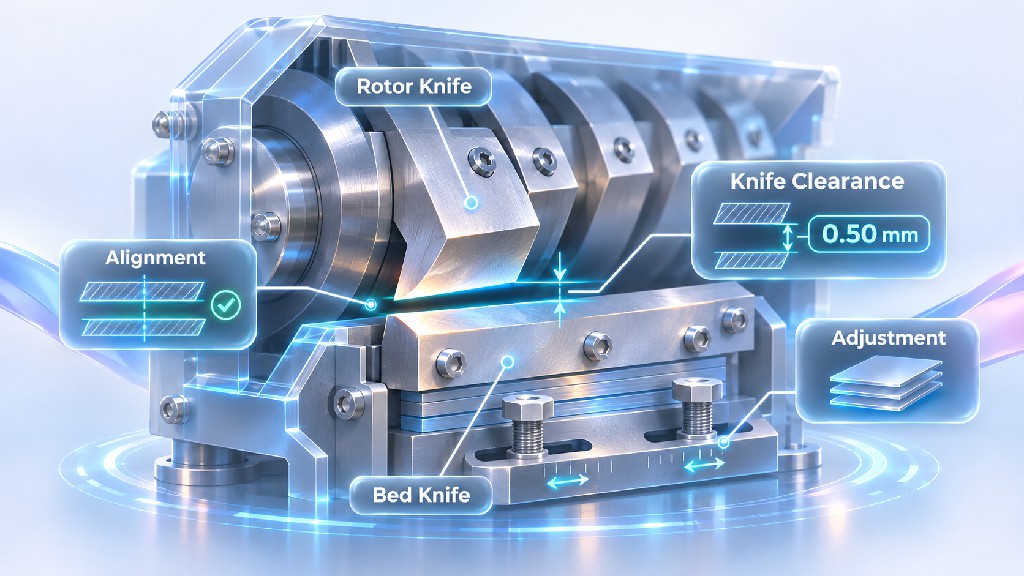
A knife suitable for sharpening should be dimensionally recoverable and structurally sound. The critical question is not “Can a grinder make this edge sharp?” It is “Can the finished knife still meet the approved dimensions, geometry, mounting support, and safe operating requirements after grinding?” If the answer is uncertain, obtain an inspection or replace the part instead of improvising.
| Knife condition | Typical decision | Reason and limitation |
|---|---|---|
| Uniform edge rounding; no structural defects; usable stock remains | Sharpen using the approved geometry | Recover the edge and verify the finished knife dimensions |
| Minor localized wear that can be removed within the permitted allowance | Consider professional regrinding after inspection | Both edge quality and minimum size must remain acceptable |
| Reversible double-edge knife with a sound unused edge | Reverse only if OEM permits and procedure specifies | Reversal is not a universal feature of crusher knives |
| Deep chips from metal strike; cracks or broken corner | Replace and inspect associated components | Grinding may not remove structural damage without exceeding limits |
| Knife below published minimum height, width, thickness, or projection | Replace | Insufficient clamping, reach, or geometry can create unsafe conditions |
| Warping, twisted body, damaged slots, loose or elongated mounting holes | Replace or obtain approved engineering assessment | Edge grinding alone cannot restore a reliable mounting interface |
| Blue or burned grinding zone, suspected heat-treatment damage | Quarantine; specialist evaluation or replacement | Further grinding is not automatically a safe cure |
| Repeated premature chipping with adequate dimensions | Investigate root cause and consider redesigned replacement | Material, feed contamination, geometry, and impact may be mismatched |
| Poor regrind despite sharp, intact knives | Diagnose gap, screen, evacuation and process | Sharpening is unlikely to solve a non-blade fault |
Cumberland advises in its service tips not to resharpen past the knife’s minimum height. The Conair TF Series manual recommends replacement where metal fragments have chipped a cutting edge, even though less severe dulling can justify sharpening. These are good examples of a broader engineering principle: a recoverable wear surface is not the same as a structurally damaged cutting tool.
Remaining material is only one limit. Consider a knife that still has measurable height but has a crack running inward from a mounting hole, an unsupported edge after damage to its seat, or deep grinding burn from a previous service. Those are possible rejection conditions irrespective of the number of times it has been sharpened. A qualified inspection must also assess whether the edge can be re-established without disrupting screw engagement, clamp contact, cutting radius, or the alignment of companion knives.
When supplier claims suggest a blade can be resharpened “five times” or “ten times,” ask what original dimensions, stock-removal allowance, minimum body size and inspection criteria support that number. There is no universal count valid across materials, granulators, or edge geometries. A longer knife with a shallow bevel can require very different stock removal from a thick segmented block with multiple usable edges.

Proper granulator knife sharpening is a controlled machining and inspection service. Grinding is usually performed on appropriate industrial grinding equipment with a suitable fixture, not by casually running a hand-held abrasive over an installed knife. The goal is a geometrically consistent cutting edge, correct datum relationships, controlled thermal input, and repeatable set matching. The exact sequence depends on whether the part is a long bed knife, a straight rotor knife, an insert, or a segmented assembly.
Tag each knife with machine identity, position, installation direction, original thickness or height, and the service history. Retain the drawing revision and record any damage on the edge, body and mounting features. Measure against approved datums and record cracks, chips, uneven wear and the remaining stock. Confirm that a manufacturer-authorized grinding route exists. If the part includes a special coating, inlay, braze joint, or multiple cutting lands, a standard grinding method may not be appropriate.
The bevel and relief surfaces influence cutting force and edge strength. Changing a bevel to make it look “sharper” can reduce support behind the edge and increase chipping risk. Different rotor and fixed knives can use different edge angles and may be ground from different reference faces. Follow the exact OEM drawing and the approved grinding fixture; mark which faces may be ground and which are critical seating datums. Surface finish should be suitable for the intended edge and specified inspection—not a purely cosmetic polishing target.
Grinding can introduce local heat rapidly into hardened tool steel. An incorrect wheel, excessive feed, poor dressing or inadequate cooling may create a visually blue or burned edge and may change its hardness or promote cracking. The Conair Viper 6 Series user guide explicitly calls for sufficient cooling during sharpening to avoid loss of hardness and toughness. Thermal damage assessment is more complex than checking color alone, so use appropriate professional inspection methods where overheating is suspected.
After sharpening, measure finished size, straightness, parallelism, edge continuity, and critical positional dimensions. Where specified, verify hardness and surface condition with the agreed method. Small sharp burrs or edge discontinuities can cause poor cutting despite a newly ground bevel. Document the material removed and the remaining permissible stock to inform the next service decision.
Rotor knives can require matched mass, dimensions, and a consistent cutting circle. Grinding individual knives to different effective radii can change knife clearance or load balance. The TF Series guide instructs the service provider to keep rotor knives as a set and maintain the specified matching tolerance. That figure is particular to its design; obtain the exact matching criterion for the machine being maintained. A long knife set also benefits from traceable position labels so that the service provider can distinguish a genuinely worn edge from a machine-specific installation problem.
| Grinding service checkpoint | Evidence to request | Common failure if omitted |
|---|---|---|
| Identification and approved drawing | Machine/knife tag and drawing revision | Wrong bevel or part substituted |
| Pre-grind acceptance | Dimensions, cracks/chip evaluation, remaining allowance | Unsafe part ground again |
| Fixture and reference faces | Documented datum and orientation | Correct-looking edge in wrong position |
| Abrasive process and cooling | Procedure appropriate to steel and heat treatment | Burns, microcracking or dimensional distortion |
| Matched set verification | Effective blade dimensions and OEM-required set matching | Unstable cutting circle or excessive variation |
| Final inspection | Edge continuity, size, straightness, mounting details | Reinstallation problems and premature wear |
| Service report | Number of grindings, stock removed and remaining limit | No reliable basis for the next replace decision |
A competent external grinding shop should be willing to explain how it controls the datum, temperature and post-grind dimensions. A quotation that specifies only “sharpen sharp” or “polish blade edge” leaves the most important acceptance criteria unclear. Ask whether the shop will reject knives that cannot meet the post-grind drawing instead of attempting to recover them at any cost.
Installing a freshly sharpened knife does not complete the repair. On adjustable machines, the rotor-to-bed clearance must be set and verified at the manufacturer-defined locations. On machines that depend on shims, fixed seats or knife positioning fixtures, matching dimensions and correct seating are even more important. A tolerance given for a different model may cause poor performance or a blade collision.
Values are taken from the linked sources for illustration, not instructions for a GUANG CHUAN product or an unrelated machine.
| Published example | Source-specific information | What not to assume |
|---|---|---|
| Conair technical bulletin | Discusses approximately 0.20–0.30 mm as a commonly encountered knife-gap range | This is not a universal setting for all granulators |
| Conair TF Series manual | Specifies a model-dependent feeler-gauge method of 0.006–0.010 in (about 0.152–0.254 mm) | Do not transfer its procedure or fastener torque to another model |
| Conair Viper 6 Series manual | For general scrap, gives a pre-adjustment distance of 0.20–0.25 mm | Other feedstocks and machine designs may require different values |
The underlying sources are the Conair maintenance bulletin, the TF Series guide and the Viper 6 Series manual. They are intentionally kept separate because specifications apply to particular designs and operating conditions. The final approved gap should come from the precise machine model, installed knife geometry and target feedstock; if documentation is missing, contact the machine OEM before adjustment.
An edge can pass acceptably at one point and approach dangerously close at another if the knife is bowed, the rotor runs out, the bed knife is not parallel, or the seat has debris. Trained technicians should use the OEM measuring procedure at the specified blade positions and across the required working length. They should confirm the gap after bolts are secured because clamping can shift a knife. All measurements and manual rotation checks must be performed only when the machine has been safely isolated and mechanically secured as required.
Use the OEM-approved torque specifications, bolt grades, replacement-bolt policy, tightening sequence and clean mounting surfaces. Never borrow a torque value from a published manual for a different machine. A knife made from premium steel can fail immediately if it moves under load or is installed against a dirty seat. For a functional breakdown of each part in this relationship, read GUANG CHUAN’s rotor knives versus fixed bed knives guide.
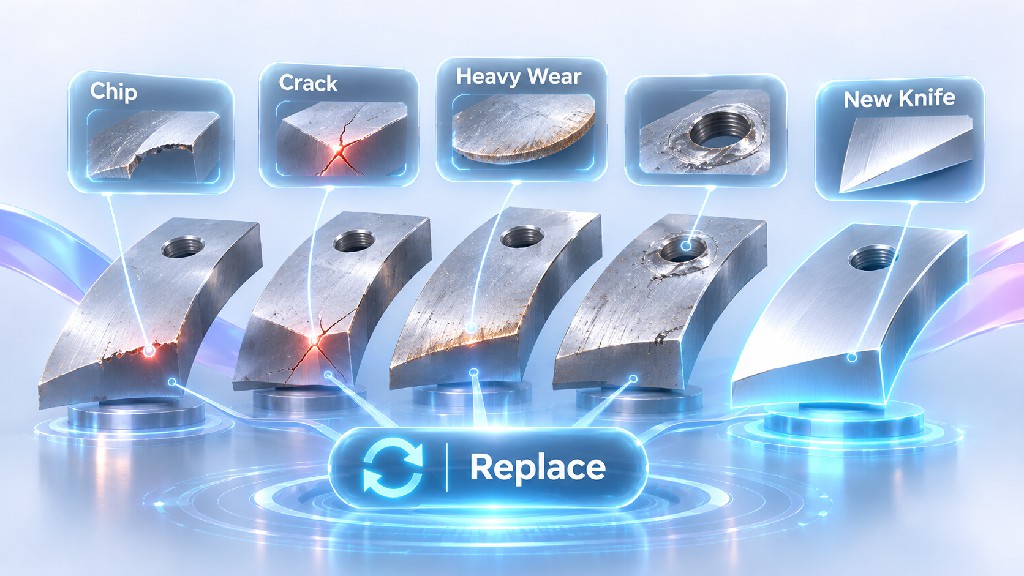
A high-speed granulator typically combines rotor knives that repeatedly travel through the cutting path with stationary knives that define the counter-edge. Those components may experience different loading, wear patterns and adjustment options. A dull bed knife can compromise the whole machine even when the rotor knives appear relatively sharp; the reverse is equally possible.
Rotor knives can accumulate repeated impact marks, abrasion across a cutting land, or localized damage where feed strikes unevenly. An improperly matched set can create variable cutting-circle geometry. If vibration increases after grinding, compare measured set dimensions, installation seating, rotor condition and secure mounting before assigning blame to the steel grade. Some designs require all rotor knives to be serviced together. Others have sectional layouts governed by their own fixture and balance requirements.
A stationary knife may show chipping where the same material or contaminant repeatedly loads its cutting line, rounded corners at concentrated cutting zones, or damage caused by an incorrectly set gap. Because the stationary knife forms the opposing edge, a defect on that edge can leave persistent defects even after the rotor set has been replaced. Assess both members of every mating cutting pair when troubleshooting.
The answer depends on condition and the OEM’s setup requirements—not a blanket rule that one side must always be ground whenever the other is. If both sets are dull and the cutting relationship must be re-established, servicing both may save repeated downtime. If one knife is still acceptable and the manufacturer permits individual replacement or adjustment, that can also be reasonable. Record exactly which components were serviced, which were retained, and the resulting clearance measurements so the next team has a traceable history.
It is not useful to quote one sharpening interval for “plastic” because PET bottle scrap, thin polyethylene film, glass-filled nylon, rigid PVC profiles and heavy polymer purges impose different loads. Contamination and filler content may matter as much as resin identity. The table below identifies concerns to investigate, not predetermined service lives or guaranteed steel selections.
| Feed material / duty | Wear or cutting concern | Maintenance priority | Potential purchasing question |
|---|---|---|---|
| Clean injection sprues and runners | Variable cross-section; relatively repeatable contamination | Track output and edge rounding by batch | Does the current grade already meet the economics? |
| PET bottle flakes or whole bottles | Thin-walled cutting plus possible grit, labels and foreign matter | Monitor abrasive wear and contamination | Would screening or cleaning improve life before alloy upgrade? |
| HDPE bottles and drums | Ductile walls and thick sections can fold or resist shearing | Monitor tearing, gap and material evacuation | Is edge geometry appropriate for the shape? |
| PP film and woven material | Stretching, wrapping and heat sensitivity | Inspect sharpness, gap, screen and airflow | Is this knife design intended for flexible feed? |
| Rigid PVC profiles | Potentially abrasive formulations and thermal sensitivity | Compare clean cut and heat trends | What fillers, additives and dust controls are present? |
| ABS housings and thick runners | Variable wall thickness and potential impact | Inspect chipping, loads and incoming metal | Does edge toughness matter more than maximum HRC? |
| Glass/mineral-filled engineering plastics | Elevated abrasive attack on the edge | Shorten inspection cadence as data warrants | Is an alternative heat treatment or material justified by a trial? |
| Large purges / dense lumps | High impact and feed-shape effects | Inspect structural damage and clamp integrity | Is the cutting machine designed for this feed geometry? |
For selection by material, GUANG CHUAN has a separate PET, HDPE, PP, PVC and ABS crusher-blade guide. For basic grades and geometric types, see Plastic Crusher Blades: Types, Materials and Selection Guide. Those resources complement a sharpening decision because frequent grinding can signal a mismatched knife design, poor cleanliness, or material selection rather than normal service consumption.
Mineral and glass fillers can create abrasive wear on cutting edges and adjacent equipment. If a plant switches from unfilled polypropylene to a heavily glass-filled engineering grade, yesterday’s sharpening schedule may become inadequate. Rather than claiming a fixed percentage reduction in life, run a controlled comparison. Record feed mass and filler specification, actual useful hours to the same output-quality limit, condition of knives, and consumed tool cost. Include screen condition, because filler-related abrasion can affect more than the blade.
A bolt, metal washer, stone, or other hard foreign object can cause severe local damage in a single incident. Deep chipping may be invisible from an operator’s position; inspect under proper isolation. Where metal ingress is plausible, evaluate upstream separation and housekeeping. Buying a harder knife is usually not the first control for repeated foreign-object impacts. Even a wear-resistant grade can fail catastrophically if the tool, mounting and load environment are incompatible.
When maintenance intervals feel too short, buyers naturally ask whether a harder replacement knife will last longer. Hardness contributes to wear resistance for some mechanisms, but it is not a complete specification. The edge also needs sufficient toughness against impact, correct microstructure, stable heat treatment, suitable geometry and a secure mounting interface. A brittle edge can chip early even when abrasive wear is low; a less hard but suitably tough knife may be more dependable on contaminated or high-impact feed.
| Material family | What it can offer | What must be verified before purchasing |
|---|---|---|
| D2 / 1.2379 / related SKD11 family | Established cold-work tool-steel options with substantial abrasive-wear potential | Actual grade, chemistry, impact duty, heat treatment and permitted grinding |
| Cr12MoV-type tool steel | Commercially available alloy option for many industrial knives | Certified grade identity; do not assume chemical identity with D2 or SKD11 |
| 6CrW2Si and other specified alloy steels | Potential engineering alternatives for a defined load profile | OEM acceptability, exact specification and edge-life trial |
| HSS, including selected M2-family variants | Potential high wear resistance under suitable conditions | Impact sensitivity, grinding method, cost and proof of benefit |
| Carbide-tipped or carbide-inlaid knives | Very high abrasion resistance in specialized designs | Joint integrity, chipping, repair method, rotor suitability and OEM authorization |
GUANG CHUAN advertises customizable alloy steel granulator knives, including a Cr12MoV plastic granulator blade product family listing selected material options and a quoted hardness range of 56–62 HRC. That figure is a supplier product specification for the listed offering, not a universal minimum or recommended value for every plastic crusher. Confirm the actual grade, required hardness band, heat-treatment route and inspection plan on the signed drawing and purchase order.
A supplier’s material recommendation should explain whether the dominant failure is gradual abrasion, edge rolling, microchipping, catastrophic impact, or thermal damage. Requests for “maximum hardness” without describing the failure mechanism are difficult to engineer responsibly. Ask for a controlled trial with a comparable knife set and a clear acceptance metric: useful hours to the same quality limit, acceptable regrind yield, shutdowns, and total effective cost.
The correct comparison is not the grinder’s invoice versus the price of a new blade. The real decision includes regrind stock left, labor and downtime, tool transportation, reinstallation and gap setting, rejected material, replacement lead time, and the risk of an unplanned failure. When a knife remains structurally sound and can be returned to specification, sharpening often avoids a premature new-part purchase. When the remaining usable life is short or uncertain, replacement may be less expensive despite the higher purchase price.
Assume a plant has a fixed 25,000 kg batch of comparable plastic scrap and a validated good-condition rate of 500 kg/h. With a worn knife set, actual accepted throughput is 430 kg/h after other faults have been excluded. The batch takes 50.0 hours when the cutting system is performing well and about 58.1 hours in the degraded condition. That is roughly 8.1 additional production hours. At an illustrative time-dependent processing cost of US$85 per hour, the additional processing time represents about US$692. These numbers are mathematical examples, not measurements from GUANG CHUAN customers.
Assumptions: identical accepted output and comparable feedstock, no capacity constraint changes, and a plant-specific US$85/h time cost.
| Illustrative metric | Good-condition baseline | Degraded cutting performance |
|---|---|---|
| Accepted regrind in batch | 25,000 kg | 25,000 kg |
| Accepted throughput | 500 kg/h | 430 kg/h |
| Run time = mass ÷ rate | 50.00 h | 58.14 h |
| Difference in run time | — | +8.14 h |
| Time-dependent operating cost assumption | $85/h | $85/h |
| Extra processing-time cost | — | about $692 |
If a properly executed sharpening event costs US$210 for service, US$45 for two-way logistics and US$170 for separately measured changeover labor and downtime, the direct modeled intervention cost is US$425. Under the narrow assumptions above, restored throughput could avoid about US$692 of additional running cost, suggesting a modeled US$267 difference before scrap, rejects, freight variance, energy-rate effects, and risk. This is not a promise that grinding will recover the full rate; the plant must verify a like-for-like post-service run.
Do not add every apparent loss to the same calculation. For example, if the 500 kg/h figure already measures accepted regrind, a separate yield adjustment may double-count material rejected as fines. If a process has ample spare time and low variable cost, “lost capacity value” may be small even when the machine slows down. Conversely, in a bottleneck production line, lost saleable output can matter more than the electricity bill. Choose the basis that reflects how your plant actually earns and spends money.
Suppose a new matched knife set costs US$900 and is suitable for four subsequent full-set sharpening services at US$210 each, with each service confirmed to meet the machine specification. The modeled purchase-plus-grinding cost over five usable cutting intervals is US$1,740, or US$348 per interval before mounting, logistics, inspection and failure costs. Buying a brand-new US$900 set for every interval would cost US$4,500 over the same five intervals. The apparent saving is substantial, but only if the sharpened sets continue to meet quality, safety, and operating requirements.
| Five-interval hypothetical plan | Repeat sharpening route | New set every interval |
|---|---|---|
| Initial/new knife sets | 1 × $900 = $900 | 5 × $900 = $4,500 |
| Subsequent sharpening services | 4 × $210 = $840 | $0 |
| Modeled blade + grinding spend | $1,740 | $4,500 |
| Average per usable interval | $348 | $900 |
| Included in model | Purchase and grinding only | Purchase only |
| Excluded | Downtime, fixtures, quality, logistics, risk | Downtime, quality, logistics, risk |
A real purchase decision should compare expected usable production hours or accepted tonnes per set—not equal intervals if grind life shortens with each rework. Additional regrinds may decrease allowable projection, change setup time, or end at the OEM minimum dimension. If a set survives one new interval but only a much shorter interval after later grindings, cost per accepted tonne is the more informative denominator.
Define the metric as (knife purchases + grinding + transport + knife-change labor + knife-related downtime + attributable rejects) ÷ accepted tonnes processed during the same comparison period. Keep the costing period and material mix constant. A premium steel grade that costs 40% more is not automatically economical; it must deliver enough additional usable output, lower downtime, or better acceptable yield to justify that price. A lower-priced blade is not automatically cheap if it causes frequent stoppages and uncertain quality.
The most useful maintenance schedule combines a calendar or operating-hours reminder with condition checks. It should evolve as the team collects data. Avoid copying an arbitrary “every 100 hours” sharpening instruction from a supplier listing; two plants with very different feedstock and contamination can wear nominally identical knives at very different rates. Use the OEM’s prescribed intervals where available, and shorten inspection frequency when conditions are unpredictable or more abrasive.
| Suggested program stage | Check or action | Trigger / record | Important limitation |
|---|---|---|---|
| Each shift or approved operator round | Observe output quality, abnormal noise, alarms and safe instrument trends | Log job, material, rate and unusual change | Only perform checks permitted during operation |
| At planned shutdowns | Inspect screen, discharge and accessible wear evidence | Compare to baseline and known defect limits | Internal work requires approved isolation |
| After new material or tooling change | Review cut quality, motor load and applicable gap checks | Record change date and first accepted sample | Do not prescribe one trial interval for all machines |
| After sharpening or replacement | Verify measured geometry, fasteners, gap and controlled post-service result | Sign off set ID and machine-specific acceptance | Follow the exact OEM return-to-service process |
| Periodic engineering review | Compare service history, cost per accepted tonne and recurring failures | Revise inspection and spare-stock plan | Do not relax safety inspections based on average performance |
The first month of a newly documented program can use relatively frequent, planned inspections to establish a credible trend, with exact frequency chosen by the site and OEM. Keep an available, approved spare set where downtime exposure warrants it. This reduces pressure on a grinding contractor to rush work or accept damaged knives because production urgently needs them.
Assign each knife or matched set an identifier. Record original supplier, steel grade, heat treatment and hardness where certified, drawing revision, original critical dimensions, installed position, each sharpening date, quantity of stock removed, finished dimensions, inspection outcome, operating conditions, and reason for removal. If knives are kept in matched sets, preserve those identities during transport and storage. Traceability makes vendor comparisons meaningful and helps show whether recurring failure is linked to a material batch, machine condition, or service provider.
A spare-set strategy is also a commercial control. Repeated emergency orders can cost more than planned inventory, particularly when products require custom heat treatment, drawing approval and international transport. However, inventory should be sized to actual lead time, criticality, and usage variability; the right stock quantity for a small beside-the-press granulator is not necessarily suitable for a central recycling operation.
A plastics plant reports more dust and a modest decline in throughput. The operator initially suspects worn crusher blades. A safely isolated inspection finds acceptable edge condition, while the discharge screen is partly blocked and the rotor-to-bed gap is outside the machine’s approved range. Cleaning the discharge path and correcting the setup, followed by a comparable trial, would be the rational first intervention. Sending acceptable knives to a grinder would remove valuable stock without addressing the primary fault. This is a constructed example, not a report of a specific customer result.
A recycler hears a sudden impact and discovers a damaged rotor edge after a foreign object entered the chamber. This is not ordinary predictable dulling. The team isolates and secures the equipment, inspects the full cutting chamber and both knife sets, checks for damage to mounts and rotor, and records the incident. If the damage is deep or structural, the affected component should be replaced in accordance with OEM set-matching rules. The line should also investigate the source of contamination; changing steel grade alone does not prevent repeated metal ingress.
A producer switches from clean HDPE runners to mixed material containing abrasive mineral filler. The existing knife grade loses its edge sooner, while the feed stream and screen wear also change. A practical response is to record the new duty, validate the downstream output specification and compare tool grades using controlled, like-for-like production runs. An upgrade to an alloy with greater wear potential may be justified, but only when impact damage and grinding cost are also considered. A more expensive knife without a documented benefit is not a successful engineering solution.
If abnormal impact or suspected contact occurs, stop using the machine under its approved emergency and isolation procedures. Do not continue running in the hope that the edges will “settle.” The technician should investigate the installed edge geometry, matched-set dimensions, seating cleanliness, gap, clamp condition and the machine’s rotor path. This is a mounting or geometry problem until proven otherwise, not a reason to increase feed rate or bypass a protective device.
When a set is no longer serviceable, crusher blade replacement should be treated as a controlled mechanical-parts purchase, not a visual match to a catalog photo. An incorrectly placed hole or reversed bevel can make a high-quality tool unusable or unsafe. The fastest route to a defensible quotation is an original OEM part number or customer-approved drawing plus a concise service history explaining why the old blade was rejected.
| RFQ information | Minimum content | Why GUANG CHUAN or another manufacturer needs it |
|---|---|---|
| Machine and knife role | Manufacturer, model, serial, rotor or bed position, count per set | Identifies the actual cutting arrangement |
| Part identification | OEM number, approved drawing revision or tagged sample | Avoids a similar-looking incorrect product |
| Major dimensions | Length, width/height, thickness, units and minimum functional datums | Establishes fit, projection and stock envelope |
| Mounting interface | Hole count, pitch, slot width/length, countersink, thread and clamp details | Controls safe seating and fastening |
| Cutting geometry | Bevel side, angle definition, edge lands, reversible surfaces, orientation | Preserves intended cutting function |
| Material and treatment | Approved grade or requested alternative, hardness and treatment requirements | Aligns wear resistance with impact and grinding policy |
| Operating conditions | Resin, filler, contamination, feed shape, rate and screen details | Explains actual cutting duty |
| Failure evidence | Photographs, defect map, previous grind count, wear measurements | Supports diagnosis and material selection |
| Quality and order terms | Required inspection report, quantity, trial size, lead time, destination | Enables meaningful technical and commercial comparison |
GUANG CHUAN’s crusher blade category includes different knife formats rather than one universal part. Its Cr12MoV granulator blade listing describes customizable edge, mounting and material options; the D2 blades for PET bottle and rigid-plastic recycling and heavy-duty knives for lumps and purges show additional use-case distinctions. These are supplier product descriptions, not confirmation that any advertised component will fit an unnamed machine. Share the part drawing before authorizing manufacture.
Ask whether the proposed design is a like-for-like replacement or a controlled engineering alternative. If the current knife fails by normal gradual abrasion, a wear-focused alloy comparison may be sensible. If it fails from metal strikes, brittle chipping or mounting instability, the decision may require toughness, contamination control, geometry or structural investigation. If the main complaint is overheating or fines, confirm that the screen, feed and gap have been addressed before spending on a premium blade.
For every suggested material substitution, request the exact proposed grade and its specification, the approved hardness range and test method, dimensional tolerances, grinding/inspection criteria, and the conditions under which the alternative is expected to help. The buyer should approve any departure from the original drawing in writing and conduct a controlled production trial before placing a large repeat order.
Subject: RFQ – Replacement plastic granulator rotor and bed knives
Machine: [brand, model, serial] | Knife role: [rotor/bed] | Quantity per set: [ ]
Current part number or drawing revision: [ ]
Dimensions and hole/slot details: [attach PDF/CAD; specify units and datums]
Current material/heat treatment, if known: [ ]
Resin and feed condition: [PET/HDPE/PP/PVC/ABS/other; clean/filled/contaminated]
Problem: [rounded edges/chipping/dust/throughput/other] | Regrinds already completed: [ ]
Required inspection and certificates: [ ]
Trial quantity / recurring demand: [ ] | Destination / desired date: [ ]
Please quote a drawing-controlled equivalent and identify any proposed changes in material, edge geometry or mounting. Please state what information is still required before manufacturing approval.
For a custom replacement, browse the custom-size replacement crusher knife offering or contact the company through GUANG CHUAN’s inquiry page. An approved drawing, a correctly identified sample, and an honest description of failure usually reduce more uncertainty than a request for the “longest-life blade.”
A reliable supplier should make the technical limits clearer, not hide them behind claims of “high performance.” For new knives, compare design control, material identification, heat-treatment consistency, critical measurements, burr-free edges, packaging protection and service response. For grinding, evaluate the ability to preserve OEM geometry, maintain matched sets, prevent heat damage and document remaining stock.
GUANG CHUAN describes its capabilities in precision industrial blades and custom manufacturing on the company information page. Its product pages may specify material options, hardness and machining claims; buyers should still request the inspection scope relevant to their own order and verify any requirements that differ from the public listing. Commercial credibility means distinguishing documented capability from a guaranteed outcome in a particular customer’s process.
There is no single correct bevel angle for every granulator or plastic. Changing the existing cutting geometry without an approved engineering basis can increase cutting force, reduce tip strength or interfere with the mating knife. Use the machine-specific drawing and the right reference face. When the original design is unknown, obtain an OEM drawing or a professionally measured approved sample before grinding.
Replacing rotor knives while leaving a badly rounded bed knife in service can perpetuate tearing, dust and inefficient cutting. Inspect the entire shear pair and make an explicit maintenance choice for each component. In a segmented system, the appropriate service grouping is dictated by that particular equipment design rather than by habit.
A visually attractive edge is not evidence of adequate remaining height, unaltered hardness, correct datum position or absence of cracks. Measure and document post-grind acceptance. Do not attempt to conceal a deep chip simply by grinding away substantial stock beyond the approved limit.
A material upgrade may be irrelevant when the screen is blocked, cutting clearance is incorrect, metal contamination continues, or the machine has a mechanical fault. First identify the failure mechanism; then decide whether new metallurgy is a rational expenditure.
Some OEMs require new fasteners during knife changes, and correct seating and torque are vital for rotating components. Follow the applicable manufacturer’s bolt specification and replacement policy. Do not reuse or substitute hardware on the basis of generic hardware-store dimensions.
Both extremes cost money. Good maintenance preserves a safely recoverable tool while rejecting a part that cannot meet functional specifications. Keep the inspection evidence and an authorized decision record; neither a full scrap bin nor a zero-scrap target is a useful measure of maintenance quality by itself.

Look for repeatable changes such as extra fines, reduced accepted throughput, abnormal noise, higher load or visibly rounded edges. Then check feed conditions, screens, discharge and manufacturer-specified knife clearance. Sharpen only when examination confirms recoverable edge wear and the post-grind dimensions can still meet the approved design.
There is no valid universal interval in hours, shifts or tonnes. The appropriate interval depends on resin and filler content, contamination, feed geometry, screen, rotor design, blade material and the acceptable quality limit. Use OEM inspection requirements plus a documented condition trend to develop a plant-specific schedule.
Sharpening removes a controlled quantity of material to recover the approved edge from a serviceable knife. Replacement introduces a new or approved spare part when the old knife cannot be returned to specification, is damaged or would be uneconomical to regrind. A knife that still looks large enough may nevertheless require replacement because of cracking or damaged mounting features.
Only if a qualified inspection shows that the defect can be removed within the OEM grinding allowance and no structural damage remains. Severe impact chipping, especially after metal ingress, often justifies replacement. Conair’s TF Series guidance specifically recommends replacing knives chipped by accidentally introduced metal fragments.
Many machines allow appropriate grinding of both, but permission, ground faces, remaining stock and dimensions vary. Some designs use reversible cutting edges, adjustable mounts or matched rotating sets. Follow the specific OEM procedure and inspect both mating edges rather than assuming all knife sets are interchangeable.
Not automatically. If the line is within its validated operating and safety limits, condition monitoring may be more economical than premature stock removal. However, follow any mandatory OEM inspection intervals and investigate emerging load, vibration or other abnormal trends before quality falls below the customer’s acceptance criteria.
A correctly sharpened knife often helps restore effective shearing, but fines also depend on resin brittleness, screen aperture, feed rate, repeated cutting, speed, gap and evacuation. Do not treat sharpening as a substitute for fixing a plugged screen or an unsuitable machine setup.
Use the value and procedure for the exact granulator model and cutting configuration. Published manufacturer examples vary. Conair documentation includes example ranges around 0.15–0.30 mm for particular models, but no one range applies to all machines or materials. Measurement positions, bolt torque and allowed rotor rotation methods are equally model-specific.
The answer is determined by original dimensions, minimum allowed height or thickness, allowable stock removal, edge geometry, matching requirements and condition. There is no universal number of permissible grindings. Track actual finished dimensions after every service and reject the knife at its documented limit.
Increased current can be associated with dull edges, but it can also indicate overfeeding, a blocked discharge, an unsuitable screen, mechanical friction or another fault. Compare current at similar load and operating conditions, and never exceed electrical limits while waiting for planned sharpening.
Choose from the machine’s approved material options and the actual failure mode. Wear-resistant tool steels such as D2-family grades or specified Cr12MoV may be good candidates in many recycling applications. Toughness and impact resistance matter where heavy lumps or foreign objects dominate. HSS and carbide designs require application-specific justification, not simply a higher headline hardness value.
Provide machine make and model, OEM part number or drawing, rotor/bed position, dimensions, hole and slot locations, bevel orientation, material, current service condition, feedstock, quantity and inspection requirements. A clear damaged-blade photo is useful, but it does not replace a controlled drawing where fit and safety-critical dimensions are concerned.
A qualified specialist with the correct grinding fixture, cooling, inspection and drawing control can reduce errors compared with improvised in-house sharpening. The choice still depends on in-house capability, safety procedures, turnaround and cost. Whether work is internal or outsourced, acceptance against the original specifications remains necessary.
Investigate cutting clearance, feed contamination, grinding heat damage, changed bevel geometry, incorrect steel or treatment, inadequate clamping, and excess rotor impact. Preserve failed parts and service records for inspection. Repeatedly grinding the same unsuccessful design without a root-cause review is unlikely to improve total operating cost.
GUANG CHUAN lists custom-size and drawing-based industrial knife offerings, but a worn sample may have lost critical original dimensions. Provide machine information and available drawings alongside the sample. A new drawing, material proposal and inspection plan should be reviewed and approved before a replacement is manufactured or installed.
For maintenance teams, the practical rule is to measure first, isolate safely, inspect the complete cutting system, then choose the least risky repair that restores specification. Sharpen when wear is recoverable and stock remains. Reverse only when the design explicitly permits. Replace when structural damage, dimensional limits or repeated poor economics make regrinding unsuitable. After either service, verify the machine-specific clearance, mounting, guarding and output quality before returning to production.
For purchasing teams, the best offer is the one that fits the actual machine and reduces cost per accepted tonne while preserving safe operation. Compare a documented sharpening program with an appropriately specified replacement, use matched and traceable knife sets when required, and select steel by observed failure mode—not by a hardness claim alone.
GUANG CHUAN supplies custom industrial blades for recycling and plastics-processing applications. Share your machine details, an approved drawing or reference sample, material stream, and the reason your current knives were removed. Our team can review the information needed to quote an appropriate replacement configuration, including alloy options, mounting geometry, and quality requirements.
Explore: Crusher Blades | Cr12MoV Plastic Granulator Knives | D2 Granulator Blades | Request a Technical Quotation
Compatibility and performance must be confirmed against the customer’s machine documentation and approved specifications before manufacture and use.

Оставить сообщение
Отсканируйте в WhatsApp :

 Pусский