



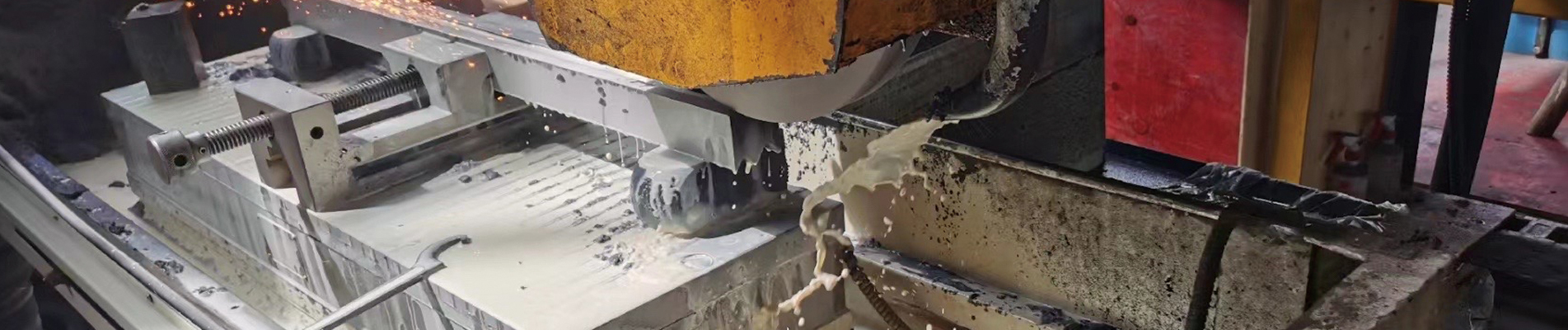

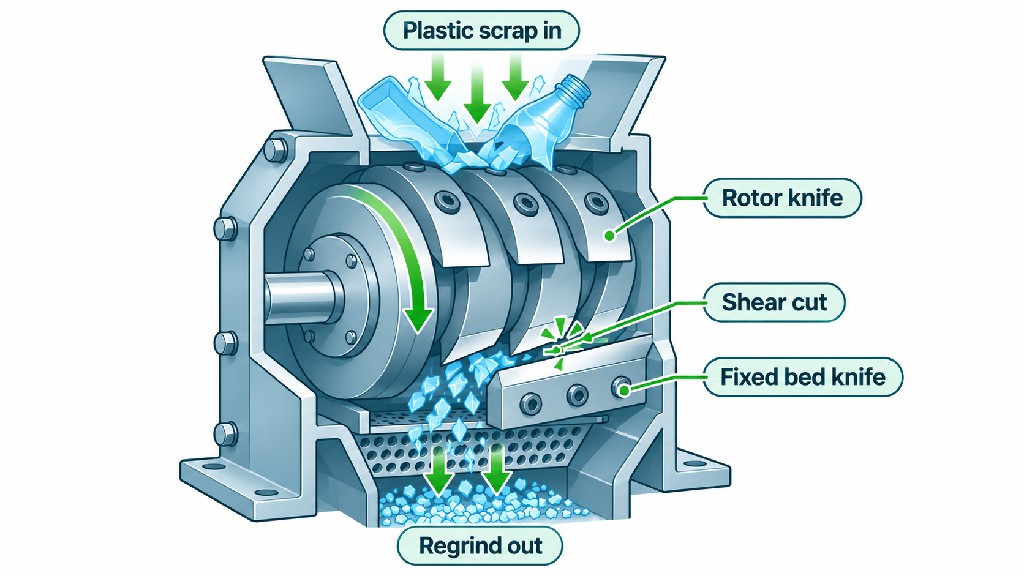
Plastic granulators do not produce clean, predictable regrind simply because their rotor turns quickly. The cutting action comes from two cooperating components: granulator rotor knives , which travel with the rotating shaft, and fixed bed knives , which remain stationary in the cutting chamber. The material passes through a controlled clearance between these edges, is cut repeatedly, and usually remains in the chamber until it can pass through a discharge screen.
That relationship matters to everyone involved in replacement-blade purchasing. A perfectly manufactured moving knife cannot compensate for a chipped stator knife, a distorted mounting seat, or an incorrectly adjusted gap. Conversely, replacing the fixed knife alone is unlikely to correct an out-of-round rotor, damaged blade clamps, or worn moving edges. The right repair starts with identifying which component is failing and why.
This guide explains the actual jobs of rotor knives and stationary granulator blades, how their geometry and materials differ, what published machine manuals say about knife clearance, and how to diagnose tearing, fines, heat, chipping, and loss of throughput. It also offers a practical RFQ checklist for purchasing OEM-compatible replacement knives or requesting a controlled design improvement from GUANG CHUAN .
Quick answer: Rotor knives move material into the cut and experience repeated dynamic loading. Fixed bed knives, also called granulator bed knives or stator knives, provide the stationary counter-edge and an accurate cutting reference. Both are necessary in a conventional rotor-and-bed granulator. Neither is universally more important, and the correct replacement is determined by the machine's drawings, mounting arrangement, service conditions, and measured operating results—not by a catalog photo alone.
Engineering note: Published clearances, hardness values, and calculation examples in this article have different sources and purposes. A range quoted from a machine maker applies to the stated model family; a grade or hardness quoted from a GUANG CHUAN product page is a supplier offering; an illustrative calculation is not measured plant performance. Always use the machine manufacturer's instructions as the controlling authority for installation and safety.
| Decision factor | Granulator rotor knives | Fixed bed knives / stator knives | What a buyer must verify |
|---|---|---|---|
| Mechanical location | Bolted or clamped to the rotating rotor | Mounted to stationary cutter housing or bed supports | Machine model, blade position, seat and drawing |
| Main cutting function | Pass the counter-edge and carry material into the shear zone | Supply the opposing cutting edge and maintain the fixed shearing line | Edge orientation and actual cutting path |
| Primary loading | Cyclic cutting loads plus rotation-related forces; impacts vary by feed | Repeated reaction forces transmitted to the housing and fasteners | Support, bolt grade, clamp condition and fit |
| Common profiles | Straight, staggered, inclined, chevron, segmented, or other OEM-specific patterns | Straight, inclined, reversible or multiple-bed configurations | Handedness, active edge, bevel and clearance position |
| Typical adjustability | Fixed, shimmed, or adjustable depending on design | Often adjusted for clearance, but not universally | Which side is designed to be adjusted |
| Wear symptoms | Rounded or chipped passing edge; imbalance or chatter if a set becomes uneven | Dull counter-edge, nicked reference line, position shift or uneven gap | Inspect both mating edges together |
| Service strategy | Replace in matched sets when the OEM requires it; regrind only where permitted | Replace, reverse, or regrind where the part and OEM procedure allow | Minimum dimensions and allowable regrinds |
| Purchasing risk | Wrong segment, rotor radius, pitch, hole pattern or weight matching | Wrong length, slot, thickness, datum face or edge direction | Approved drawing and position-specific part number |
The distinction is functional rather than a universal material rule. A rotor knife is not automatically harder than a bed knife. Some machine families use the same grade for both, while other applications justify separate grades or heat treatments. A further complication is terminology: suppliers may call fixed bed knives stationary knives , counter-knives , stator knives , or fixed blades . These terms often refer to the same role, but the actual component still must be confirmed against the equipment drawing.
Imagine a piece of injection-molding runner falling into a granulator. A rotating knife catches part of the runner and brings it toward an edge attached to the cutting chamber. As the moving edge passes the fixed edge, the plastic is loaded over a small region. With correct sharpness, geometry, support, and clearance, the system breaks the piece into smaller fragments by cutting and fracture rather than repeatedly bending it without making progress.
The material may encounter the knife pair many times before it exits. A perforated screen underneath or around the lower chamber retains pieces that cannot yet pass through its openings. Once fragments fit through by size, shape, and orientation, they leave the chamber for collection or conveying. A nominal screen-hole diameter is not a guarantee that every discharged fragment has a smaller maximum length; elongated pieces can sometimes orient themselves through an opening.
This operating principle is described in the Polymer Machinery Manufacturers and Distributors Association's guide to granulators , which identifies a rotor carrying rotating knives, stationary knives in the chamber, a discharge screen, and a collection system. The same fundamentals underlie many granulators found beside injection molding machines and in central recycling systems.
The screen, feeding arrangement, pneumatic evacuation, motor, and knives form an interacting process. Changing one variable can shift the behavior of the others. An aggressive knife setting cannot correct a plugged screen, and a smaller screen is not automatically a route to better recycled feedstock. Production results must be measured across the entire system.
Rotor knives travel around the shaft at a radius defined by the machine. Their job is to present a cutting edge repeatedly at the right position and angle. Depending on the design, the rotor may be open, closed, staggered, V-shaped, or segmented. The arrangement influences the sequence in which the blade contacts the material and may affect the instantaneous load applied to the drive. A spiral or staggered pattern spreads contact along the width in some machines, but no profile guarantees a particular energy saving without a test on the actual feedstock.
The rotor also has engineering limits beyond cutting quality. Its mass distribution, bearings, shaft condition, knife seats, clamping, and balance are important. Replacing one rotor blade with a different mass or protrusion can disturb a system designed to operate as a balanced assembly. Never change rotor geometry, fastening arrangements, or material removal limits solely to match a cheaper aftermarket blade.
A fixed bed knife creates a consistent line against which the moving blade cuts. It must resist reaction loads without lifting or shifting. Its seating surface, side support, hold-down or clamping plate, and bolts are therefore part of the cutting system. A stationary knife that looks sharp but is not fully seated can create a gap variation, vibration, and eventually damaged edges or fasteners.
Many granulators have front and rear bed knives; some have additional fixed stations. Their positions and edge orientations are not interchangeable unless the manufacturer says so. Even where two bed knives have the same length, their mounting slots, bevel direction, seating face, or usable-edge orientation can differ. Label the parts by actual installed location before disassembly.
A rotor knife repeatedly enters and leaves the cutting zone. It may see a relatively steady load when processing uniform thin sections, then a sudden peak when a thick runner, purge piece, or rigid lump enters. The moving edge must be sufficiently wear-resistant to remain sharp yet sufficiently tough to resist microchipping under the expected impacts. Hardness alone cannot describe this balance.
The knife's installed height and projection are just as important as the steel grade. Where a rotor uses several separate knives, all cutting edges must follow the machine's defined envelope. A protruding section can reduce clearance at one point, while a recessed section may do very little cutting. Abrupt variation also influences torque pulsation and can produce a periodic knocking sound that appears once per passing blade.
On some machines, segmented rotor inserts are replaceable rather than resharpenable. Other machines use long flat rotor knives that may be reground under tightly specified limits. The Conair 8 Series granulator manual documents different service rules for particular rotor configurations, illustrating why a universal statement such as “all rotor blades can be resharpened” is unsafe.
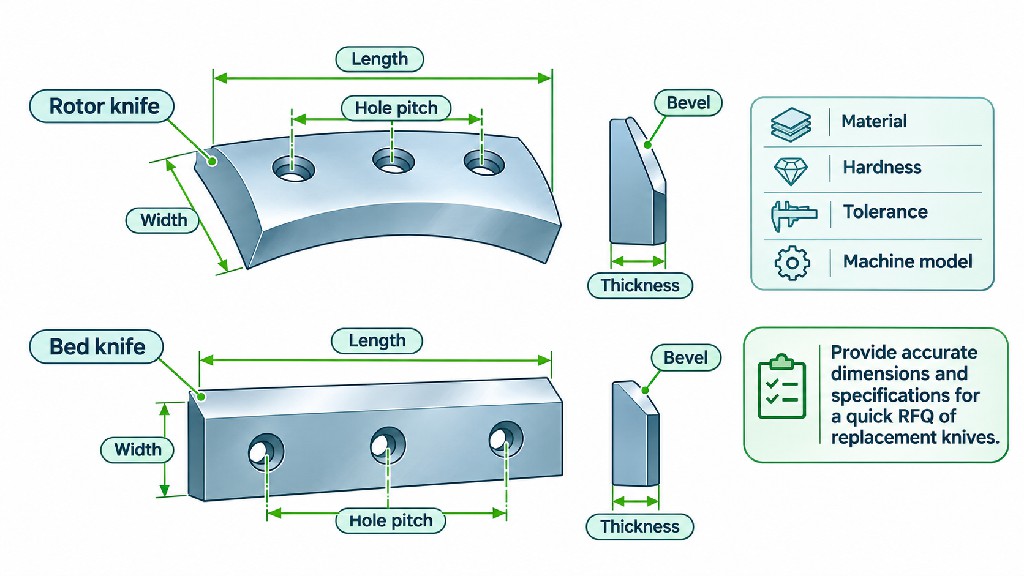
A straight knife can provide a simple full-length shearing interface; an angled or chevron arrangement may bring the edge into contact progressively. But the drawing must define far more than a visible outline. The cutting bevel, clearance face, hole diameter, counterbore, slot width, mounting pitch, distance from mounting datum to cutting tip, and grind direction can determine whether a knife fits at all.
On a rotor with several locations, the knives may be mirrored or otherwise position-specific. If the buyer assumes that a photograph of one blade represents the entire set, the shipment can contain the right steel in the wrong configuration. A reliable order therefore identifies the position, quantity per position, and whether the original part was a left-hand, right-hand, or non-handed design. The same applies to segmented blades where the central, outer, or end pieces may differ.
GUANG CHUAN's D2 steel plastic granulator blade product discusses adjustable slotted flat knives and alternative edge designs. This is an example of a configurable replacement family, not proof of interchangeability with every granulator.
The fixed knife is often assumed to be the easier component because it does not rotate. In practice, its support condition has a direct influence on cutting accuracy. It can be clamped against a machined seat, adjusted through slots or screws, and loaded in reaction to every passing rotor knife. If chips, trapped granulate, corrosion, or burrs prevent it from sitting correctly, a new bed knife may produce a worse gap than the old one.
A machinist checking a stationary knife should consider both the condition of the cutting edge and the condition of its reference faces. The body thickness, parallelism, straightness, bolt-hole positions, and contact area under the clamp affect whether the edge remains where it is intended. Severe over-tightening, incorrect screw length, or damaged threads can also compromise the system. Follow the relevant OEM torque specification; torque values from an unrelated model are not transferable.
Some granulator bed knives have two working edges and can be reversed when one becomes dull. Reversibility is a property of the exact knife design, not a general feature of everything sold as a stator knife. A replacement should have the specified bevel on each usable side, enough material to support the load, and a mounting design that positions either edge correctly.
Even with a reversible knife, a clean second edge does not solve a damaged seat or an incorrectly adjusted mating blade. If the knife has suffered edge chipping from metal contamination, inspect the entire chamber before reversal. Metal pieces or screws may remain lodged near the screen or supports. The root cause of the first failure can damage the second edge immediately after restarting.
The word fixed also does not mean that the bed knife cannot be adjusted. Several conventional granulators use an adjustable stationary knife while their rotor knives seat against fixed rotor geometry; others use adjustable rotor knives, preset fixtures, or shims. The supplier and maintenance team must identify the adjustment mechanism provided by the actual machine.
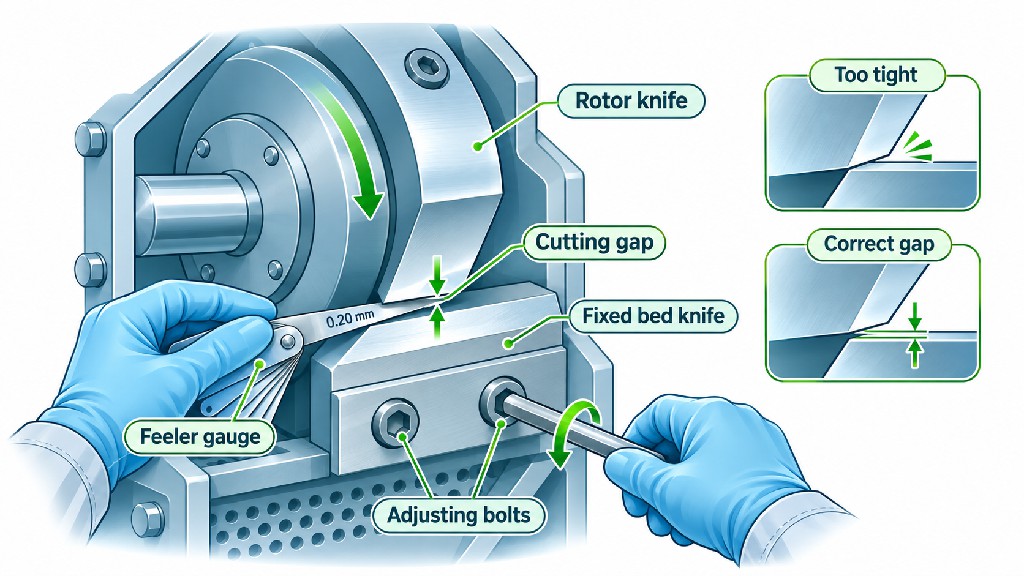
The knife clearance is the separation between the passing rotor edge and the stationary cutting edge at their closest intended approach. It must be checked in the manner specified by the OEM, commonly using a suitable feeler gauge with the machine fully isolated and the rotor mechanically secured under its service procedure. This is a gap between the two cutting edges , not the distance from a knife to a chamber wall or from a rotor tip to the discharge screen.
If the gap is excessive for the feed and design, material may fold, tear, heat, or bounce instead of being cut cleanly. The result can be poor throughput, increased fines or irregular fragments, and higher motor load. If the clearance is too small, blade-to-blade contact becomes possible, particularly when there is thermal growth, mechanical deflection, or a runout problem. Contact can create severe chipping and other damage. These consequences are discussed in Conair's granulator maintenance guidance and ZERMA's blade service overview .
| Source and machine family | Published rotor-to-fixed clearance | Appropriate interpretation |
|---|---|---|
| Conair 8 Series granulators, standard processing | 0.15–0.25 mm | Model-family guideline reported in the user guide; verify machine revision and application |
| Conair 8 Series, film application | 0.10–0.25 mm | Application-specific guideline in the same manual |
| Shini SGF-26 / SGF-26E roll-feed granulators | 0.10–0.15 mm | Manufacturer's installation guidance for the identified series |
| Shini SG-23/30 sound-proof central granulator manual | 0.20–0.30 mm | Published setting for this machine family, not for all Shini products |
The Conair values are provided in its 8 Series operating manual ; the Shini examples come from its SGF roll-feed manual and SG-23/30 central granulator manual . Different values across credible manufacturers are evidence that the machine drawing and application must govern the adjustment. Do not average the ranges or select the smallest number as a shortcut to cleaner regrind.
A single number taken at the center of a long blade may conceal a serious problem. For the Conair 8 Series, the service instructions call for checking the clearance at the left, middle, and right positions at the knife seat. They also require repeating the inspection for each relevant knife seat. The principle is straightforward: a uniform shearing line is more valuable than one apparently correct reading.
For example, imagine a hypothetical machine whose OEM specifies 0.15–0.25 mm. Measurements of 0.18, 0.20, and 0.22 mm on one pair fall within that example range, whereas 0.16, 0.25, and 0.31 mm do not. The second result suggests a geometry or seating problem even though one reading is acceptable. This is an illustrative inspection example , not a tolerance specification for any GUANG CHUAN product.
Do not compensate for shaft runout, loose bearings, deformed housing, or blade-seat damage merely by pushing the bed knife closer. Identify and correct the mechanical cause. If the closest-point clearance varies as the rotor turns, the maintenance team must examine the rotor assembly as a system before treating the blade as the only faulty part.
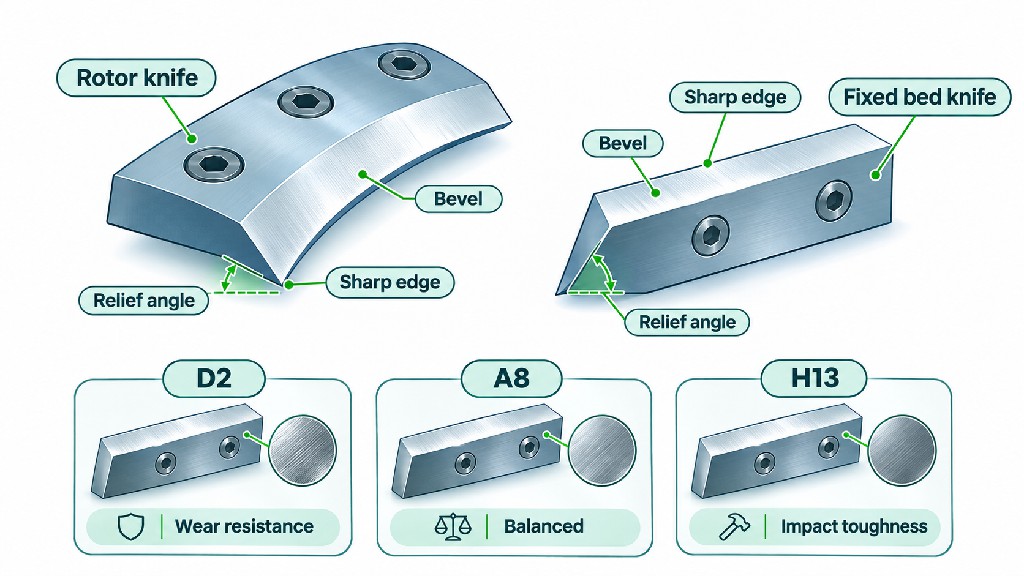
Knife drawings should distinguish the cutting face, relief face, included edge angle, active cutting direction, and datum faces used for inspection. A single-bevel knife is not automatically interchangeable with a double-bevel knife. Likewise, a knife that has been flipped to use another edge may now present the wrong relief geometry unless it was designed for that operation.
Sharper, more acute edges can reduce the initial force needed for a clean cut in some materials, but they leave less supporting metal behind the tip. More robust edges may resist chipping during high-impact service but can create higher cutting forces or different fragment behavior. The suitable compromise depends on polymer type, thickness, filler content, feed temperature, loading, and the knife's support geometry. There is no scientifically defensible one-angle recommendation for all plastic granulators.
A tiny micro-bevel may be used to strengthen a vulnerable edge in a particular application. It should not be applied casually during maintenance, because it changes the actual cutting geometry. The supplier must know whether the original part was ground to an exact angle or had a specified edge preparation. A blade with the correct gross dimensions and an incorrect edge preparation can still give unacceptable results.
In a straight-edge configuration, a comparatively wide section can engage at once, depending on the feed geometry. A staggered or inclined rotor arrangement can spread the cutting event along the blade length. This may improve load distribution on some lines, but a change of layout typically requires rotor design changes, not just a differently shaped replacement knife. An aftermarket blade vendor should reproduce the validated OEM arrangement unless a documented engineering modification has been approved.
In some machines the stationary knife itself is inclined or installed in multiple positions to cooperate with the rotor. Its apparent geometry must therefore be interpreted relative to the rotor's swept cutting path. Photographs taken on a table cannot show that relationship reliably. A dimensioned drawing or a measured sample accompanied by photographs of its installed position is a far stronger technical input.
When evaluating alternate designs, ask the supplier to confirm what can remain interchangeable. A steel-grade substitution may be possible without changing the cutting envelope. A new rake angle, thicker knife, different bolt pattern, or modified edge protrusion may not be. Engineering changes should be reviewed by the machine owner and the OEM where required.
Choosing material solely by a high Rockwell hardness value is a common procurement error. A blade must resist abrasive wear while surviving the impacts, cutting forces, and mounting stresses of its application. It also must be manufacturable to the required geometry and, if the OEM permits regrinding, maintain its properties after the planned refurbishment process.
Common supplier options include D2-class cold-work tool steels, Cr12MoV, 9CrSi, M2 high-speed steel, and application-specific alloys. These names are not interchangeable labels for a single performance level. Importantly, AISI D2 is a cold-work tool steel, not an HSS grade ; M2 is a high-speed steel. DAIDO STEEL's cold-work tool steel classification separates D2-equivalent grades from high-speed tool steels. The choice among them requires more than a marketing headline.
| Candidate blade material | Potential reason to consider it | Main question before purchasing |
|---|---|---|
| D2 / D2-type cold-work tool steel | Abrasive wear resistance for defined plastic-cutting duties | Is the edge tough enough for feed impact and contaminants? |
| Cr12MoV | Common alloy-tool-steel option used in many industrial knives | What exact chemistry, finished hardness and heat treatment are supplied? |
| 9CrSi | Alternative alloy tool steel for selected blade designs | Does it meet the actual wear, impact and dimensional requirements? |
| M2 high-speed steel | Where an HSS property profile is justified by severe cutting duty | Will the extra cost improve validated life or quality on this line? |
| Toughness-oriented proprietary alloy | When repeated edge chipping dominates the failure history | Is there evidence from controlled production trials? |
| Carbide-tipped or carbide-containing design | Where exceptional abrasion dominates and the construction is compatible | Can it safely withstand impact and maintain the designed edge? |
This table is a qualitative decision framework , not a ranking of universal blade life. Even two blades made from nominally equivalent steel may differ because of raw-material quality, heat treatment, carbide distribution, final grinding, section thickness, and operating conditions. GUANG CHUAN's plastic granulator replacement blade listing publishes material options and product-family hardness claims; those offerings should be confirmed in a quotation and inspection plan for a particular order.
Rockwell C hardness is useful for verifying that a blade falls within an agreed heat-treatment target. It does not directly report fracture toughness, microchipping resistance, impact energy, or edge geometry. A harder edge may retain its sharpness longer during relatively clean abrasive service yet chip sooner when it strikes embedded metal or a thick brittle object. In that situation, an optimized lower-hardness condition or tougher alloy may be less costly in practice.
The materials manufacturer Uddeholm explicitly evaluates wear and chipping resistance as distinct properties of tool steels. For granulator purchasing, this reinforces the need to define the dominant failure mechanism before requesting a more wear-resistant grade. Otherwise, an upgrade intended to reduce wear can create a more expensive chipping problem.
Rotor and fixed knives may experience different impact patterns, support conditions, and service access. This can justify evaluating different grades or hardness targets for each role. But such a change must be treated as an engineered system decision. A significantly different edge hardness may influence how the blades wear against the same feedstock; an inappropriate combination can also complicate refurbishment and maintenance.
For a straightforward OEM replacement, the best starting point is to reproduce the original approved material and heat-treatment requirements. If recurring failures remain after geometry, clearance, feed cleanliness, and installation are corrected, compare two controlled alternatives using measured outcomes. Request documented hardness, material traceability, relevant dimensional reports, and an agreed acceptance plan rather than relying on a claim of “premium steel.”
Relatively clean, consistent injection-molding runners are often the easiest duty to characterize. The operator usually knows the resin, approximate wall thickness, cycle frequency, and whether the runners are processed at room temperature or while still warm. That information helps establish a repeatable baseline. It does not eliminate the need to inspect the cutting chamber: a small machine operating beside a molding press can still suffer from poor suction, screen plugging, incorrect feed rate, or highly variable runner shapes.
When a line produces irregular flakes, the first checks should include edge condition on both the moving and fixed knives, knife clearance, screen condition, and feed consistency. Replacing every knife with a higher alloy before diagnosing the system may increase cost without addressing the actual cause. For clean material, predictable maintenance intervals and controlled regrind quality are often more valuable than pursuing maximum theoretical blade hardness.
PET bottles and rigid packaging introduce a mix of wall sections, necks, closures, and labels. A cleaned bottle stream behaves differently from a stream containing sand, glass, metal caps, or other contamination. The first consideration should be whether the granulator is intended for the feed dimensions and whether any upstream sorting or size reduction is necessary. Knives should then be chosen for the validated machine geometry and the dominant loading conditions.
In these applications, evaluate the generation of fines, stable feeding, temperature rise, and edge wear over an agreed mass of processed material. If a fresh blade set gives consistent flake quality but deteriorates rapidly with a dirty stream, the primary issue may be contamination management rather than the knife grade. GUANG CHUAN offers D2 steel granulator blades for PET bottle and rigid plastic recycling , but selection still requires machine measurements and feedstock details.
Flexible films can stretch, wrap, or fold rather than present a rigid cross-section to the cutting edge. Low-density material can also feed unevenly, while a screen and discharge system that works well with rigid plastic may be less effective with film. A narrow or precise cutting gap may be particularly important for a film-oriented granulator, but only the relevant OEM documentation can establish the correct operating clearance for that design.
Before changing material grade, check how the film is introduced, whether rolls or feed devices are suitable, and whether the rotor and bed knife arrangement is intended for flexible feed. Monitor wrapped film, uncut ribbons, discharge restriction, and material temperature. Thin-film cutting performance cannot be reliably inferred from a blade supplier's experience with thick rigid purges.
Heavy purges and thick solid sections produce different loads from thin packaging. They may be too large for direct introduction into a particular granulator or may cause torque peaks and repeated impacts. If this is the duty, confirm the machine's feed capacity and recommended handling method before specifying a knife. A more impact-tolerant blade cannot make an undersized machine structurally suitable for oversized feedstock.
Engineering plastics with glass or mineral reinforcement may increase abrasive wear. For these streams, material traceability, edge support, chip resistance, and scheduled inspections can become more important. GUANG CHUAN's heavy-duty blades for plastic lump and purge crushing illustrate a supplier product family aimed at more demanding feedstock. A buyer should request evidence of suitable geometry and material properties for the actual machine rather than treating that product category as a universal upgrade.
A useful diagnostic approach connects an observable symptom to a small set of testable causes. The same symptom can have more than one origin. Increased motor current, for example, can result from dull knives, excess feed, blocked discharge, material change, or mechanical drag. It is therefore a signal to investigate, not automatic proof that one specific knife needs replacing.
| Observed symptom | Possible knife-related causes | Other conditions to investigate | First evidence to collect |
|---|---|---|---|
| Increased fines or dusty regrind | Rounded edges; excessive or uneven clearance; chipping | Screen wear, brittle feed, long residence time, poor conveying | Regrind samples, screen photos, gap record |
| Long ribbons or uncut film | Poor rotor-to-bed shear, dull edge, wrong gap | Film wrapping, inadequate feed control, incorrect machine type | Feed video from a guarded observation point, sample and OEM settings |
| Motor load or temperature trending upward | Dull edges, edge contact, altered profile | Overfeeding, plugged screen, bearing drag, exhaust restriction | Trend data, feed rate, maintenance history |
| Rhythmic knocking or chatter | Uneven knife protrusion, damaged mounting, edge contact | Rotor imbalance, loose components or bearing faults | Stop and isolate; inspect seats and record observations |
| Repeated small edge chips | Insufficient toughness, unsuitable bevel, incorrect gap | Metal, glass or stones in the feed; loose fasteners | Magnified edge photos, feed contaminant analysis |
| Variable flake size | Unequal cutting performance along the width | Worn screen holes, mixed feed, discharge problems | Size distribution by sample and width position |
Use a planned shutdown and the authorized maintenance procedure for all intrusive checks. A noise or vibration change that suggests blade contact or loose hardware warrants immediate action under the facility's safety rules; continued operation to “see whether it improves” can turn a small knife problem into rotor or housing damage.
For further troubleshooting of edge chipping, GUANG CHUAN's crusher blade chipping guide discusses material selection, clearance, contamination, and installation. Treat that information as a diagnostic checklist alongside the machine manufacturer's service documentation.
Knife inspection is a hazardous maintenance activity. The rotor can contain significant inertia and may move unexpectedly if not secured correctly. Powered feed mechanisms, hydraulic or pneumatic systems, and ancillary equipment can also store energy. Machine-specific lockout, mechanical blocking, and verification of isolation are essential before access to the cutting chamber. OSHA's 29 CFR 1910.147 sets out requirements for the control of hazardous energy in covered workplaces; local regulations and the equipment manual must also be followed.
The following is an inspection framework for planning and documentation, not a substitute for the OEM's blade-change instructions :
Some machines provide setting jigs or adjustable knife holders to make these operations more repeatable. Conair's maintenance discussion notes that presetting arrangements can improve consistency and simplify replacement, especially compared with certain older machines that permit adjustment only after installation. Such features are machine-dependent, and the presence of a slot in an aftermarket blade does not establish that it is safe to adjust beyond the designed range.
A replacement can fail soon after installation even when the steel and grinding are correct. Common explanations include an incorrectly oriented knife, debris beneath a blade, mixed fastener lengths, unsupported cutting edges, incorrect bolt torque, an out-of-spec gap, or a fragment of foreign material still inside the chamber. The timing of failure matters: damage within the first few operating minutes suggests installation or system conditions deserve urgent investigation, while progressive rounding over many hours suggests a different failure pattern.
Do not infer the root cause from one chipped fragment alone. Preserve photographs of the cutting edge and seat before further cleaning or grinding. Record which rotor position and which side of the blade were damaged. If several knives chip at the same circumferential location, compare their installed geometry and check the corresponding stationary knife location. A traceable failure record makes a technical discussion with the supplier far more productive than an email stating only that the blades “do not last.”
A granulator can appear to run normally while producing a particle distribution that causes downstream instability. The appropriate quality measures depend on whether material will be remolded in-house, sold as regrind, washed, compounded, or converted into another product. A plant should define an acceptance method before comparing replacement knife options.
A practical starting set of measures is: actual throughput in kilograms per hour under a controlled feed condition; mass fraction passing a designated fine-particle sieve; screen condition; motor current or energy per kilogram; rejected or uncut fragments; downtime; and blade condition after a stated operating duration or processed mass. Repeat tests under comparable resin, moisture, contamination, feed size, and screen conditions. Otherwise, an apparently improved blade may simply have been tested on an easier material.
| Metric | Example measurement method | How it helps decisions |
|---|---|---|
| Throughput, kg/h | Weigh accepted discharge over a measured interval | Detects process restriction and makes trials comparable |
| Fines fraction, mass % | Sieve a representative sample using a defined method | Tracks unwanted small particles without relying on appearance |
| Specific energy, kWh/kg | Measure electrical consumption and divide by mass processed | Separates output volume from electricity intensity |
| Blade service life, tonnes or hours | Log mass processed or running time between interventions | Helps estimate planned blade and labor cost |
| Regrind temperature | Use a repeatable approved sampling location and instrument | Helps detect friction or residence-time problems |
| Unplanned stops, events/month | Record root cause, duration, and affected component | Quantifies whether a different blade reduces actual disruption |
These are proposed plant KPIs , not reported measurements from GUANG CHUAN or an external test laboratory. The acceptance limits must be defined by the processor and the downstream specification. In particular, specifying a “low fines” blade without defining what counts as fines, the sieve used, and the sampling protocol leaves the supplier with an untestable promise.
The screen is inseparable from the output test. A worn or damaged perforation may permit larger or irregular pieces to leave even when the knives are sharp. Conversely, a fine screen can keep material in the chamber longer, changing throughput and fines generation. The maintenance assessment should record screen hole size, shape, wear, and whether the screen was changed during the trial.
An elementary calculation can help explain why small geometry problems become important during continuous operation. Suppose a hypothetical granulator runs at 600 revolutions per minute and has three rotor knife rows that each pass one specified fixed-knife station once per revolution. The encounter frequency at that station is:
Knife-row encounters per second = rotor speed (rpm) × number of passing rows ÷ 60.
For the assumptions above, the result is 600 × 3 ÷ 60 = 30 encounters per second . Over an eight-hour scheduled run, the arithmetic gives 30 × 3,600 × 8 = 864,000 potential row passages at that one station. This is not the number of actual loaded cuts: feed may be absent during many passages, rotor rows may be segmented, and cutting engagement depends on the exact machine and material.
The calculation demonstrates why a small misalignment can repeatedly load the same edge. It does not establish a universal recommended rpm, the force of a cutting event, the number of knives fitted to a particular machine, or the life of an individual blade. Those values cannot be inferred from rpm alone. If a maintenance engineer uses this relationship, the real rotor-row count and number of fixed cutting stations must be taken from the machine drawing.
A more useful production comparison is often made in tonnes of input processed per correctly installed knife set. For example, two blade options should be compared only if the tested polymer and operating conditions are comparable. A knife that processes more tonnes before requiring adjustment may provide a stronger business case than one that looks sharper after an arbitrary number of calendar weeks.
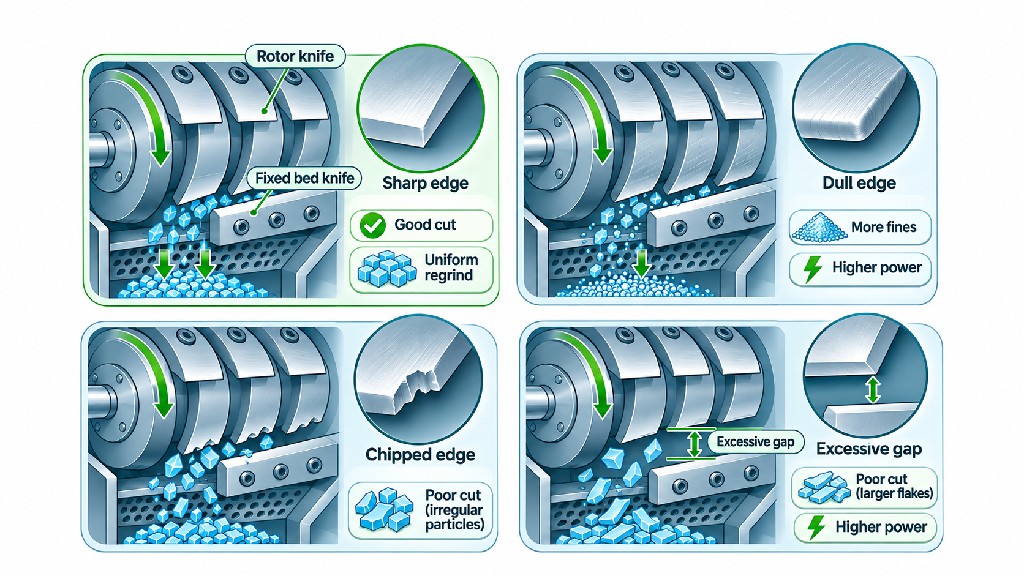
The cheapest new part is not necessarily the lowest-cost operating solution. A properly designed resharpenable rotor knife may have several useful service cycles; a disposable segment may have none. Similarly, a double-edged stationary knife may be reversible, but a single-edge bed knife may not be. The OEM's minimum dimensions, grinding instructions, and fastening rules determine what is allowed.
Before approving grinding, verify whether material removal would change cutting-edge projection, the effective clearance, screw engagement, or rotor balance. Heat generated during grinding can damage the hardened edge if not controlled. A poor grind can create surface burns, an uneven bevel, local waviness, or a geometry that cannot be adjusted into the correct working envelope. Where the OEM provides grinding fixtures and permitted regrind limits, those instructions should be included in the service purchase order.
Resharpening also creates a logistical decision. If a plant needs a full day to remove, send out, grind, receive, and reinstall a single set, it may be more economical to keep a verified spare set ready. This reduces dependence on emergency freight and allows the maintenance crew to inspect removed knives off-line. However, spare inventory should be sized to actual consumption, lead time, and production risk; automatically buying several high-cost sets may tie up unnecessary capital.
A useful request to the knife supplier asks for an explicit recommendation: new replacement, approved regrind, reversible second edge, or an engineered material revision. The answer should be based on part drawings and machine requirements. A supplier should not promise unlimited regrinding or reversal simply because the blade looks thick enough.
Commercial evaluation should include blade purchase price, planned replacement labor, downtime exposure, freight, scrapped feedstock, and potential quality losses. Some of these costs are easy to measure and others require assumptions. The purpose of the following example is to show the calculation method transparently, not to claim that a particular GUANG CHUAN blade delivers these results .
Assume a granulator operates 2,400 production hours per year . A baseline knife set needs planned replacement after every 300 operating hours , while an alternative—if validated in production—extends the interval to 400 operating hours . Each replacement takes 2 hours of unavailable granulator time. Suppose the internally estimated contribution or disruption cost for that downtime is US$300 per hour . Ignore different knife prices, labor costs, and partial-year inventory for this first calculation.
| Assumption or result | Baseline set | Hypothetical alternative |
|---|---|---|
| Annual scheduled operating hours | 2,400 h | 2,400 h |
| Hours between knife-set replacements | 300 h | 400 h |
| Approximate replacement events per year | 8 | 6 |
| Downtime per event | 2 h | 2 h |
| Annual planned downtime | 16 h | 12 h |
| Downtime cost at US$300/h | US$4,800 | US$3,600 |
Under only those assumptions, the annual illustrative downtime saving is US$1,200 . A decision-ready calculation would then add the actual prices of six versus eight replacement sets, the labor and consumables per change, freight, quality losses, regrinding expenses, and any change in throughput. If the premium knife costs more per set, that increment must be weighed against the reduced number of interventions. The hypothetical 400-hour interval is not a performance warranty.
Cost comparisons should use consistent accounting. If the machine can run while another cell operates normally, its downtime may not be worth the full estimated hourly contribution. If the granulator is a bottleneck that stops an entire line, the disruption cost may be larger. Procurement should agree on this assumption with production and finance rather than choosing a number that makes a preferred supplier appear attractive.
A credible quotation depends on the quality of the buyer's input. Two parts can share length, width, thickness, and nominal steel grade yet differ in edge direction or the position of mounting features. A photograph beside a ruler is useful for first contact, but it is rarely sufficient to approve a dimensionally critical replacement.
| Required RFQ information | Recommended detail | Why it matters |
|---|---|---|
| Machine identity | Manufacturer, model, serial number, year, and cutter-housing type | Distinguishes equipment revisions and blade families |
| Knife function | Rotor knife, bed knife, front/rear stator, or numbered station | Prevents role and position mix-ups |
| Quantity | Number of knives per position and number of complete sets | Supports correct packaging and pricing |
| Geometry | Overall length, width, thickness, bevel, active edge, corner detail | Establishes fit and cutting behavior |
| Mounting features | Hole centers, sizes, slots, counterbores, offsets and datum faces | Controls installation compatibility |
| Material specification | Exact steel standard or approved equivalent, hardness target and any treatment | Makes grades and certificates comparable |
| Existing part documentation | OEM drawing, old part number, revision and clear photographs | Reduces reverse-engineering ambiguity |
| Application | Polymer, fillers, contamination, feed form, screen size, operating conditions | Supports material and edge recommendations |
| Quality requirements | Inspection datums, tolerances, certification and acceptance method | Makes the quotation auditable |
| Commercial needs | Delivery location, requested date, spare-set policy, packaging and terms | Prevents avoidable lead-time surprises |
A useful drawing should show the active cutting edge and the mounting datum in the same view. For a slotted bed knife, document the slot geometry and adjustment direction rather than recording only the slot length. For a rotor knife, document the installed location and cutting envelope. If left- and right-hand components are present, provide separate part IDs and labeled photos.
When the original OEM drawing cannot be released, the buyer and supplier can agree on reverse engineering from a physical sample. The sample should be representative, ideally unworn or accompanied by an unworn drawing reference, because wear and prior regrinding can change critical dimensions. A worn sample may reproduce the exact problem that led to replacement unless the original dimensions are reconstructed appropriately.
GUANG CHUAN describes custom crusher blades , adjustable U-slot industrial crusher knives , and OEM/ODM manufacturing capabilities . Use these pages to identify the relevant product family, then request a drawing-based quotation rather than ordering on product description alone.
For a long-term purchasing relationship, a repeatable acceptance specification is more valuable than an unsupported claim of extraordinary precision. The buyer should specify which dimensions actually control fit, function, and clearance. Tolerances must be derived from the machine drawing and inspection method—not invented by taking the tightest figure found on a supplier website.
A practical purchase specification may require a material certificate, finished hardness test results, evidence of controlled heat treatment where relevant, dimensional inspection against agreed datums, and a report of edge straightness or flatness if these are critical features. More specialized measurements, such as runout of an assembled rotor, belong to the appropriate assembly-level inspection rather than being assumed to be properties of an individual flat knife.
Check the relationship between dimensional tolerances and the chosen measuring method. A stated thickness tolerance has little meaning if the supplier and customer measure at different locations or use different temperature, surface, and datum conditions. Likewise, a blade can meet an individual hole-position measurement but fail to mount when several features are assessed together. Drawing notes should define the critical fit and functional surfaces clearly.
For traceability, request packaging labels showing part number, revision, lot identification, quantity, and installation position where appropriate. Protect cutting edges and precision faces during transport. A blade that leaves the grinder in correct condition can still arrive chipped from poor packaging. Receiving inspection should record shipping damage before the parts enter the spare-parts cabinet.
GUANG CHUAN's manufacturer overview describes CNC machining, grinding, heat treatment, and customization capabilities. Specific inspection results and tolerances for your order should nevertheless be agreed in the approved drawing and order documentation rather than presumed from a general company description.
A molding plant runs a screened granulator on known PP runners. Regrind quality has gradually worsened, but machine vibration remains normal and no foreign-object event has been reported. The responsible engineer inspects the screen, checks the OEM-prescribed gap at the required positions, and finds that the moving and stationary edges are rounded. In this case, a like-for-like blade set with known dimensions and material may be the most controlled answer.
The purchasing team should send the machine details, the approved drawing or undamaged sample, and the required rotor/bed counts. After installation under the OEM procedure, the plant can compare throughput and fines with its own earlier baseline. There is no need to redesign the knife simply because a harder alloy is available. If ordinary wear was the cause, disciplined maintenance and proper sharpening or replacement intervals may deliver the biggest benefit.
A central recycling line begins reporting recurring chips on one knife position after switching to larger purge pieces. A purchase order for “extra-hard granulator blades” would be premature. The team should first check whether the machine is approved for the feed dimensions, whether metal contamination is present, and whether the knife seats and clearance are correct. The pattern and location of damage may help distinguish impact loading from a systematic interference problem.
If the mechanics are verified and the application remains within machine capability, a supplier can evaluate a tougher material condition or edge geometry while preserving the required cutting envelope. Such an alternative should be accepted through a controlled trial rather than only a material-name substitution. GUANG CHUAN's heavy-duty granulator blade family is relevant to an initial commercial discussion, but it does not remove the need for OEM approval and documented performance criteria.
A film processor installs replacement knives and then sees longer uncut ribbons, increased wrapping, and a lower output rate. Rather than immediately purchasing a more expensive steel, the maintenance engineer verifies that the knives are the correct handed parts, that the active edges face the intended direction, that mounting seats are clean, and that the film-specific OEM clearance has been achieved across the full cutting width. The processor also checks feed and evacuation arrangements.
If the issue began immediately after the change, installation geometry deserves particular attention. A dimensionally inaccurate slot or an incorrect bevel can prevent correct cutting even when the part appears visually similar. The supplier should review the original drawing and the actual received part measurements. This kind of evidence-based collaboration is more likely to resolve the problem than exchanging photographs of sharpened blades without dimensional context.
A standard replacement is attractive when the part is well identified, the machine is running successfully on the original design, and the objective is to restore predictable cutting performance. It reduces engineering uncertainty and allows the maintenance team to use established procedures. Standardization also simplifies stocking, receiving inspection, and future repeat orders.
Custom manufacturing becomes appropriate when the original knife is obsolete, the machine is non-standard, a drawing-based substitute is needed, or repeated failures justify a controlled material or geometry review. The word custom should not imply unnecessary redesign. Often the best custom knife is a precise replica of the existing approved design, manufactured to documented dimensions and with controlled quality.
Before authorizing a change that affects the blade's swept path, clamping, protrusion, balance, or structural loading, obtain approval from the equipment owner and machine manufacturer where needed. A supplier can propose materials or edge alternatives, but that is not the same as approving a modified high-speed rotating assembly. A safe, commercially effective sourcing process makes this responsibility explicit.
GUANG CHUAN offers both industrial crusher blades and plastic granulator replacement knives . The useful next step for a purchaser is not to choose the most impressive-sounding product title; it is to define the current geometry, feed conditions, service failure history, and acceptance requirements so that a suitable quotation can be prepared.
No, not merely because they look alike or use the same steel. They occupy different positions in the machine and can differ in mounting patterns, bevel direction, dimensions, adjustment features, and service limits. Some engineered designs share common part geometries, but interchangeability must be confirmed by the OEM part list and controlled drawing. If in doubt, request separate position-specific quotes and dimensions.
In the context of many conventional plastic granulators, yes: stator knife , fixed knife , counter-knife , and bed knife are often names for the stationary cutting component. However, terminology changes among equipment makers and across types of shredders. Identify the installed knife by its physical role and drawing, especially when purchasing from an overseas supplier that uses different English product names.
There is no universal clearance. As published examples, Conair's 8 Series guidance includes 0.15–0.25 mm for a standard application, while certain Shini models specify 0.10–0.15 mm or 0.20–0.30 mm. These model-specific values should not be mixed into a generic recommendation. Confirm the exact equipment revision, material being processed, and approved method for checking the gap before making an adjustment.
No. The required material and hardness depend on the rotor design, feedstock, impact loads, edge support, and maintenance strategy. Some machines can use comparable blade materials in both positions; an alternative paired specification may be justified only through engineering review. More hardness does not automatically provide longer life, especially if chipping is the main problem.
Neither always wears faster. Wear depends on the layout, loading sequence, abrasive content, edge geometry, and frequency of actual cutting engagement. One installation may show pronounced wear on moving edges; another may develop localized notches on a fixed knife. Inspect both parts and record the wear pattern before changing only one side of the cutting pair.
Only where the knife was designed for reversal or resharpening and the OEM permits it. A two-edge bed knife may provide a second working edge, but that does not guarantee unlimited use. The condition of the seat, the edge preparation, and any minimum grinding dimensions still matter. The correct decision comes from the part drawing and maintenance manual, not from visual symmetry alone.
Possible reasons include a wrong gap, incorrect edge geometry or orientation, a damaged screen, a change in feedstock, or excessive residence time. A sharp blade can create fines if the overall operating condition is wrong. Compare the previous and current knife dimensions, verify the intended installation, inspect the screen, and measure fines consistently before concluding that the blade alloy is defective.
No. D2 and SKD11 are broadly corresponding cold-work die-steel designations, subject to the applicable standard and supplier chemistry; M2 is a different high-speed steel grade. Do not approve a material substitution based on labels such as “D2 HSS.” Request the specified steel standard, chemistry or certificate, finished hardness, and heat treatment appropriate to the application.
The answer depends on actual service consumption, regrind or replacement lead time, supplier reliability, and the cost of a stopped line. A high-throughput operation with a single granulator may value a ready-to-install spare set more than a small molding cell with backup equipment. Calculate inventory from documented replacement intervals and lead-time risk. Include rotor and fixed knives in the stock plan if both are required for a planned change.
Send machine maker and model, serial number if available, the required rotor and fixed-knife quantities, a dimensional drawing or physical sample, photographs showing installed positions, material to be processed, current blade grade, and any observed failure. State whether the order needs a direct replacement or a reviewed upgrade. For further product information, visit the crusher blade category or contact GUANG CHUAN .
Before releasing a purchase order, make sure the technical question has been answered in the correct order. First, identify the machine's working principle: conventional screened granulator or another size-reduction architecture. Second, identify every moving and stationary cutting position. Third, determine whether the current problem arises from normal wear, abnormal impact, wrong clearance, mounting faults, feedstock, or the discharge system. Only then should material, edge geometry, and cost be compared.
The plant should retain three sets of evidence: baseline data describing acceptable regrind quality and running conditions; component records covering drawings, material, dimensions, and installation settings; and commercial records showing price, lead time, downtime, and actual service intervals. With these, a supplier recommendation can be tested rather than accepted on confidence alone.
For a new supplier, consider a trial order with agreed acceptance dimensions and a monitored production run. Measure the same quality and maintenance KPIs as for the existing blade set. If the alternative performs well, approve the controlled drawing revision and stock plan. If it performs poorly, the measured differences make root-cause analysis faster and more objective.
The most useful long-term relationship is one in which the machine operator, maintenance engineer, and knife manufacturer share accurate information. An industrial knife is a precision part inside a system; supplier responsibility begins with manufacturing quality, but successful service also depends on the machine's condition, operating practice, and correct installation.
GUANG CHUAN supplies industrial cutting tools for recycling and other production equipment, including custom crusher and granulator blades. Buyers evaluating granulator rotor knives , fixed bed knives , granulator bed knives , and other moving and stationary granulator blades can begin with the company's crusher blade products , D2 plastic granulator knife options , and heavy-duty granulator blades .
For an actionable technical review, provide a clear drawing or sample, identify each blade's mounting location and cutting direction, describe the feedstock and failure pattern, and state any OEM restrictions on material or dimensions. The resulting quotation can then address the right steel and heat treatment, edge geometry, dimensional inspection, packaging, quantity, and delivery conditions. This approach reduces the likelihood of a wrong-fit shipment and supports a meaningful comparison of purchase price with service performance.
Request a drawing-based quotation: Use the GUANG CHUAN contact page to share your granulator model, photographs, drawings, and application details. The objective is a verified, fit-for-purpose cutting pair that produces consistent regrind—not a generic promise that one knife is best for every plastic granulator.
Rotor knives and fixed bed knives perform different jobs, but they only achieve reliable size reduction as a matched cutting system. The moving blade supplies repeated cutting engagement; the stationary bed knife supplies a controlled counter-edge. Their geometry, clearance, mounting stability, material properties, and maintenance condition determine whether plastic is sheared cleanly or repeatedly torn and heated.
For a maintenance team, the priority is to measure the cause of poor performance before ordering. For an OEM or purchasing manager, the priority is to specify exact position, geometry, material, and inspection criteria before comparing quotations. For a recycler, the relevant outcome is not hardness or edge appearance alone but stable throughput, acceptable flake quality, predictable service intervals, and safe operation. Those are the criteria that turn a replacement blade into an engineering and commercial improvement.

Оставить сообщение
Отсканируйте в WhatsApp :

 Pусский