



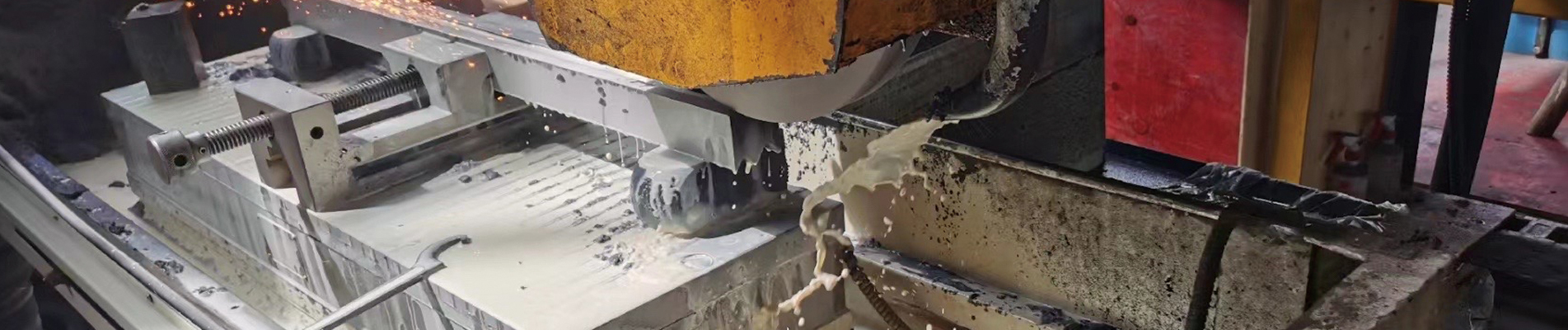

A horizontal flow wrapper can run a perfectly good film, make an acceptable longitudinal seal, and still produce a stream of packages connected by tiny uncut bridges. Another machine may separate every pack yet leave sharp, irregular zigzag corners that split during handling. In both cases, the visible problem is at the cut, but the correct remedy may involve the knife, the opposing anvil, the cross-sealing jaws, film tension, timing, or several of these together.
This guide is for packaging engineers, maintenance supervisors, OEM spare-parts buyers, and procurement teams comparing flow wrapper knives, HFFS knives, horizontal packaging machine blades, flow pack cutting blades, and flow wrapper serrated blades. Its purpose is practical: explain how to specify a replacement that fits, how to distinguish a poor cutting edge from a poor setup, how to test proposals fairly, and how to buy for cost per accepted pack rather than for the lowest unit quotation.
A knife supplier should not guess the tooth profile from a marketing description such as “universal flow pack cutter.” The OEM-approved part, the actual cutting mechanism, and the film-pack specification come first. Product examples and industry sources below are evidence of available designs, not permission to substitute a part without approval. Where calculations appear, their assumptions are disclosed; they are illustrative planning scenarios, not factory test results or claimed performance figures for GUANG CHUAN products.
Quick answer: For a conventional horizontal form-fill-seal (HFFS) flow wrapper with a knife-and-anvil end-seal unit, start by matching the original knife's external dimensions, mounting geometry, edge position, and mating anvil. Choose fine, coarse, straight, zigzag, or special serration based on the actual film and desired opening behavior. Then evaluate steel grade, heat treatment, precision, wear pattern, installation method, and total cost in a controlled production trial. There is no universally best tooth pitch or hardness for every flow wrapper.
The knife is usually a relatively inexpensive component inside an expensive and highly coordinated packaging system. Its failure can nevertheless interrupt product flow, create manual separation work, produce questionable end seals, waste printed laminate, and require repeated stops at precisely the moment a line should be delivering finished goods. Unlike a blade used for rough material reduction, a flow-wrapper knife must preserve both packaging function and appearance: the cut must be complete without unnecessarily disturbing the sealed areas on either side.
Consider a line programmed for 150 packs per minute. During an eight-hour scheduled operating period, the theoretical total is 72,000 packs before normal losses, cleaning, breaks, and other downtime. A ten-minute stoppage corresponds to 1,500 packs of theoretical capacity at that set speed. This is arithmetic, not a promise that all of those packs would otherwise have been saleable. Actual recovered output depends on product availability, average effective speed, upstream constraints, and downstream equipment. Still, it explains why a modest difference in blade change frequency can justify a more careful purchasing decision.
The correct business metric is not simply blade life in days. One day might represent a short batch at 60 packs per minute; another could involve continuous production at several times that rate. A better comparison records the number of accepted packages between qualified blade changes, plus the rejects, interventions, labor, and downtime incurred over the same production quantity. This approach also prevents a hard, expensive knife from being called “better” when it chips early, damages its anvil, or requires longer adjustment.
The economic impact becomes harder to see when a cutting problem is temporarily solved by turning up jaw pressure or increasing blade projection. More aggressive contact may make the next few hundred cuts look better while increasing tooth wear, crushing a seal area, or overloading the mechanism. A reliable flow pack cutting blade should work within the machine builder's specified geometry and operating window, not depend on continual over-adjustment.
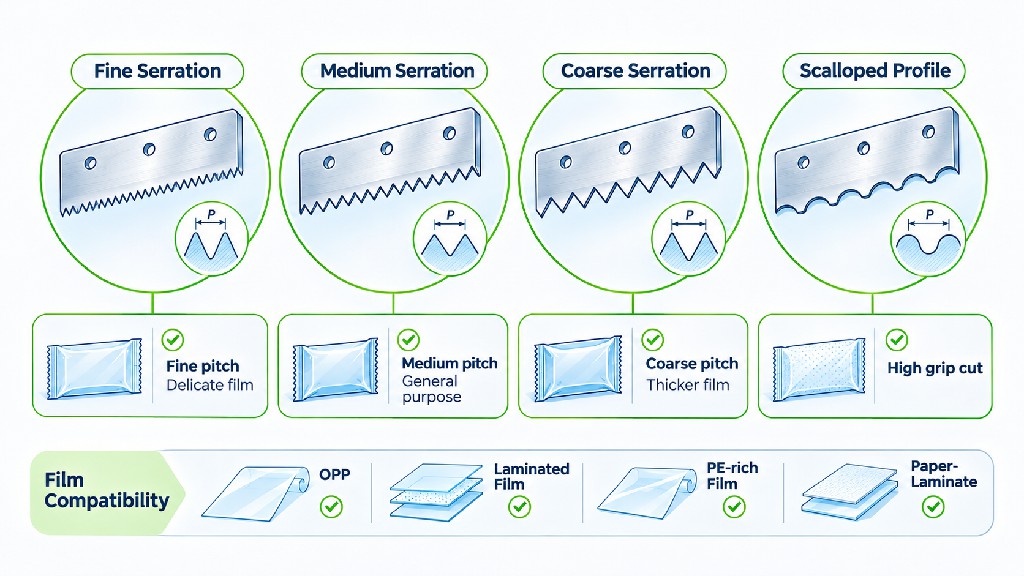
The term HFFS means horizontal form-fill-seal. Products move horizontally, commonly in spaced positions along an infeed conveyor. Packaging film unwinds from a roll, passes around a forming shoulder or box, and becomes a tube around the product. A longitudinal fin seal or lap seal closes the tube. The end-seal assembly then forms the back seal of one pack and the front seal of the following pack, with a cut separating them. The precise layout varies by machine and package format.
In a familiar rotary-jaw arrangement, opposed rotating shafts carry crimp or sealing jaws. One side contains a knife; its mating element includes an anvil or other approved counter-surface. The packaging web is compressed and sealed in the transverse direction, and separation occurs at the specified position between the two seals. The technical guide Guide to Flow Wrapping describes this synchronized process and notes that the knife may be straight or serrated to support a particular package opening feature. For modern motion-control context, the Siemens Horizontal Form Fill Seal Machine application documentation explains why coordination between film feed, product infeed, cross-sealer motion, and print-mark registration matters.
Not all HFFS machines cut in exactly the same way. Some use rotary crimpers; others employ box-motion sealing heads, intermittent systems, different jaw geometries, or proprietary seal-and-cut arrangements. A knife-and-anvil set is common, but its contact mode, movement, number of knives, and allowable adjustment depend on the machine. Never assume that a knife described for one form-fill-seal machine can be transferred to another simply because the working width is similar.
A complete cut has several simultaneous requirements. The film must be presented at the right location and tension. There must be sufficient support for the edge to penetrate or shear the material without dragging it. The knife and mating surface must interact as intended. The timing must place the cut in the proper transverse seal zone; a blade cannot rescue a package when product has entered the jaw or the printed registration is moving out of position. Finally, both seals must retain whatever width and integrity the pack specification requires.
Manufacturers of specialist flow-wrapper knives describe the components as a matched knife-and-anvil system. For example, EDGE Industrial Technologies' flow-wrapper knife information identifies matching anvils, straight and zigzag forms, V-notches, variable-pitch profiles, and specialized configurations. This is valuable evidence that “flow wrapper knife” names an application family, not a single standardized interchangeable part.
The knife carries the sharpened edge or tooth pattern that separates the web. The anvil supports or opposes that knife according to the equipment's cutting design. The sealing jaw supplies the geometry, motion, heat and/or pressure needed to create a transverse seal. These items may be separate replaceable elements or integrated into an assembly, but their jobs should not be confused.
Replacing a dull knife does not restore an anvil with a damaged contact area. Replacing the anvil does not correct a loose holder, misregistered jaw, or incorrect knife protrusion. And a harder cutter cannot compensate for the wrong sealing temperature or inadequate dwell time. When requesting parts, state whether the order covers the knife only, knife plus anvil, jaw inserts, or a complete matched assembly.
A fully separating serrated knife may leave a zigzag edge while cutting the package all the way across. A perforating blade intentionally leaves bridges between cut segments to form a controlled tear line. A tear-notch tool creates a local opening feature, often at an intended position. These are not synonyms. If the packaging specification requires complete separation into individual pillow packs, the tool should not leave inter-pack bridges simply because its salesperson calls the profile “perforated.”
Conversely, a completely severed edge may be the wrong solution where the package uses a pre-engineered easy-open feature. Specify the result on the finished pack—full separation, controlled perforation, or notch—rather than ordering solely by the visible tooth shape.
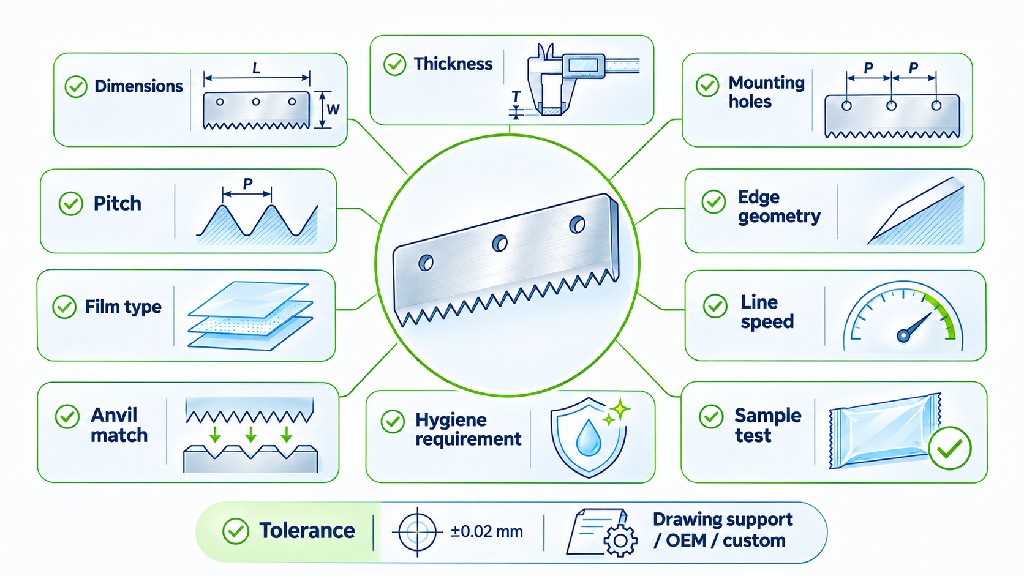
A defensible selection process begins with the package and the machine instead of the steel catalog. Work through these seven decisions in order. Each reduces the chance of paying for the wrong custom cutter or running an inconclusive trial.
1. Identify the exact machine and cutoff station. Record the machine manufacturer, model, serial or revision information, packaging width, jaw configuration, number of jaws, and whether cutting occurs with rotary, intermittent, or box-motion action. Photographs should show the installed knife location, not just the loose blade on a workbench.
2. Establish the approved geometry. The original drawing or a reliably measured, undamaged sample should define overall length, body width, thickness, mounting holes or slots, blade projection, bevel orientation, and tooth specification. The counterface geometry is part of this decision. A measurement from a worn, reground blade is not automatically the original design dimension.
3. Describe the film construction. Include the substrate layers, nominal total thickness, thickness tolerance where available, sealant layer, coatings, print or adhesive features, roll direction, and intended operating temperature. A “plastic film” label is much too broad: oriented polypropylene and a thick polyethylene-rich laminate can respond differently to the same edge.
4. Define the required finished package. Is the edge supposed to be smooth, attractive, easily opened, resistant to accidental tearing, or compatible with a tamper-evident system? Does a customer specify maximum notch depth or minimum uninterrupted seal land? If the target is undefined, suppliers can optimize different and mutually incompatible outcomes.
5. Diagnose the current fault. Record whether the old knife produces film tails, intermittent incomplete cuts, edge tearing, tooth chipping, contamination buildup, or a progressive decline after a known number of cycles. Note whether defects occur on one side, at the center, or only after a particular film roll or changeover.
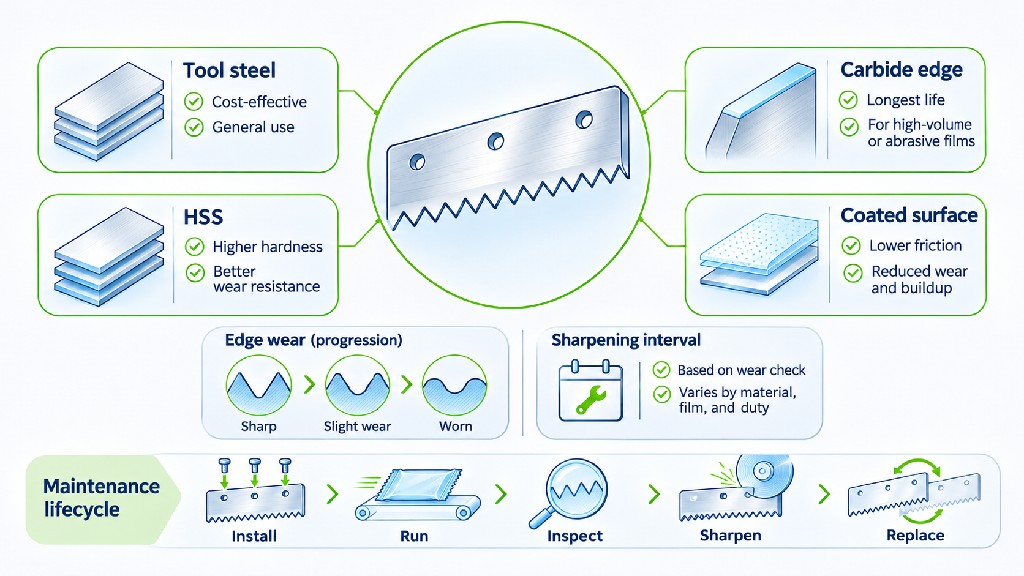
6. Compare materials and production capabilities. HSS, tool steel, stainless steel, and carbide have different trade-offs. Ask how heat treatment, tooth grinding, flatness, edge finish, inspection, and traceability will be controlled. Do not rely on hardness alone as evidence of suitability.
7. Approve with production evidence. Trial the proposed replacement on the real packaging line under safe, controlled conditions. Compare it with a known reference at the same operating conditions, using predefined measures of cuts, seals, defects, intervention time, and service interval. Only then place a larger repeat order.
Two blades can have exactly the same overall size and both be sold as “zigzag knives,” yet their cutting behavior may be very different. The tooth points, valleys, angles, grinding direction, and edge position all influence how the film first contacts the edge and how the fracture progresses across its width. A procurement drawing needs more than a photograph of a row of triangles.
Pitch is generally the distance from one corresponding tooth point to the next, measured along the blade's length. For example, a 1.5 mm nominal pitch means repeated points are spaced approximately 1.5 mm apart along the working edge; it does not specify tooth height, sharpness, or film compatibility. Some suppliers quote teeth per unit length rather than distance between points. Agree on units and the exact feature used for measurement before discussing tolerances.
Smaller pitch normally means more tooth points engage over a given length. A fine profile may create a closely spaced edge appearance and relatively distributed penetration, but only if the tips are consistent and the film has the right support. Larger pitch produces more conspicuous teeth and wider notch spacing; it may be useful for certain opening objectives, but can create unwanted tear initiators. Neither profile should be assigned an invented universal cutting-speed advantage.
Some published GUANG CHUAN product specifications discuss custom pitches for particular packaging blades. Those are product-specific options, not a standard that every HFFS machine accepts. Keep the OEM tooth profile as the reference unless there is a reason—and approval—to test a change.
The height or depth from the tooth tip to its valley changes how aggressively the edge contacts and opens the web. A deeper valley may produce a strong zigzag appearance, but could also encourage a tear to propagate toward the seal or leave unnecessarily sharp package corners. A very shallow profile may preserve an attractive edge but fail to provide the expected easy-open effect. Tooth depth must also be compatible with the anvil and the available penetration envelope.
Tip radius is another overlooked dimension. Freshly ground points are not perfectly mathematical points; every real edge has a finite radius. Excessive rounding can let an elastic film deform before cutting. Extremely delicate points, especially when produced in a brittle high-hardness state, may chip under impact or contact with a damaged anvil. Ask how the proposed production process maintains tip consistency across the knife and from batch to batch.
Flank angle describes the sides of the teeth. Bevel geometry refers to the ground face or faces that create the cutting edge. A symmetrical double-bevel knife may not position its effective edge like an asymmetric single-bevel knife, and reversing a directional blade can move the cutting line. The correct part is governed by the machine's approved design, not by whichever orientation makes the teeth appear to face forward in a photograph.
For replacement work, mark the operator-side view, mounting face, cutting direction, and datum surfaces on the drawing. On a rotary assembly, note the travel direction of the jaws and which side of the knife meets the counterface. A mirrored blade can share the same length and holes and still be unsuitable. These details are particularly important when a production facility operates several generations of equipment from the same OEM.
A straight cutting edge has a continuous, unnotched line. A straight-bodied serrated knife is a rectangular or bar-shaped knife with teeth along that line; the word “straight” describes the body, not the edge. Zigzag teeth create a recognizable repeated angular cut. Diagonal or combined diagonal-zigzag profiles may change the appearance and order of engagement. Scalloped forms have rounded or curved repeated features. Variable-pitch designs intentionally alter tooth spacing along the edge.
All of these may be useful in a defined system; none is a universal upgrade. NORDPRÄZISION's packaging-knife overview documents custom tooth patterns, pitch, cutting angles, and opposing knives, confirming that application-specific geometry is standard engineering practice in this sector. A supplier proposing a non-original form should explain the defect being addressed, the dimensional changes, and how compatibility will be demonstrated.
Serrations can localize initial contact at tooth tips and change the force pattern during penetration. That can help on certain films that stretch before a smooth edge starts the cut. But the total work and peak load depend on blade sharpness, film properties, jaw support, engagement sequence, speed, and the condition of the anvil. A poorly ground serrated knife may need more force than a well-supported straight cutting edge. The only reliable way to assert a percentage improvement is to run comparable measurements with controlled conditions.
The finished package can also create a trade-off: a zigzag cut that opens conveniently for the consumer may reduce resistance to an accidental tear during cartoning. A blade that produces a very neat edge might require a separate opening feature. Treat consumer usability, transport resistance, seal integrity, and line uptime as a connected set of acceptance requirements.
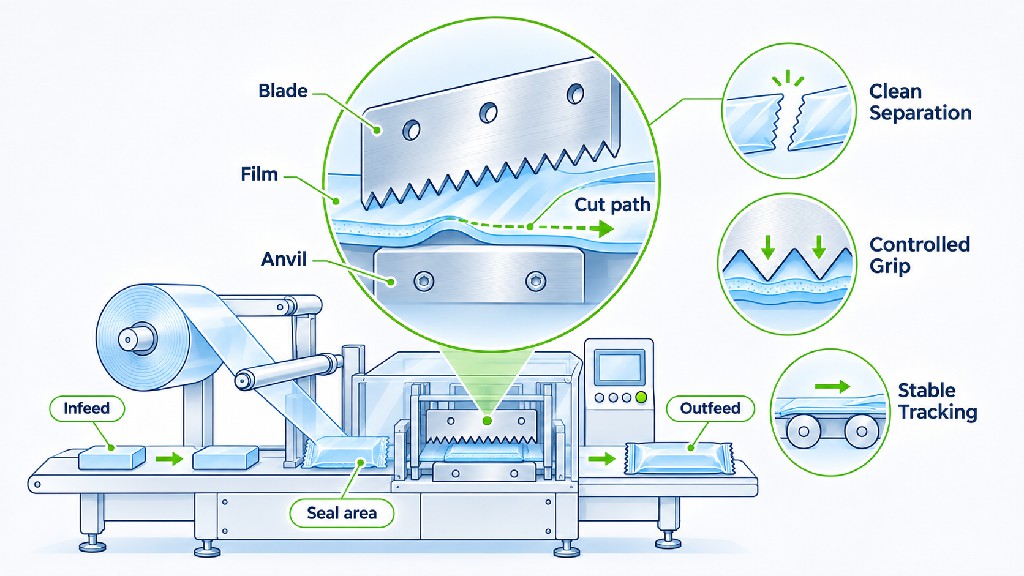
Film structure influences cutting much more than a simple nominal thickness number suggests. The outer layer may provide stiffness and printability; an inner sealant layer may soften at the sealing jaw, stretch under tension, or create a different cut response. Laminate adhesives, coatings, paper fibers, and aluminum foil can all alter the way the knife penetrates and how the finished edge tears. Consequently, two films with the same measured thickness can require different setup windows.
Use the following matrix as a trial-planning guide, not a prescriptive tooth-pitch chart. It highlights common failure modes and practical questions. OEM-approved knife designs and the film manufacturer's specifications remain the starting point.
| Film or package format | What may influence the cut | Sensible trial starting point | What to inspect on the finished pack |
|---|---|---|---|
| BOPP-based snack or biscuit flow wrap | Orientation, brittleness or tear tendency, coating and sealant structure | Original OEM fine zigzag or straight profile; compare only if a defect is observed | Notches running into the seal, brittle corners, clean separation |
| PET/PE or other multilayer laminate | Stiffer outer layer coupled to more extensible sealant | Precisely matched, sharp knife and anvil; assess support before changing pitch | Uncut PE tails, delamination, edge stretching and seal damage |
| PE-rich or soft polyolefin film | Stretch-before-cut, tension and temperature sensitivity | Fine serration may merit an approved trial when current knife drags the web | Elastic threads, incomplete separation and consistent registration |
| Paper/polymer flexible wrap | Fiber tearing, dust and uneven fracture | Compare an approved straight edge with a suitable serration if appearance permits | Loose fibers, visible dust, ragged paper edge and seal area |
| Foil-containing laminate | Foil cracking, burrs and laminate interface damage | Sharp, well-supported geometry with controlled contact | Foil burrs, microscopic tears, delamination and leakage |
| Cold-seal flow-wrap film | Seal coating location, pressure and unintended adhesive pickup | Preserve approved knife and jaw geometry; verify coatings and cleaning practice | Adhesive buildup, cut registration and seal integrity |
Biaxially oriented polypropylene (BOPP) is used widely in flexible packaging, but its behavior is not identical in every grade, coating, and laminate structure. Material orientation can influence how tears propagate after the initial notch is formed. A serrated cut provides multiple possible initiation points; that can be useful when opening is intended at the end edge and undesirable when the tear travels into printed graphics or toward the product cavity.
For a printed snack wrapper, test both the desired opening action and resistance to unintended opening during distribution. Do not declare success merely because an operator can rip a package easily. A commercial pack also has to survive conveying, collection, counting, cartoning, and shipping. If a marketing team requests a “more dramatic zigzag,” convert that aesthetic request into a measurable cut-edge drawing and a package handling test before ordering tooling.
A common scenario involves a laminate whose outer layer appears fully cut while a thin inner sealant layer remains connected. The result may look like a string or web between finished packs. This does not prove the steel is too soft. The blade may be dull at the valleys, the anvil may be worn centrally, the film may be displaced rather than supported, or the stroke may not reach its approved position. Film tension and temperature can aggravate the problem.
Before approving a coarser tooth form, examine the defect under magnification and record its position across the width. If the uncut material is concentrated near the middle of the knife, investigate bowing, holder distortion, contact geometry, and anvil wear. If tails appear along the entire edge after a specific film change, check the new film's layer structure and actual thickness. A material switch can explain a new defect even when the mechanical configuration has not changed.
Always include total film thickness in micrometers or mils, with units clearly stated. Where possible, also provide layer structure and supplier information. Do not automatically convert a micrometer value into a universal tooth recommendation: thickness interacts with elasticity, orientation, jaw temperature, film speed, and blade support. Ask the supplier to qualify the recommendation against a representative material sample and a desired end-cut photograph.
The edge must also be judged at realistic production speed. A blade that cuts a stationary sample on a bench may behave differently when the web is moving under tension. Production tests should include both nominal line speed and the most demanding approved operating condition, with the product and downstream handling present.
For most replacement projects, the largest avoidable commercial mistake is ordering a knife by its overall length while ignoring its location in the holder. A difference in thickness or mounting datum can shift the cutting edge into or away from the mating component. A seemingly minor profile change can affect the contact line, knife projection, and cut timing relative to jaw closure. “Same machine brand” does not necessarily mean “same knife”; OEMs revise tooling, and factories sometimes modify holders after years of service.
At minimum, the approved drawing should specify overall length, body height, thickness, hole or slot diameter, hole centers, countersink or counterbore details, slot end radii, mounting face, edge-to-datum distance, bevel position, and tooth dimensions. State dimensions in a single primary unit system and mark which features require tolerance confirmation. If critical dimensions have been remeasured from an old part, note the measurement method and whether wear or prior grinding has altered the original shape.
A rotary jaw makes a cyclic motion around its shaft. Its engagement conditions depend on jaw radius, rotational synchronization, cutter position, number of jaws, and the package pitch. A box-motion system may move along with the product during a portion of the cycle, creating a different time and positional relationship. These distinctions matter when discussing knife protrusion, permissible contact, and sample validation. An HFFS replacement must be specified against the actual head design, not a generic photograph of a horizontal packaging machine.
In its HFFS application example, Siemens describes synchronization between the infeed, film feed, and cross sealer, including the use of print-mark sensing and position correction. This reinforces an important diagnostic rule: if the cut is sharp but consistently located off the intended graphic or seal center, investigate registration and motion control before trying a different steel grade.
Knife projection is the distance the cutting edge extends relative to the specified holder or jaw datum. Its nominal value and adjustment procedure are machine-specific. Depending on the design, the system may use shims, ground spacers, an adjustable holder, or a fixed location. Never copy another factory's reported clearance or turn a general internet tip into a setpoint. Incorrect projection can damage the anvil, cause premature point breakage, or fail to sever the web.
Inspect the mating anvil for grooves, localized impacts, rounding, and uneven contact. Where the OEM specifies a matched set, purchase or qualify the knife and anvil together. If only one element is replaced, record the condition and identification of the retained element. It is often more economical to reject a questionable anvil in a controlled service window than to sacrifice a new precision knife in the first production shift.
Some cutting heads contain multiple knives or jaws per revolution. A buyer must identify each installed location and whether the spare is genuinely common across positions. Left-hand and right-hand versions, alternate offsets, and different tooth directions may coexist. Standardizing spares can reduce inventory, but only after the equipment builder or a qualified engineering review verifies functional interchangeability.
Create a part master record with the approved drawing revision, machine list, position number, material designation, tooth form, supplier identification, and a clear image showing the mounting orientation. This is far more dependable than a warehouse label reading “HFFS blade 300 mm.”
Knife material selection should balance wear resistance, resistance to chipping, corrosion behavior, ease of precision grinding, availability, heat-treatment control, and the economics of replacement or regrinding. “Hardest” and “best” are not synonyms. A very hard, wear-resistant steel can perform poorly when the jaw strikes an out-of-position anvil or when delicate tooth tips experience impact loads that exceed their toughness.
Alloy tool steels and D2-type grades. These are familiar choices for industrial cutting tools where wear resistance matters. A D2-type grade can be attractive for appropriate film-cutting applications, but its high carbide content and microstructure also influence toughness and edge preparation. Verify the actual grade standard and the supplier's heat-treatment capability. Do not accept “D2/HSS” as if these were interchangeable names: D2 is a cold-work tool steel, whereas high-speed steel is a different material family.
High-speed steels such as M2, M35, and M42. HSS grades are offered for precision packaging knives where a combination of hardness, wear resistance, and edge retention is needed. Their alloy content, grindability, and cost differ. A higher-alloy grade is not automatically beneficial if the existing failure is caused by a mismatched anvil, poor mounting, or contaminated film. Specialist manufacturers including EDGE publish M2, M35, M42 and carbide among their flow-wrapper knife options, illustrating the range of engineered solutions rather than establishing a universal hierarchy.
Martensitic stainless steels such as 420 and 440C. Corrosion resistance can be valuable in selected washdown or moisture-exposed environments, and hardened stainless grades may be suitable for specific food-packaging equipment. They still require suitable surface finish, cleaning practices, inspection, and application-specific compliance review. Stainless steel is not equivalent to a universal “food-grade certified blade,” and a stainless option should not be specified without confirming its hardness, edge behavior, and contact conditions.
Tungsten carbide. Carbide offers excellent wear potential in some cutting applications, but its brittleness, edge support requirements, fabrication constraints, and replacement cost need careful evaluation. An impact-prone, poorly aligned knife-and-anvil system may be a poor candidate. Carbide should be considered when the machine design and actual failure mechanism justify it, not merely because a competitor advertises a longer life.
Coatings and special finishes. Non-stick or wear-resistant coatings can be considered where adhesion, buildup, or specific abrasive contact is well documented. Ask what problem the coating addresses, the added thickness, adhesion, cleaning compatibility, and what happens if the edge is reground. A coating does not correct inaccurate tooth geometry. Its usefulness should be validated against the exact film, seal coating, and sanitation routine.
Hardness is normally reported using a method and scale, such as Rockwell C (HRC), but numerical targets should be matched to the specific steel, geometry, and engineering specification. A single HRC value cannot describe edge toughness, carbide distribution, flatness, or residual stresses. The same nominal grade can perform differently when heat treatment and grinding are poorly controlled.
GUANG CHUAN's precision HSS serrated packaging blade example provides a starting point for discussing the company's available packaging product forms. A published hardness range or tolerance on one listing must not be represented as a guaranteed value for every custom flow-wrapper knife. On a quotation, request the grade designation, agreed hardness range, measurement location or test approach where relevant, and any batch inspection documentation required by the application.
If the current steel delivers clean cuts but needs replacing frequently because its teeth wear evenly, compare a better-controlled version of the same grade with a suitable higher-wear alternative. If teeth are breaking, inspect collisions, edge geometry, hardness/toughness trade-offs, and anvil condition before paying for a harder steel. If rust or staining is the primary problem, review cleaning chemistry, drying, material compatibility, and stainless alternatives. If the knife picks up cold-seal residue, resolve the adhesive contact or cleaning procedure before treating an exotic coating as a cure.
The most useful supplier explanation links a documented failure mode to a defined metallurgical or geometric change and then proposes a trial that could prove the change worked. Marketing phrases such as “ultra-hard premium tool steel” without grade, traceability, or acceptance criteria do not provide that assurance.
High-quality production is not demonstrated by an attractive product photograph. For OEM-style replacements, drawings and inspection records must establish whether the knife locates the same way in the machine, presents the same cutting profile, and can be repeated from one manufacturing batch to the next. A useful quality plan identifies the dimensions that affect fit and cut rather than treating every noncritical measurement as equally important.
Dimensional inspection should address body length, thickness, flatness, mounting-hole size and location, reference faces, tooth geometry, and the relationship between cutting edge and mounting datums. Specify which dimensions are critical and the measuring instruments used. Depending on feature size and tolerance, these may include calibrated micrometers, height gauges, optical comparators, vision measurement, and controlled profile inspection. Do not request “micron accuracy” without naming the dimension, tolerance, and inspection capability; that phrase alone is not a measurable acceptance condition.
Edge inspection should look for burrs, chipped tips, local overheating from grinding, inconsistent valleys, and geometry changes at the ends of the knife. Burrs can drag film, create debris, or make a new blade appear dull immediately. Uneven grinding can leave regions that cut differently across the width. For precision work, agree on representative first-article samples or photographs with a scale and orientation that let both teams compare the same features.
Material and heat treatment deserve separate records. Request a purchase specification or recognized grade designation, heat-treatment identification where feasible, and a defined hardness acceptance window. If corrosion or hygiene requirements matter, request the relevant materials and surface-finish documentation. A supplier's generic statement that every product meets “all international standards” is not a substitute for naming the applicable requirements.
Traceability enables useful root-cause analysis. A production lot number, drawing revision, material record, and dispatch batch let a plant determine whether a cutting change coincided with a new blade lot, anvil change, film supply, machine maintenance, or settings revision. This matters especially for factories operating several shifts or sites. When a batch fails, traceable blades can be compared without guessing when and where they were installed.
For food packaging, assess whether and how the knife or nearby components could contact the food, create fragments, or affect the packaging material. Avoid assuming that a “food-safe stainless” marketing description proves compliance. The European Commission's food-contact materials guidance explains the framework for articles intended for food contact, while the actual applicability to a specific blade, its surface treatment, and the packaged product must be determined for that use. Food-contact packaging film compliance and machine-part suitability are related but not identical questions.
Engineering controls may include corrosion-resistant design where justified, burr and fragment prevention, hygienic cleaning, and a documented pre-start inspection after maintenance. A chipped tooth discovered during a shift should trigger the site's contamination and product-assessment procedure, not a casual assumption that the missing material is harmless. Any statements about ISO, food-contact approval, or certificates should name the exact scope and current documents.
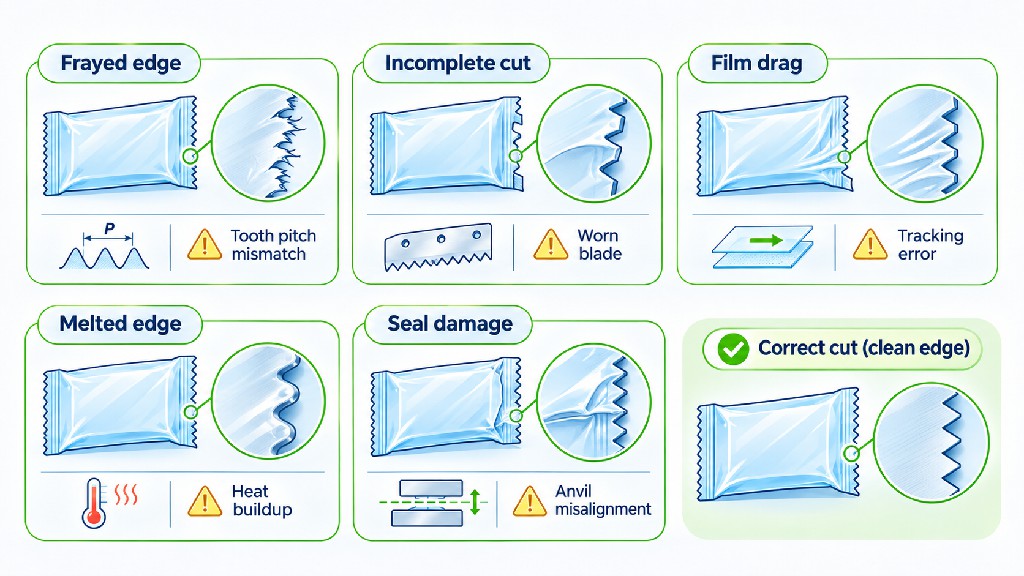
A replacement decision is strongest when the plant understands the original failure. Otherwise, the new knife may cut well during commissioning and return to the same problem after a few thousand cycles. Use the pattern of the defect to narrow the investigation. The following checks are diagnostic prompts, not instructions to defeat a guard or adjust a live cutting mechanism.
| Production symptom | Plausible causes to check | Practical evidence to collect | Buying implication |
|---|---|---|---|
| Packs remain linked by fine film tails | Worn tips/valleys, incorrect knife-anvil interaction, elastic sealant, uneven support | Close-up of connected region, film structure, location across width | Verify geometry and counterface before requesting a coarser pitch |
| Incomplete cutting mainly in the center | Bowed or poorly seated knife, damaged anvil, holder distortion, uneven contact | Straightness/flatness data, width-position defect map, mating-face inspection | A new blade alone may not resolve the holder or anvil problem |
| Torn corners or cracks into the seal | Excessive notch depth, incorrect film response, sharp damaged tips, offset cut | Pack-edge photographs, tear direction, intact seal width | Consider approved profile change only after seal and position checks |
| Repeating chips at the same location | Mechanical interference, debris, mounting error, impact on damaged anvil | Chip position, anvil marks, installation records | Correct interference before specifying harder or more brittle material |
| Cut is clean but in the wrong printed position | Registration, sensor, synchronization, film tracking or product pitch | Print-mark logs, position trend, machine settings | Do not treat a timing defect as a blade-material problem |
| Quality declines after warm-up | Residue buildup, changing film response, thermal effects, holder movement | Defect rate by elapsed time, temperature trend, deposit images | Investigate process and cleaning before changing the knife alloy |
First, describe precisely what is uncut. Is it one layer of a laminate, a short bridge at the end, or a continuous hair-like strand? Photograph both sides of several failed packages beside a ruler. Record the defect location as operator side, center, or drive side, rather than writing “bad cut” in the maintenance log.
Second, compare the event against film and machine history. Did it begin immediately after a replacement, after the machine warmed up, when a new roll was loaded, or gradually over a measured number of cycles? A sudden one-sided failure after maintenance strongly suggests a different investigation from a gradual uniform loss of sharpness after long service.
Third, stop and isolate the machine under the site's approved procedure before inspecting accessible tooling. Review the knife for wear, burrs, cracked points, correct orientation, clean mounting surfaces, and evidence of movement. Check the anvil and holder as well. Never place a hand near jaws to observe a cut on a running machine, and never bypass interlocks for an informal test. In the United States, the OSHA control-of-hazardous-energy standard, 29 CFR 1910.147, provides requirements for relevant servicing and maintenance operations; local regulations and the equipment builder's instructions also apply.
Fourth, distinguish cutting failure from sealing failure. If a correctly separated pack leaks, the root cause could be heat, pressure, dwell time, contamination, seal design, or a knife positioned too close to the seal. If the cut is off center but mechanically clean, verify registration and synchronized motion. A visually attractive cut cannot establish package integrity.
Finally, test one approved change at a time. Simultaneously changing tooth pitch, jaw pressure, film tension, and temperature may make the defect disappear, but it prevents a useful causal conclusion and risks causing a different problem. Record the baseline, the exact intervention, and the results before the next adjustment.
The package must pass its own quality specification. For flexible barrier seals, ASTM F88/F88M describes seal-strength measurement and explains why consistency and opening-force limits matter. Seal strength alone is not proof that no leak path exists. For appropriate package constructions and validation contexts, ASTM F2096 addresses gross-leak detection by internal pressurization; its limitations must be checked before applying the method. Neither standard is a universal mandatory flow-wrapper-blade certification, and test selection must match the package, material, market, and risk.
The important operational distinction is that the new knife must not compromise the validated packaging process. Define cut position relative to the sealed zone, remaining seal land, edge integrity, and applicable leak or peel criteria before comparing blades. For high-risk or tightly specified products, packaging quality and regulatory teams should approve both the trial and the resulting change documentation.
A promising knife sample is not the same as a proven replacement. Commercial approval should follow a trial protocol that is simple enough for production staff to execute and specific enough for engineering and purchasing to interpret. Start with the original approved blade or a known-good reference. Record the film lot, product size, format, jaw arrangement, machine settings, effective speed, and recent maintenance history. A trial without a trustworthy baseline cannot show whether a new tool actually improved anything.
Before installation, inspect the candidate against the drawing and agreed first-article requirements. Confirm that the edge is clean, the hole pattern fits without forcing, and the knife is oriented correctly. Inspect the anvil and relevant mounting surfaces; if they are not in acceptable condition, repair or replace them according to the OEM procedure before the comparison. Do not evaluate an expensive precision knife against a damaged counterface and call the resulting wear a materials test.
During commissioning, use the machine builder's safe start-up and adjustment sequence. The first objective is stable, complete separation in the correct seal location, not maximum speed on the first cycle. Verify that the knife does not interfere with the jaw or anvil and that the package continues to meet required seal and appearance criteria. Once qualified, document the settings so both knife candidates are evaluated under comparable conditions.
During sustained operation, measure accepted packs, cut-related rejects, unplanned knife interventions, intervention time, gradual edge deterioration, and any damage to the anvil. Sample output from the beginning, middle, and end of the run. Pay attention to changes after warm-up, after roll splices, and near the end of the expected service interval. Where the application makes it relevant, evaluate package opening, seal integrity, and downstream transport after the packs have been stored or handled normally.
At the end, compare the reference and candidate using the same denominator: accepted packs, actual cycles, or operating hours with clearly documented speed. If a new blade is still sharp when the trial ends, record the service life as at least the tested number of cuts, not an invented eventual lifetime. A controlled result may support a limited production approval while longer-term durability remains under observation.
A useful trial form includes: blade ID and batch; approved drawing revision; material and heat-treatment record; machine, knife position and anvil ID; film supplier and roll lot; normal/maximum speed; total attempted packs; accepted packs; cut-related rejects; seal-related rejects; downtime by cause; and operator/quality sign-off. This information turns a supplier discussion into a repeatable purchasing decision.
A low purchase price is easy to compare, but it is not necessarily the lowest operating cost. A better commercial evaluation includes the knife price, installation labor or downtime, related consumables, scrap caused by the cutting process, and the number of acceptable packages obtained before the blade is changed. It may also include freight, purchasing overhead, emergency supply risk, and any change in anvil consumption when those differ materially between options.
A simple procurement metric is:
Knife-system cost per 1,000 accepted packs = (knife purchase price + allocated changeover cost + attributable cut-related scrap cost) / accepted packs produced × 1,000.
The following deliberately hypothetical comparison demonstrates the arithmetic. The numbers do not describe GUANG CHUAN, a competitor, or an industry benchmark. We assume a downtime/labor allocation of US$2 per minute, an attributable scrap cost of US$0.08 per rejected pack, and cut-related scrap calculated from the approximate attempted production volume for each blade. To keep the illustration transparent, the stated reject percentages are applied to the stated production volumes as a close approximation; actual reports should use precise attempted and accepted counts.
| Illustrative input or result | Option A: lower-priced blade | Option B: higher-priced blade |
|---|---|---|
| Knife purchase price | US$35 | US$59 |
| Approximate accepted packs per blade | 150,000 | 300,000 |
| Allocated changeover time | 8 minutes | 10 minutes |
| Changeover allocation at US$2/min | US$16 | US$20 |
| Illustrative cut-related reject rate | 0.35% | 0.15% |
| Approximate cut-related scrap cost | US$42 | US$36 |
| Approximate total evaluated cost | US$93 | US$115 |
| Cost per 1,000 accepted packs | US$0.620 | US$0.383 |
In this scenario, the higher-priced blade costs about 38% less per 1,000 accepted packs on the defined cost items, despite a higher initial invoice price. The result is not proof that more expensive HFFS knives generally outperform cheaper knives; it merely demonstrates the importance of the denominator and of process quality. If Option B had damaged anvils, required more specialist adjustment, or failed a package seal requirement, its real business case would be worse than this simplified model indicates.
For a line with expensive printed film, scrap may matter more than the price of the knife. For a facility with limited maintenance staffing, repeated interventions may dominate. For a seasonal plant facing long international lead times, availability of safe replacement spares may be a major financial risk. Use the actual costs and constraints rather than copying someone else's example.
Track causes separately. Do not charge every product rejection to the cutter: underweight packs, bad seals, incorrect product spacing, and print-registration faults may have unrelated causes. Similarly, do not attribute a full unplanned stop to the knife when a product changeover or cleaning operation was already scheduled. An honest total-cost model helps suppliers solve the right problem and prevents the cheapest or most expensive offer from winning by default.
A premium material proposal is most credible when the current knife suffers predictable abrasive wear and the machine is otherwise stable. Estimate the potential reduction in blade replacements over a real production schedule, then compare that value against purchase price, setup time, regrinding possibilities, anvil wear, and potential breakage. If a plant can extend service life without sacrificing cut quality, the saving may be substantial. If the dominant problem is alignment or film contamination, a more costly alloy is unlikely to deliver the advertised return until that process issue is resolved.
There are three common purchasing routes. An OEM replacement is ordered through the machine builder or its approved network using the specified part and revision. An aftermarket replacement is manufactured by another supplier to a verified specification. A custom-developed knife changes geometry, material, or other features to address a documented application need. They carry different technical and commercial risks.
OEM-sourced parts often offer a clear specification and established compatibility path, subject to the age and maintenance history of the machine. Qualified aftermarket parts may provide competitive pricing, sourcing flexibility, and custom manufacturing support, but the buyer must verify that critical dimensions and functional requirements are met. A newly engineered variant needs the most disciplined change control because it can affect more than blade life: it may alter jaw contact, package opening, seal margin, or the validated operating range.
When comparing quotations, ask whether the quoted item covers a single knife, one knife-and-anvil pair, or a set for the complete cutting head. Clarify included inspections, material specification, packaging for shipment, freight terms, minimum order quantity, sample process, return or nonconformance procedure, and drawing ownership. A low unit price with an unmentioned set quantity can easily become an expensive misunderstanding.
Beware of false universal compatibility claims. A product listing that names several popular packaging-machine brands may describe an application category rather than a verified fit for every model and serial revision. Purchase approval should always reference a drawing, OEM part number, confirmed sample, or other agreed dimensional evidence. It is also prudent to separate approval of a replacement for an existing tool from approval of an altered cutting process.
GUANG CHUAN is the brand of Ma'anshan Guangchuan Machinery Knife Mold Technology Co., Ltd., a manufacturer of industrial blades and cutting tools. Its company overview describes precision machining, grinding, heat-treatment capability, and custom work based on drawings or physical samples. For HFFS buyers, the relevant commercial route is to begin with a documented replacement requirement and ask the engineering team to confirm whether that tool can be manufactured and how it should be checked.
The company's Packaging Machine Toothed Blades category shows different toothed packaging products, while its industrial stainless steel serrated packaging blade listing identifies horizontal flow wrappers among the intended application areas for that product family. These published listings demonstrate available product directions; they do not establish that every listed blade fits every flow-wrapper model or that every advertised property applies to a bespoke order.
Customers who are still deciding between edge forms may first review the site's serrated versus straight packaging blade comparison. The broader packaging machine knives selection guide covers other stations and material choices. For facilities that also operate vertical baggers, the separate VFFS cutting blade guide helps keep those replacement specifications distinct: a VFFS knife and a rotary HFFS flow-wrapper cutter should not be assumed interchangeable.
A useful engineering conversation with GUANG CHUAN should cover the currently approved blade geometry, the mating anvil, the actual film, the intended end-edge quality, the failure mode, and the required inspection plan. Ask for confirmation of what can be made, any deviations from the reference part, the material and tolerance specification, sample validation arrangements, lead time, and final quoted scope. Specific responses to those questions matter more than generic claims about cutting efficiency.
Buyers can reduce revisions and sample failures by sending a concise technical RFQ package. Begin with the machine identification: manufacturer, model, year or version where known, cutting-head type, jaw arrangement, installed knife count, application, and operating speed range. Include the original part number if available, but do not rely on it as the only identifier when equipment has been modified.
Next attach an approved dimensioned drawing or arrange for the supplier to inspect a representative physical sample. Label overall dimensions, holes and slots, mounting faces, cutting-edge position, tooth profile, bevel orientation, and critical tolerances. Provide front, side, and installed photographs with a ruler or known scale. State explicitly whether the sample is worn, chipped, reground, or believed to be original. If the anvil is being requested, include its drawing, condition, and the mating relationship.
Provide the film and product specification: structure and thickness, sealant and coating information where known, intended finished-package dimensions, seal configuration, product type, environmental exposure, and representative film samples when appropriate. If one machine runs several films, identify the most demanding format instead of offering a single convenient sample. Provide photographs of acceptable and defective cuts, including a close-up of any film tails or tearing.
State the commercial and quality requirements: initial sample quantity, annual forecast, agreed material alternatives, required documentation, lead-time needs, permissible regrinding, packaging/handling requirements, and your proposed acceptance test. A supplier cannot responsibly guarantee an application-specific service interval without relevant testing conditions and evidence. Ask which performance claims are established by manufacturing inspection and which require a line trial.
The following text can be copied into an RFQ email or purchasing brief:
Request: Replacement or custom flow-wrapper serrated knife for [machine model and cutoff station]. Reference: [drawing/revision, OEM number, or sample ID]. Knife/anvil scope: [knife only / matched set / complete head set]. Film: [layers, thickness, roll direction and coating]. Target: [full separation, permitted edge profile, required seal margin]. Current failure: [symptom, location, cycles before failure]. Operation: [normal and maximum packs/minute, jaw count]. Quality evidence requested: [material grade, critical-dimension inspection, lot ID, sample approval]. Quantity and delivery: [trial quantity, annual estimate, destination and required date]. Please identify any proposed deviation from the reference geometry before manufacture.
An RFQ with this level of detail is useful even if your purchasing team has not finalized the blade material. It lets the supplier identify gaps that matter before the purchase order is issued and helps compare offers fairly.
No. HFFS and VFFS describe horizontal and vertical form-fill-seal equipment. Both may use toothed cutting knives, but the tooling, mounting, motion, counterface, and packaging sequence can differ significantly. A particular straight-bodied VFFS knife should not be ordered as a rotary HFFS knife without confirmed geometry and functional compatibility.
No. Some machines and pack specifications use straight or differently formed cutting edges. A zigzag or serrated edge may be chosen for cut initiation, package appearance, or a consumer opening feature, but a smooth edge can be better for other formats. The machine builder's approved configuration is the default reference.
There is no trustworthy universal pitch. Film behavior, knife-and-anvil design, edge appearance, easy-open requirement, and machine motion determine the trial. Specify pitch in a defined unit, and confirm tooth depth, tip condition, flank profile, and anvil fit at the same time. A quoted pitch without those other dimensions is incomplete.
Not necessarily. Fine teeth can be a sensible option where many small initiation points are advantageous, but they may foul with certain coatings, wear unevenly, or fail to deliver the specified consumer opening. A sharp and properly supported straight edge may outperform a poor serration. Test the actual film and desired finished package.
Do not assume that higher hardness will stop chipping. Point breakage can be caused by collision, mounting stress, geometry, a damaged anvil, or inadequate toughness. First establish the fracture pattern and mechanical interaction. A harder or more brittle alternative could make an impact-related failure worse.
Visible sharpness does not confirm that the edge reaches or interacts with the counterface correctly over its full width. Inspect for uneven anvil wear, holder distortion, incorrect projection, local burrs, tooth-valley wear, and film stretching. Record where the remaining connection occurs before changing the profile.
Yes, an incorrectly specified or positioned cutter may intrude into the required sealed land, deform the film, or create cuts that propagate into the package. However, many seal defects arise from sealing parameters or contamination rather than the blade. Validate cutting location and seal performance separately.
Some can be reconditioned when the material, remaining dimensions, original tooth design, and mounting relationship permit it. Regrinding can shift the edge datum or alter tooth depth and tip form. Require the regrinder to confirm a drawing-based process and discard limits; do not assume that every serrated knife remains usable after arbitrary stock removal.
Not universally. The answer depends on the machine builder's instructions and the anvil's inspection condition. A worn or damaged anvil can shorten new-knife life, so assess it whenever the cutter fails or cutting becomes uneven. For some designs, a matched replacement pair is the sensible purchasing unit; for others, approved inspection allows separate service.
Compare the same drawing revision, material specification, critical tolerances, quality documentation, delivery scope, and trial conditions. Calculate cost per accepted pack with intervention time and cut-related rejects included. A price comparison between a single loose knife and a complete knife-anvil set is not valid.
There is no fixed industry quantity. Consider consumption per line, the number of interchangeable positions, real lead time, transport variability, planned maintenance windows, and the cost of stopping production. Establish a minimum stock based on service usage and replenishment risk, then revisit it after collecting actual blade-life data. Avoid assuming every model shares one spare.
Some blade designs work across several materials, but successful cutting on one film does not prove universal suitability. Compare the material's behavior, coatings, thickness, tear resistance, required edge, and the condition of the mating surface. When a line changes film family, repeat the relevant qualification checks.
Stop the affected operation according to approved site procedures, safely inspect and account for fragments where possible, and involve the facility's quality or food-safety team in evaluating potentially affected product. Identify the cause of tooth fracture and inspect the anvil before resuming. Do not treat a missing tooth as merely a cosmetic defect.
The best flow wrapper knives are the ones that repeatedly produce the right, fully separated and acceptably sealed package in the machine that actually runs them. Start with an approved drawing and a sound knife-and-anvil interface. Define the film, end-edge appearance, and required package performance. Confirm mounting and engagement, then compare tooth geometry and steel grade as engineering choices—not as universal upgrades. Validate any proposed change with production evidence and calculate the cost per accepted package.
If you are comparing HFFS knives, replacement horizontal packaging machine blades, or custom flow wrapper serrated blades, review GUANG CHUAN's packaging toothed blade product family and contact the team for a drawing-based quotation. Send the machine model, reference knife and anvil dimensions, film specification, observed fault, quality target, and expected order quantity. Ask for a clearly defined material, geometry, inspection scope, and sample approval process before placing a production order.
Editorial and technical scope: This guide combines publicly available machinery documentation, industrial knife manufacturers' published application descriptions, recognized packaging test methods, and GUANG CHUAN's published product information. The troubleshooting and buying steps are general engineering guidance; they do not replace OEM manuals, site safety procedures, independent package validation, or a material-specific trial. No unverified blade-life improvement percentages, customer results, universal clearance values, or third-party certifications are asserted.

Оставить сообщение
Отсканируйте в WhatsApp :

 Pусский